Synonyms for Tired: 30+ Words for When You Need a Rest
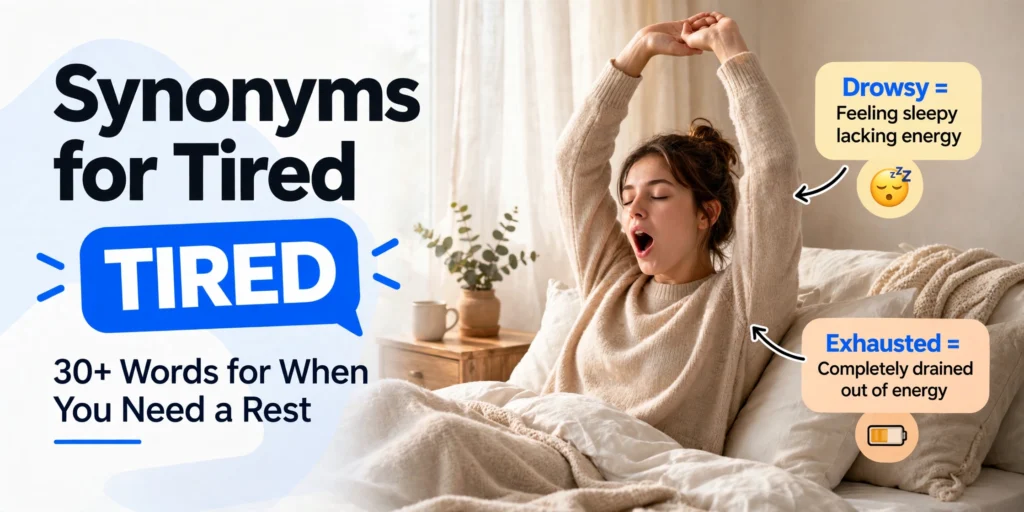
We all say we are tired. After a long day at work, a broken night’s sleep, or a week that never seemed to slow down, tired is the word that comes out first. It is honest, but it is also vague. It can mean that your eyes are closing, that your legs ache, that your mind feels foggy, or simply that you have had enough of something.
English gives you far more precise choices. Sleepy is not the same as exhausted. Weary is not quite the same as drained. Knackered, a very British favourite, sounds stronger than tired but friendlier than fatigued. Choosing the right word helps the person listening, or reading, understand exactly how you feel, and how much rest you really need.
In this guide, you will find more than 30 synonyms for tired, grouped by strength. We start with gentle words for feeling a little sleepy, move through everyday tiredness, and finish with the strongest words for complete exhaustion. You will also learn the important difference between being tired and being tired of something, with example sentences for every word so you can use them with confidence.
Quick Answer
The best synonyms for tired are sleepy, drowsy, weary, exhausted, drained, worn out, fatigued, knackered, shattered and lethargic. Use sleepy or drowsy when you need a nap, weary or drained when a long day has worn you down, and exhausted, shattered or knackered when you have no energy left at all. For boredom, use fed up, jaded or sick of instead.
A Bit Sleepy: Words for the Early Stages
These are the gentlest words on the list. They describe the feeling before you are truly tired, when your eyelids feel heavy, you yawn more often, and a short rest or a good night’s sleep would probably put things right.
- Sleepy: ready for bed or a nap. “I felt sleepy after lunch and wanted a short nap.”
- Drowsy: heavy-eyed and drifting towards sleep. “The warm room made me feel drowsy during the lecture.”
- Dozy: a little sleepy and not fully awake. “I was still dozy when the alarm went off.”
- Groggy: confused and unsteady after waking up. “I felt groggy after a short nap on the sofa.”
- Bleary-eyed: with tired eyes after too little sleep. “She arrived at work bleary-eyed after an early flight.”
- Heavy-eyed: struggling to keep your eyes open. “He sat there heavy-eyed, trying to finish the last page.”
- Nodding off: almost falling asleep without meaning to. “I kept nodding off during the film.”
Use these words when the problem is sleep, not effort. A sleepy person needs rest, not a holiday. They are friendly, everyday words, and they work well in conversation, messages and informal writing.
Tired: Everyday Words for a Long Day
This is the middle of the scale, where most of us live on a normal working day. You have done enough to feel it in your body and mind, but you can still carry on if you have to.
- Weary: tired in body and mind after a long effort. “Weary after the journey, we went straight to bed.”
- Drained: with no energy left after giving a lot. “The meeting left me feeling completely drained.”
- Worn out: tired after hard work or a busy day. “I was worn out after cleaning the house all morning.”
- Run down: tired and a little unwell from doing too much. “She felt run down after a week of late nights.”
- Fatigued: the formal word for very tired. “The doctor asked if he often felt fatigued.”
- Lethargic: slow and lacking energy. “The heat made us all feel lethargic by the afternoon.”
- Sluggish: slow to move or think. “I felt sluggish until my second cup of coffee.”
- Dog-tired: informal, very tired after a long day. “I was dog-tired after walking ten miles.”
Weary and fatigued suit more formal writing, while worn out and dog-tired are best in conversation. Drained is useful when the cause is emotional as well as physical, such as a difficult day at work or a long, stressful journey.
Exhausted: When You Have Nothing Left
These are the strongest words for tiredness. Save them for times when rest is not a luxury but a necessity, and a short nap will not be enough.
- Exhausted: completely without energy. “After the marathon, she was utterly exhausted.”
- Shattered: British informal, extremely tired. “I was shattered after the night shift.”
- Knackered: British informal, worn out. “I am knackered after moving house all day.”
- Wiped out: informal, with no energy left. “The long flight left us wiped out.”
- Spent: with all your strength used up. “He felt spent after the final match.”
- Burnt out: exhausted from too much work over a long time. “She felt burnt out after months without a break.”
- Dead on your feet: informal, so tired you can barely stand. “He was dead on his feet by midnight.”
- On your last legs: informal, almost unable to continue. “The old car and its driver were both on their last legs.”
Do not use these words for a mild yawn after lunch. They describe a real limit, so they lose their force if you use them too often. If you do feel this tired, a proper night’s sleep matters more than another coffee, and if the feeling lasts for weeks, it is worth speaking to a doctor. This kind of tiredness often follows a strong effort, such as a long run, a difficult shift or a demanding week.
Tired of Something: When You Mean Bored or Fed Up
Tired of is different. It does not mean that you need sleep. It means that you have had enough of something, often because it is boring, repetitive or annoying.
- Fed up: annoyed because you have had enough. “I am fed up with waiting for the bus.”
- Sick of: informal, tired of something unpleasant. “I am sick of hearing the same excuse.”
- Jaded: tired of something because you have experienced it too often. “He felt jaded after years of the same routine.”
- Bored: with nothing interesting to do. “The children were bored on the rainy afternoon.”
- Weary of: tired of something, in a more formal style. “She grew weary of the constant arguments.”
- Had enough: a plain way to say you want something to stop. “I have had enough of this noise.”
- Disillusioned: disappointed after realising something is not as good as you hoped. “He felt disillusioned with the job after a year.”
The test is simple. If a nap would help, use a word for sleepiness. If a change would help, use a word for boredom. Tiredness and low mood often arrive together, so if sadness is part of how you feel, you may find our guide to synonyms for sad useful too.
Common Mistakes
Tired is easy to use, but these small errors can change the meaning or sound unnatural. Check the pairs below before you write.
- Wrong: “I am tired from this film.” Right: “I am tired of this film.” Use tired of for boredom, and tired from or tired after for the cause of physical tiredness.
- Wrong: “The walk was tired.” Right: “The walk was tiring.” Tired describes a person, while tiring describes the thing that causes tiredness.
- Wrong: “I am very exhausted after lunch.” Right: “I feel a bit sleepy after lunch.” Exhausted means completely without energy, so save it for a much stronger feeling.
- Wrong: “I am too tired to doing my homework.” Right: “I am too tired to do my homework.” Use too tired to plus the base form of the verb.
- Wrong: “We are knackered, the report confirms.” Right: “We are exhausted, the report confirms.” Knackered is informal British English, so use exhausted or fatigued in formal writing.
Frequently Asked Questions
What is a formal synonym for tired?
Fatigued is the most formal choice, and weary is a good formal or literary choice. You might write, “The team felt fatigued after the long project,” in a report, but you would usually say tired or worn out in conversation.
What is a British slang synonym for tired?
Knackered and shattered are the most common British informal choices. Both mean very tired. For example, “I am absolutely knackered after that shift,” sounds natural in conversation but not in a formal letter.
What is the difference between tired and exhausted?
Tired is the general word, while exhausted is much stronger. A tired person can usually carry on, rest for a while and recover. An exhausted person has no energy left and needs proper sleep and recovery time.
What can I say instead of “I am tired of this”?
Try “I am fed up with this,” “I am sick of this,” or “I have had enough of this.” Jaded works when you have experienced something too often, and weary of is a more formal choice for the same idea.
Next time tired feels too vague, choose a word that matches how you really feel, whether that is sleepy, weary or completely shattered. A precise word makes your meaning clearer, and it may even remind you to take the rest you need. For more kind words to thank someone who helped you through a long day, see our guide to synonyms for kind.

Join the conversation