Synonyms for Sad: 40+ Words to Use Instead
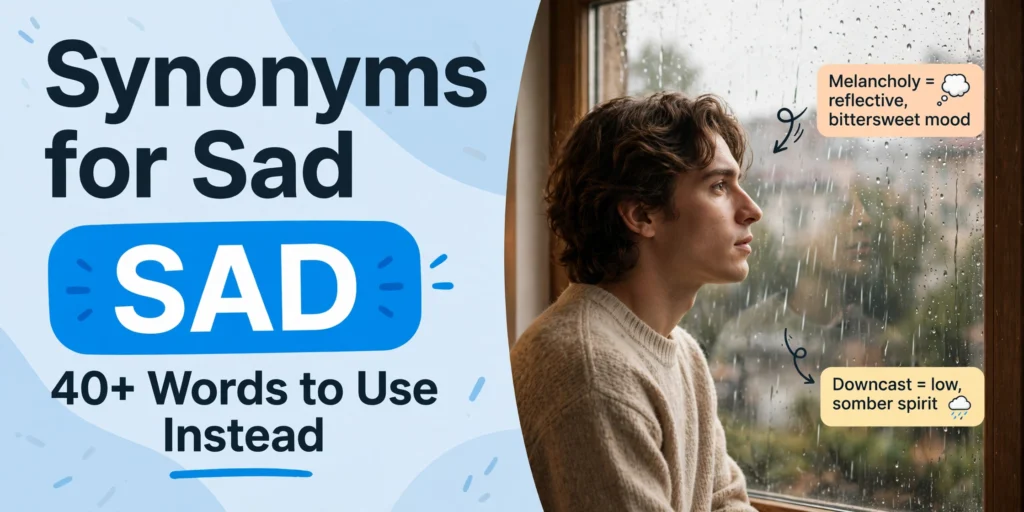
Sad is one of the first feeling words most of us learn, and it is also one of the most overused. It covers everything from a disappointing afternoon to a genuine loss, which means it often tells the reader very little on its own. Saying you felt sad after a cancelled plan and sad after saying goodbye to a close friend describes two very different experiences, yet the same small word is doing all the work in both sentences.
That is why a good range of synonyms for sad matters. The right word can show whether the feeling is mild and passing, heavy and lasting, or not really a feeling at all but a judgement about something disappointing. Choosing carefully makes writing clearer, more honest and more interesting to read, whether you are writing an essay, a story, a message to a friend or a work email.
In this guide, you will find more than 40 synonyms for sad, grouped by intensity and context, with example sentences and notes on when each word fits best. You will also learn which words to avoid in formal writing and which ones change meaning altogether if used carelessly.
Quick Answer
The best synonym for sad depends on the strength of the feeling. Use unhappy, down or low for mild sadness, gloomy, miserable or despondent for a heavier mood, and heartbroken, grief-stricken or devastated for deep sorrow. When sad means disappointing rather than emotional, use words such as sorry, pitiful or lamentable instead.
Mildly Sad: Unhappy, Down and Low
Not every sad feeling is dramatic. Often we are just a little flat, tired or out of sorts, and a gentle word suits the moment far better than a heavy one. These synonyms describe mild sadness that is usually temporary.
- Unhappy — the most direct, neutral replacement for sad. Example: She felt unhappy with the way the meeting had gone.
- Down — informal and common in everyday speech. Example: He has been feeling a bit down since the holiday ended.
- Low — suggests low energy or low spirits rather than strong emotion. Example: After a poor night’s sleep, she felt low all morning.
- Blue — a slightly literary way to say mildly sad, often used for a passing mood. Example: The grey weather left him feeling blue.
- Glum — describes someone looking or sounding quietly unhappy. Example: The team looked glum after losing the final match.
- Downcast — a little more formal than down, often used to describe someone’s expression. Example: She walked home with a downcast look on her face.
- Melancholy — a gentle, thoughtful sadness, often mixed with nostalgia. Example: Listening to old songs filled him with a quiet melancholy.
These words work well when you want to be honest without exaggerating. Saying you feel low or a bit down is usually more accurate, and more believable, than claiming to be devastated over a minor setback.
Deeply Sorrowful: Heartbroken, Devastated and Grief-Stricken
Some sadness runs much deeper, and mild words simply do not carry enough weight. The words in this group describe intense sorrow, often linked to loss, separation or a serious disappointment. Use them sparingly, because their strength is exactly what makes them effective.
- Heartbroken — describes sorrow caused by loss or the end of a close relationship. Example: She was heartbroken when her childhood home was sold.
- Devastated — very strong, suggesting someone feels overwhelmed by bad news. Example: The family was devastated by the closure of the local school.
- Grief-stricken — formal and serious, used for sorrow following a death or major loss. Example: The grief-stricken community gathered to remember those who had died.
- Desolate — suggests emptiness and loneliness as well as sadness. Example: He felt desolate in the empty house after everyone had left.
- Inconsolable — means unable to be comforted, and should be reserved for extreme sorrow. Example: The inconsolable child cried for her lost dog all evening.
- Despondent — describes losing hope as well as feeling sad. Example: After months without work, he grew increasingly despondent.
- Wretched — a strong, rather old-fashioned word for feeling deeply unhappy. Example: She felt wretched after the argument with her best friend.
A useful test is to ask whether the feeling would still be described the same way a week later. If the answer is yes, a stronger word may be justified. If the feeling passes by lunchtime, stick with the milder group.
Gloomy, Miserable and Downcast Moods
Some synonyms for sad describe a mood or atmosphere rather than a single moment of feeling. These are especially useful in stories and descriptions, where you want to show sadness through behaviour, weather or setting as well as through emotion.
- Gloomy — can describe a person, a mood or a place that feels dark and sad. Example: The gloomy afternoon matched her mood perfectly.
- Miserable — stronger than unhappy, suggesting real discomfort or unhappiness. Example: He felt miserable stuck indoors with a cold all weekend.
- Dismal — often used for sad, depressing situations or results. Example: The dismal news from the office ruined everyone’s Friday.
- Morose — describes someone who is sullen and withdrawn because they are unhappy. Example: He became morose and barely spoke during the long journey home.
- Sombre — a formal word for a serious, sad mood, often at solemn occasions. Example: The sombre crowd stood in silence at the memorial.
- Forlorn — suggests sadness combined with loneliness or abandonment. Example: The forlorn puppy waited by the gate for its owner.
- Doleful — a literary word for a mournful, sorrowful look or sound. Example: She gave him a doleful glance as he packed his bags.
Just as it helps to vary your words for happiness, as in our guide to synonyms for happy, varying your sad vocabulary stops your writing from sounding repetitive. A gloomy morning, a miserable journey and a forlorn farewell each paint a different picture.
When Sad Means Disappointing or Pitiful
Sad has a second, quite different meaning. We also use it to describe something disappointing, inadequate or worthy of pity, as in a sad state of affairs or a sad excuse. In this sense, the word is a judgement, not a feeling, and the synonyms change completely.
- Sorry — as in a sorry state or a sorry excuse, meaning poor or regrettable. Example: The sorry performance of the team disappointed their supporters.
- Pitiful — suggests something so poor or weak that it deserves pity. Example: The pitiful turnout at the event surprised the organisers.
- Lamentable — formal, meaning regrettable or deplorable. Example: The lamentable lack of funding left the library struggling.
- Deplorable — strong and formal, used for conditions or behaviour that deserve disapproval. Example: The deplorable state of the building shocked the inspectors.
- Regrettable — a polite, formal way to say unfortunate or disappointing. Example: The delay was regrettable, and the company apologised.
- Pathetic — very negative, so use it with care; it can sound insulting when applied to a person. Example: The old bicycle was in a pathetic condition after years of neglect.
The context usually makes the meaning clear, but in formal writing it is worth checking. A sentence about a sad situation could mean that people feel sad, or that the situation itself is poor, and those are not the same thing.
Choosing the Right Word for Sad
With so many options, the best choice usually comes down to three questions. First, how strong is the feeling? Mild words such as unhappy and low suit everyday disappointments, while heartbroken and devastated should be kept for serious events. Second, is the sadness a feeling or a judgement? If you mean disappointing, choose sorry, lamentable or regrettable instead of an emotional word.
Third, consider the tone of your writing. Down, blue and glum are natural in conversation and informal writing, while despondent, sombre and grief-stricken suit formal essays, reports and news writing. Mixing registers carelessly can make a sentence feel odd, such as describing a formal memorial as glum rather than sombre. For a similar range of positive alternatives, see our guide to synonyms for good, and for words that describe pleasing things rather than feelings, see our list of synonyms for beautiful.
Finally, remember that precision beats drama. A single well-chosen word, such as melancholy for a thoughtful sadness or forlorn for a lonely one, tells the reader far more than piling on several strong words at once.
Common Mistakes
- Wrong: He was devastated that the shop had run out of his favourite biscuits. Right: He was disappointed that the shop had run out of his favourite biscuits.
- Wrong: She felt depressed because it rained on her picnic. Right: She felt down because it rained on her picnic. (Depressed is a clinical term and should not be used casually for ordinary sadness.)
- Wrong: The sad performance of the car surprised the mechanic. Right: The poor performance of the car surprised the mechanic. (Here sad is vague; poor or disappointing is clearer.)
- Wrong: He gave a pathetic smile and thanked her warmly. Right: He gave a wistful smile and thanked her warmly. (Pathetic is insulting when applied to a person; wistful captures gentle sadness.)
- Wrong: The funeral was a glum occasion. Right: The funeral was a sombre occasion. (Glum is too informal and light for a solemn event.)
Frequently Asked Questions
What is the best synonym for sad?
Unhappy is the safest general synonym for sad, because it works in almost any context. For mild sadness, use down or low. For deep sorrow, heartbroken or devastated is more accurate, provided the situation genuinely deserves that strength.
What is a formal synonym for sad?
Despondent, sombre, grief-stricken and lamentable are all formal options, but they suit different situations. Despondent and grief-stricken describe feelings, sombre describes a mood or occasion, and lamentable describes a regrettable situation rather than an emotion.
What is the difference between sad and unhappy?
The two words overlap a great deal, but unhappy is slightly broader and often sounds a little more measured. Sad tends to describe a feeling in the moment, while unhappy can also describe a general state, such as being unhappy in a job over a long period.
Can sad mean disappointing?
Yes. When we say a sad excuse or a sad state of affairs, we mean poor, regrettable or worthy of pity, not that anyone feels sad. In formal writing, words such as regrettable, deplorable or lamentable usually express this meaning more clearly.
Related reading: explore more feeling words with our guides to synonyms for happy, synonyms for good and synonyms for beautiful.



Join the conversation