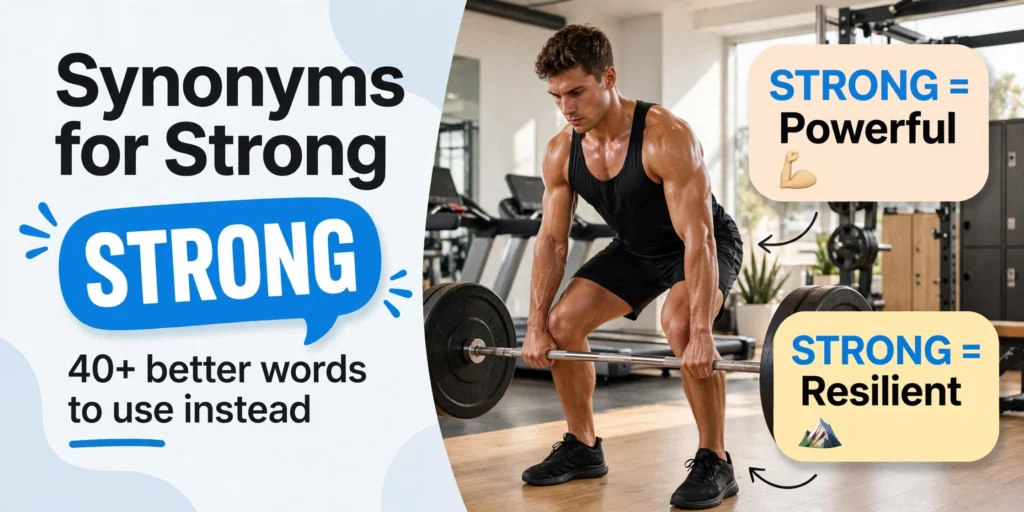
Synonyms for Strong: 40+ Better Words to Use Instead
“Strong” is one of those words we reach for far too often. A strong coffee, a strong argument, a strong wind, a strong friendship — the word does a lot of work, but it rarely says exactly what we mean. When you swap it for a more precise synonym, your writing instantly becomes clearer and more interesting. A “sturdy” chair and a “compelling” argument are both strong in their own way, yet they describe completely different qualities.
The trick is that “strong” covers several distinct meanings: physical power, the ability to endure hardship, intensity, persuasiveness, and durability. Choosing the right synonym depends on which of these you actually mean. This guide groups more than 40 synonyms for strong by nuance, with examples for each, so you can pick the word that fits your sentence rather than settling for a vague one.
Quick Answer
The best synonym for “strong” depends on what you mean. Use “powerful” or “mighty” for physical force, “resilient” or “tough” for endurance, “intense” or “forceful” for strength of feeling or effect, “compelling” or “convincing” for arguments, and “sturdy” or “robust” for things built to last. Each word carries a slightly different shade of meaning, so match the synonym to the context.
Synonyms for Strong When You Mean Physically Powerful
When you are describing a person, an animal, or a machine with great physical power, these words are far more vivid than “strong”:
- Powerful — “The powerful engine pulled the heavy carriage up the hill with ease.”
- Mighty — “The mighty oak had stood in the field for two hundred years.”
- Muscular — “Years of rowing had made him broad-shouldered and muscular.”
- Brawny — “The brawny dockworker lifted the crate onto his shoulder without help.”
- Burly — “A burly security guard stood by the entrance.”
- Sturdy — “She has a sturdy build and rarely falls ill.”
- Strapping — “He was a strapping young man, well over six feet tall.”
- Athletic — “Her athletic frame made her a natural choice for the team.”
- Hefty — “He gave the door a hefty shove and it swung open.”
- Formidable — “The opposing team looked formidable, but we were ready for them.”
Notice how each word paints a different picture. “Muscular” and “brawny” describe a body, “mighty” suggests grandeur as well as power, and “hefty” works well for a single forceful action. “Formidable” is useful when strength inspires a little respect or fear — a formidable opponent is one you would rather not face.
Synonyms for Strong When You Mean Resilient and Tough
Sometimes “strong” has nothing to do with muscles. It describes someone who keeps going through illness, loss, or difficulty. These synonyms capture that kind of strength:
- Resilient — “After the setback, she proved remarkably resilient and rebuilt her business within a year.”
- Tough — “It takes a tough character to keep training through a long winter.”
- Enduring — “Their enduring friendship survived decades apart.”
- Hardy — “Hardy plants can survive the frost without any protection.”
- Steadfast — “He remained steadfast in his beliefs despite the criticism.”
- Unyielding — “Her unyielding determination carried her through the final exams.”
- Tenacious — “The tenacious reporter refused to drop the story.”
- Indomitable — “She faced every challenge with an indomitable spirit.”
- Dauntless — “The dauntless climbers pressed on toward the summit.”
- Gritty — “It was a gritty performance from a team that refused to give up.”
These words differ in tone. “Resilient” suggests the ability to bounce back, while “unyielding” and “tenacious” suggest refusing to bend or let go. “Indomitable” and “dauntless” are more formal and dramatic — save them for moments that deserve a grander word. In everyday writing, “tough” and “resilient” are usually the clearest choices.
Synonyms for Strong When You Mean Intense or Forceful
“Strong” often describes intensity: a strong smell, a strong wind, strong feelings. When the sense is force or severity, try one of these:
- Intense — “The intense heat made it impossible to work outdoors at midday.”
- Forceful — “A forceful gust of wind slammed the gate shut.”
- Vigorous — “A vigorous debate followed the announcement.”
- Potent — “Garlic is a potent flavour — a little goes a long way.”
- Vehement — “She was vehement in her denial of the rumours.”
- Fierce — “The fierce storm brought down trees across the county.”
- Acute — “He felt an acute sense of disappointment when the results arrived.”
- Severe — “The severe frost damaged the early crops.”
- Pungent — “The pungent smell of vinegar filled the kitchen.”
- Overpowering — “The overpowering scent of roses drifted through the open window.”
Be careful with the more extreme words in this group. “Overpowering” and “vehement” suggest something almost too much, which is exactly right when you want that effect but misleading when you do not. “Potent” works well for medicines, flavours, and ideas, while “vigorous” suits effort, debate, and exercise. For more words that describe intensity in a positive light, see our guide to synonyms for good.
Synonyms for Strong When You Mean Convincing
A strong argument, case, or piece of evidence is one that persuades. These synonyms are ideal for essays, reports, and formal writing:
- Compelling — “She presented a compelling case for changing the policy.”
- Convincing — “The evidence was convincing enough to settle the matter.”
- Persuasive — “His persuasive speech won over even the sceptics.”
- Cogent — “The report offered a cogent analysis of the problem.”
- Sound — “The plan rests on sound reasoning and solid data.”
- Conclusive — “The test results were conclusive — there was no room for doubt.”
- Irrefutable — “The photographs provided irrefutable proof of what had happened.”
- Valid — “That is a valid point, and it deserves a proper answer.”
- Weighty — “The committee considered the weighty evidence for several hours.”
“Compelling” and “persuasive” are the most versatile choices here, and they work in both formal and informal writing. “Cogent” and “irrefutable” are stronger and more formal, so use them sparingly — an argument described as irrefutable had better truly leave no room for doubt. “Sound” is a quieter, reliable option when you want to praise reasoning without exaggerating.
Synonyms for Strong When You Mean Durable or Sturdy
For objects, materials, and structures, “strong” usually means built to last. These words are more precise:
- Durable — “These boots are made from durable leather that lasts for years.”
- Robust — “The company needs a robust system that can handle busy periods.”
- Solid — “The table is solid oak and will outlast us all.”
- Sturdy — “Choose a sturdy ladder before you start painting the ceiling.”
- Rugged — “A rugged phone case is essential for anyone working outdoors.”
- Heavy-duty — “The heavy-duty shelving can hold hundreds of books.”
- Reinforced — “The reinforced concrete walls were designed to withstand earthquakes.”
- Unbreakable — “The unbreakable glass survived the drop without a scratch.”
- Long-lasting — “A long-lasting relationship is built on trust and respect.”
“Durable” and “robust” are excellent all-rounders for products and systems, while “rugged” suggests something designed for rough conditions. Note that “solid” can also mean reliable or dependable in a figurative sense — a solid performance, a solid friend — which makes it a useful bridge between physical and abstract strength. If you are describing size as well as strength, our list of synonyms for big may help you find an even better fit.
Common Mistakes
Choosing a synonym for “strong” is mostly a matter of matching the word to the meaning — but a few pairings are easy to get wrong:
- Wrong: “She gave a muscular argument in the meeting.” Right: “She gave a compelling argument in the meeting.” — “Muscular” describes bodies, not ideas.
- Wrong: “The sturdy evidence convinced the jury.” Right: “The compelling evidence convinced the jury.” — “Sturdy” describes physical objects, not evidence.
- Wrong: “He is a potent runner.” Right: “He is a powerful runner.” — “Potent” describes flavours, medicines, and effects, not people.
- Wrong: “The building is resilient.” Right: “The building is sturdy.” — “Resilient” suits people, communities, and economies that recover from setbacks; buildings are sturdy or robust.
- Wrong: “An irrefutable smell came from the kitchen.” Right: “A pungent smell came from the kitchen.” — “Irrefutable” is for arguments and evidence, never for smells.
The pattern is simple: physical words belong with physical things, persuasive words belong with arguments, and emotional words belong with feelings. If a synonym sounds odd when you read the sentence aloud, it probably belongs in a different group.
Frequently Asked Questions
What is the best synonym for strong?
There is no single best synonym, because “strong” has several meanings. “Powerful” is the closest general replacement for physical strength, “resilient” is best for endurance, “compelling” is best for arguments, and “sturdy” is best for objects. Choose the word that matches the specific kind of strength you mean.
What is a more formal word for strong?
“Formidable”, “robust”, “cogent”, and “indomitable” are all formal alternatives. “Formidable” suits opponents and challenges, “robust” suits systems and evidence, “cogent” suits arguments, and “indomitable” suits a person’s spirit. In academic or business writing, “robust” and “compelling” are usually the safest formal choices.
What is a synonym for strong feelings?
For feelings, try “intense”, “fierce”, “passionate”, “deep”, or “profound”. You might feel an intense joy, a fierce loyalty, or a profound sense of relief. For more words to describe feelings and relationships, see our guide to synonyms for love and our list of synonyms for important.
What is the opposite of strong?
The opposite depends on the meaning. The opposite of physically strong is “weak” or “feeble”; the opposite of a strong argument is a “weak” or “flimsy” one; the opposite of a sturdy object is “fragile” or “flimsy”. As with synonyms, match the antonym to the context rather than using one word for every case.
Now that you can tell a “resilient” person from a “robust” system and a “compelling” argument from a “potent” flavour, your writing will be sharper and more precise. For more word-choice guides, explore our lists of synonyms for good, synonyms for big, and synonyms for important.


Comments (1)