Synonyms for Kind: 40+ Better Words to Use Instead
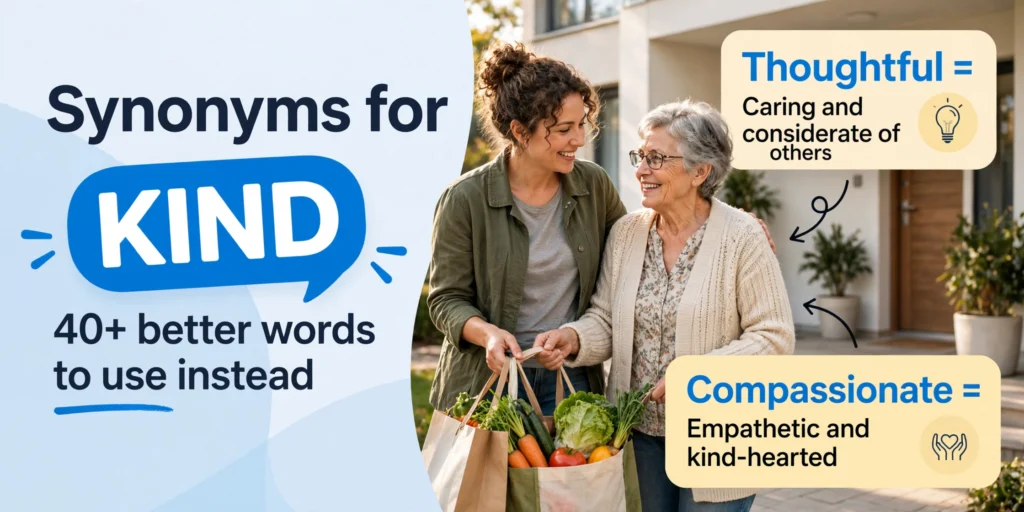
“Kind” is one of the most useful words in English, but it is also one of the most overused. We describe kind people, kind gestures, kind words and kind neighbours, and after a while the word starts to feel flat. It tells the reader that something was pleasant and well-meaning, yet it says very little about exactly how. Was the person generous with their time? Gentle in the way they spoke? Thoughtful in remembering a small detail? Each of those is a different kind of kindness, and English has a precise word for every one of them.
Learning synonyms for kind is not about showing off a large vocabulary. It is about being specific. A writer who says a nurse was “compassionate” paints a clearer picture than one who simply calls her “kind”. A speaker who describes a stranger as “good-natured” gives a different impression from one who calls him “generous”. The right synonym adds warmth, accuracy and personality to a sentence, whether you are writing an essay, a job application, a thank-you note or a story.
In this guide, you will find more than 40 synonyms for kind, grouped by nuance so you can find the exact word you need. Each group comes with definitions and example sentences, plus tips on choosing between close words such as kind, nice and friendly. By the end, you will rarely need to reach for “kind” when a better word is waiting.
Quick Answer
The best synonyms for kind include generous, compassionate, caring, gentle, thoughtful, friendly, considerate and good-natured. Choose generous for giving, compassionate for caring about suffering, gentle for a soft manner, thoughtful for remembering others’ needs, and friendly for warmth towards people you meet. Each synonym captures a different shade of kindness, so match the word to the situation rather than using them interchangeably.
What Does Kind Really Mean?
At its simplest, “kind” means caring about other people and treating them well. A kind person notices when someone needs help, speaks gently, shares what they have and tries not to cause harm. The word covers a wide range of behaviour, from holding a door open for a stranger to looking after a sick relative for months. That breadth is its strength and its weakness: it applies to almost any good deed, but it rarely tells us which one.
Kindness also has an emotional side. We often use “kind” to describe someone’s character rather than a single act. When we say “she has a kind heart”, we mean she is habitually warm, patient and generous, not simply that she did one nice thing. This is why synonyms matter. Words such as “compassionate” and “selfless” describe character too, but they highlight different qualities — compassion points to feeling another person’s pain, while selflessness points to putting others before yourself.
It is also worth remembering that kindness is not the same as politeness. A person can be polite without being kind, for example by saying all the right words while refusing to help. True kindness usually involves action, attention or sacrifice, however small. Keeping this distinction in mind will help you choose synonyms that describe what someone actually did, not just how they sounded. If you want more words for describing good character in general, our guide to synonyms for good covers a wider set of positive adjectives.
Synonyms for Kind: Generous and Caring
When kindness takes the form of giving — money, time, attention or possessions — these words are the most accurate choices.
Generous
Generous describes someone who gives freely and willingly, often more than is expected. It is the natural choice when the kindness involves sharing resources.
- Generous: “Our generous neighbours shared their garden vegetables with the whole street.”
- Charitable: “She made a charitable donation to the food bank every month.”
- Giving: “He is a giving person who always volunteers at the shelter.”
- Selfless: “The selfless nurse stayed late to comfort the worried family.”
- Big-hearted: “My big-hearted grandmother took in stray cats for years.”
- Open-handed: “The open-handed shopkeeper often gave bread to people who could not pay.”
- Magnanimous: “In a magnanimous gesture, she forgave the debt and wished him well.”
- Altruistic: “His altruistic work with refugees earned him deep respect in the community.”
Use “generous” for everyday giving, “charitable” for donations and organised help, and “magnanimous” for grand, forgiving gestures. “Altruistic” is the most formal of the group and suits essays and formal writing best. For a related set of warm, positive words, see our list of synonyms for happy, which pairs well with descriptions of generous people.
Synonyms for Kind: Gentle and Soft-Hearted
Some kindness is quiet. It shows in a soft voice, a careful touch and a refusal to hurt others. These synonyms suit people, animals and actions that are tender rather than showy.
- Gentle: “The gentle teacher never raised her voice, even when the class was noisy.”
- Tender: “He spoke in a tender voice as he read to his daughter.”
- Soft-hearted: “My soft-hearted uncle cannot bear to see anyone upset.”
- Tender-hearted: “The tender-hearted vet treated every animal as if it were her own.”
- Compassionate: “A compassionate doctor listens carefully before offering treatment.”
- Sympathetic: “Her sympathetic reply made me feel understood, not judged.”
- Empathetic: “An empathetic manager understands why an employee might be struggling.”
- Warm-hearted: “The warm-hearted host made every guest feel at home.”
“Compassionate” is the strongest word here: it means feeling another person’s suffering and wanting to ease it, so it suits serious contexts such as healthcare, charity and grief. “Sympathetic” is lighter and means showing understanding, while “empathetic” means actually sharing or imagining another person’s feelings. “Gentle” and “tender” describe manner rather than feeling, so they work well for voices, touches and ways of speaking.
Synonyms for Kind: Friendly and Warm
When kindness shows as openness towards other people — a smile, a welcome, an easy conversation — these friendly synonyms are the right fit.
- Friendly: “The friendly waiter remembered our names on our second visit.”
- Amiable: “Our amiable guide chatted happily with everyone on the tour.”
- Affable: “The affable professor was popular with students and staff alike.”
- Warm: “She gave us a warm welcome when we arrived at her home.”
- Welcoming: “The welcoming community helped the new family settle in quickly.”
- Cordial: “We exchanged cordial greetings before the meeting began.”
- Approachable: “An approachable boss is one employees feel comfortable talking to.”
- Neighbourly: “In a neighbourly gesture, he cleared snow from the path next door.”
“Friendly” is the everyday, all-purpose word in this group, while “amiable” and “affable” are slightly more formal and often describe someone who is pleasant company. “Cordial” is the most formal and suits written invitations and professional settings. “Approachable” is especially useful at work or school, where it describes someone who is easy to talk to and willing to listen.
Synonyms for Kind: Thoughtful and Considerate
Thoughtful kindness is shown through attention to detail: remembering a birthday, noticing someone is tired, or making life easier for others. These words describe people who think before they act.
- Thoughtful: “It was thoughtful of you to bring soup while I was ill.”
- Considerate: “A considerate driver always leaves room for cyclists.”
- Attentive: “The attentive waiter noticed my empty glass before I asked.”
- Helpful: “The helpful librarian found the book I needed in minutes.”
- Supportive: “My supportive friends encouraged me through every exam.”
- Accommodating: “The accommodating hotel changed our room without any fuss.”
- Obliging: “The obliging receptionist printed my tickets and called a taxi.”
- Courteous: “He was courteous enough to hold the lift for the elderly couple.”
“Thoughtful” usually refers to a specific kind act, while “considerate” describes a habit of thinking about others. “Supportive” is the best choice when kindness means encouragement over time, such as supporting a friend through illness or study. If you are writing a thank-you message, you may also like our guide to ways to say have a good day for warm closing phrases.
Synonyms for Kind: Good-Natured and Easygoing
Some people are kind because it is simply their nature: they are cheerful, patient and easy to be around. These synonyms describe that sunny, good-hearted character.
- Good-natured: “The good-natured farmer laughed off the rain and carried on working.”
- Good-hearted: “She is a good-hearted soul who would help anyone in need.”
- Sweet-natured: “The sweet-natured child shared her sweets with her little brother.”
- Easygoing: “My easygoing flatmate never minds when plans change.”
- Gracious: “The gracious winner thanked her opponent and praised her skill.”
- Benevolent: “The benevolent charity funds schools in some of the poorest regions.”
- Humane: “We should treat all animals in a humane way.”
- Decent: “He is a decent man who always keeps his promises.”
- Kind-hearted: “The kind-hearted stranger paid for the old woman’s shopping.”
- Caring: “A caring parent listens to their child, even on a busy day.”
- Loving: “She wrote a loving letter to her mother on her birthday.”
“Good-natured” and “easygoing” describe temperament — a person who is relaxed, cheerful and hard to upset. “Benevolent” is formal and often used for organisations, rulers or donors, while “humane” specifically means showing kindness towards people or animals who are suffering or vulnerable. “Decent” is a quiet compliment: it means honest, fair and kind in an ordinary, reliable way. For words that describe deep affection rather than general kindness, see our guide to synonyms for love.
How to Choose the Right Synonym for Kind
With more than 40 options, the best choice depends on three things: what the person did, how they did it, and how formal your writing is. Start with the action. If someone gave money, choose “generous” or “charitable”. If someone listened patiently, choose “compassionate” or “attentive”. If someone made you feel welcome, choose “warm” or “welcoming”. Matching the word to the action is the single most useful habit you can build.
Next, consider tone. In a formal essay or a job reference, “compassionate”, “benevolent”, “magnanimous” and “considerate” sound natural. In a friendly email or a story, “warm-hearted”, “big-hearted”, “easygoing” and “good-natured” feel more natural. Using a very formal word in a casual message can sound stiff, just as a very casual word in a formal letter can sound careless.
Finally, watch the strength of the word. “Nice” and “friendly” are mild; “selfless” and “altruistic” are strong. If you describe a colleague who held a door open as “altruistic”, you will sound as if you are exaggerating. Save the strongest words for the most remarkable kindness, and your writing will be far more believable.
- Identify the action: giving, listening, welcoming or supporting.
- Pick the group that matches that action.
- Check the formality: formal, neutral or casual.
- Read the sentence aloud and ask whether the word fits the scale of the kindness.
Kind vs Nice vs Friendly: What Is the Difference?
These three words are often used as if they meant the same thing, but they do not. “Kind” describes a caring character and usually involves action — helping, giving or comforting. “Nice” is a much weaker word: it usually means pleasant or agreeable, and it can describe anything from weather to a meal. Calling a person “nice” tells us very little about them. “Friendly” describes how someone behaves towards others socially: they smile, chat and make people feel welcome, but a friendly person is not always kind in a deeper sense.
A useful way to remember the difference is this: a friendly shopkeeper greets you warmly, a nice shopkeeper is pleasant to deal with, but a kind shopkeeper gives a free loaf to someone who cannot pay. In writing, “kind” is almost always a better choice than “nice”, and a specific synonym such as “generous” or “compassionate” is better still.
Common Mistakes
Wrong: She is a very kindful person.
Right: She is a very kind person. (“Kindful” is not a standard English word; use “kind” or “kind-hearted” instead.)
Wrong: He was so altruistic to hold the door for me.
Right: He was so courteous to hold the door for me. (“Altruistic” describes deep selflessness, which is far too strong for a small everyday courtesy.)
Wrong: The benevolent waiter smiled at us.
Right: The friendly waiter smiled at us. (“Benevolent” is formal and usually describes donors or organisations, not someone smiling at work.)
Wrong: She gave a sympathetic donation to the charity.
Right: She gave a generous donation to the charity. (“Sympathetic” describes feelings and understanding, not giving; “generous” is the right word for donations.)
Wrong: It was very nice of you to look after my mother for a month.
Right: It was very kind of you to look after my mother for a month. (“Nice” is too weak for a major act of care; “kind”, “selfless” or “compassionate” fits the scale of the favour.)
Frequently Asked Questions
What is the best synonym for kind?
There is no single best synonym, because the right word depends on the situation. “Generous” is best for giving, “compassionate” for caring about suffering, “thoughtful” for remembering others’ needs, and “friendly” for warmth towards people you meet. If you need one safe, all-purpose alternative, “caring” or “good-hearted” works in most contexts.
What is a formal synonym for kind?
Formal synonyms for kind include compassionate, benevolent, magnanimous, considerate and altruistic. These suit essays, references, speeches and formal letters. For example, you might describe a charity founder as “benevolent” or a nurse as “compassionate” in a formal recommendation.
What is the difference between kind and nice?
“Kind” describes a caring character and usually involves helpful action, while “nice” simply means pleasant or agreeable and is much weaker. A nice person is pleasant to be around; a kind person actively helps others. In most writing, “kind” or a more specific synonym is a better choice than “nice”.
Can I use “kind” to describe a thing?
Yes, but only in a limited way. We say “a kind word”, “a kind gesture” or “a kind offer”, where “kind” describes something done with good intentions. We do not usually describe objects as kind — a chair or a car cannot be kind. For things, use words such as “helpful”, “thoughtful” or “welcome” instead, depending on what you mean.
Related reading: if you enjoyed this guide, explore our synonyms for good, synonyms for happy and synonyms for love to build a richer, more precise vocabulary.


Comments (1)