Synonyms for Interesting: 40+ Better Words to Use Instead
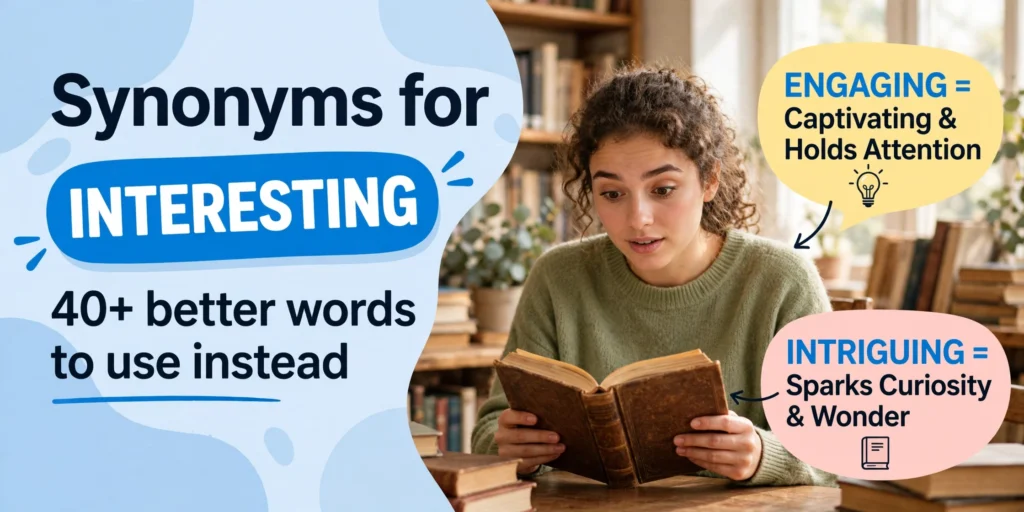
Interesting is one of the most overused words in English. We use it for books, films, conversations, ideas, places and people, often because we cannot think of a more exact word in the moment. It is not wrong, but it is vague. It tells the reader that something caught your attention without explaining why, how, or in what way.
That vagueness is the problem. A lecture can be interesting because it is full of surprising facts. A film can be interesting because it keeps you guessing until the end. A person can be interesting because they have lived an unusual life. In each case, a stronger word would give the reader a clearer picture and make your writing feel more confident and precise.
This guide groups more than 40 synonyms for interesting by meaning, so you can choose the right one for the situation. You will find words for things that fascinate, intrigue, entertain, make you think, and stand out from the ordinary. Each group includes simple definitions and examples you can adapt for essays, emails, stories and everyday conversation. If you are also looking for alternatives to another common word, our guide to synonyms for good follows the same approach.
Quick Answer
The best synonym for interesting depends on the meaning you want. Use fascinating or captivating for something that holds your attention, intriguing for something that makes you curious, entertaining for something fun to watch or read, thought-provoking for something that makes you think, and remarkable or noteworthy for something unusual or important.
Fascinating and Engaging: When Something Holds Your Attention
Use this group when something is so absorbing that you do not want to stop reading, watching or listening. These words suggest strong attention, excitement and sometimes wonder. They work well for books, documentaries, talks, exhibitions and stories.
- Fascinating: extremely interesting and hard to look away from. The documentary about deep-sea creatures was fascinating from start to finish.
- Captivating: holding your attention completely. Her captivating voice kept the whole hall silent.
- Engrossing: so interesting that you forget everything else. It was an engrossing novel, and I finished it in two days.
- Absorbing: taking up all your attention. The puzzle was so absorbing that I lost track of time.
- Compelling: powerful and hard to ignore. He gave a compelling account of his journey across the desert.
- Riveting: extremely exciting and interesting. The final chapter was riveting, with a twist I did not expect.
- Gripping: holding your attention tightly. It was a gripping story about a family torn apart by war.
- Enthralling: filling you with delight and interest. The ballet was enthralling, and the audience rose to applaud.
- Spellbinding: so interesting that you cannot move or look away. The storyteller held the children spellbound with a spellbinding tale.
Choose fascinating for general use, captivating for performances and people, and engrossing or absorbing for books, films and tasks that take over your full attention.
Intriguing: When Something Makes You Curious
Use this group when something raises a question in your mind. These words do not just mean interesting. They mean you want to know more, solve a mystery, or understand a strange idea. They are useful in reviews, essays and descriptions of research.
- Intriguing: arousing curiosity and interest. The book opens with an intriguing question about time travel.
- Curious: strange or unusual enough to make you wonder. It was a curious fact that the town had no street names.
- Puzzling: difficult to understand, but interesting because of it. The results were puzzling, and the team decided to repeat the test.
- Mysterious: hard to explain and full of secrets. A mysterious letter arrived with no return address.
- Enigmatic: mysterious and difficult to understand. The artist was an enigmatic figure who rarely gave interviews.
- Provocative: causing thought, discussion or debate. The essay made a provocative claim about the future of work.
- Tantalising: exciting because it promises something you cannot quite reach. The trailer offered only a tantalising glimpse of the film.
Intriguing is the safest choice in this group. Use mysterious or enigmatic when secrecy is part of the appeal, and provocative when an idea is meant to challenge the reader.
Entertaining: When Something Is Fun to Read, Watch or Hear
Use this group when the main quality is enjoyment. Something can be entertaining without being serious, deep or surprising. These words suit films, plays, podcasts, speeches, parties and light reading.
- Entertaining: enjoyable and fun. It was an entertaining evening, full of music and good conversation.
- Amusing: funny in a gentle way. He told an amusing story about his first day at school.
- Delightful: giving great pleasure. We spent a delightful afternoon in the old bookshop.
- Enjoyable: pleasant and fun to experience. The walk along the coast was thoroughly enjoyable.
- Lively: full of energy and excitement. The debate was lively, with strong views on both sides.
- Witty: clever and funny. Her witty remarks kept the audience laughing throughout the talk.
- Charming: pleasant and attractive in a warm way. The small hotel was charming, with a garden full of roses.
- Fun: enjoyable and light-hearted. The quiz was fun, even though our team came last.
Entertaining and enjoyable are useful in formal and informal writing. Save witty for clever humour, charming for people and places with warmth, and delightful for a pleasant experience rather than a serious subject.
Thought-Provoking: When Something Makes You Think
Use this group when an idea, book, film or speech changes how you think. These words suggest depth and value, not just enjoyment. They are ideal for essays, reviews and academic writing, where you need to show that a subject has real substance.
- Thought-provoking: making you think seriously about a subject. The lecture was thought-provoking and sparked a long discussion.
- Stimulating: exciting your mind and encouraging new ideas. It was a stimulating course, full of fresh arguments.
- Insightful: showing a deep understanding of a subject. Her insightful comments helped me see the problem clearly.
- Enlightening: giving you new knowledge or understanding. The interview was enlightening, especially on the history of the town.
- Eye-opening: surprising and changing your view of something. Visiting the factory was an eye-opening experience.
- Profound: deep, serious and important. The poem explores a profound question about loss and hope.
- Inspiring: filling you with the desire to act or create. His inspiring speech encouraged students to keep learning.
Thought-provoking is the best direct replacement here. Use insightful for a person or comment, enlightening for new information, and profound only when the subject is genuinely deep and serious. For words that describe value and weight in a similar way, see our list of synonyms for important.
Unusual and Noteworthy: When Something Stands Out
Use this group when something is interesting because it is different, rare or worth remembering. These words do not describe how it makes you feel. They describe why it deserves attention in the first place.
- Remarkable: unusual and worthy of attention. She made a remarkable recovery after the accident.
- Noteworthy: important or interesting enough to mention. The report includes several noteworthy findings.
- Striking: very noticeable and impressive. The building has a striking design, with a curved glass roof.
- Extraordinary: very unusual and surprising. It was an extraordinary achievement for such a young team.
- Unusual: not common or ordinary. The house had an unusual shape, with round windows.
- Distinctive: clearly different and easy to recognise. The writer has a distinctive voice, full of short, sharp sentences.
- Memorable: worth remembering. Our trip to the mountains was truly memorable.
- Notable: important and deserving attention. He is a notable expert on medieval history.
- Exceptional: unusually good or special. The students showed exceptional talent in the final performance.
- Unforgettable: so good or striking that you cannot forget it. It was an unforgettable night under the stars.
Remarkable and noteworthy work well in formal writing. Use striking for appearance, distinctive for style or character, and memorable or unforgettable for experiences you want to praise. For more words that describe difference, see our guide to synonyms for different.
Common Mistakes
Choosing a stronger synonym is only helpful if the meaning still fits. These common mistakes show where interesting is often replaced with the wrong word.
- Wrong: The comedy show was profound. Right: The comedy show was entertaining. Profound means deep and serious, not funny.
- Wrong: Her joke was thought-provoking. Right: Her joke was witty. A joke can be clever, but thought-provoking suits a serious idea.
- Wrong: The boring lecture was fascinating. Right: The lecture was dull, or the lecture was disappointing. Fascinating means the opposite of boring, so do not use it to soften a negative judgement.
- Wrong: It was a mysterious film about baking. Right: It was a delightful film about baking. Mysterious needs secrecy or a puzzle, not just a pleasant subject.
- Wrong: The maths problem was entertaining. Right: The maths problem was intriguing. Entertaining suggests fun, while intriguing fits a problem that makes you curious.
Before you replace interesting, ask one question: is it fascinating, funny, puzzling, deep, or unusual? The answer will point you to the right group.
Frequently Asked Questions
What is the best synonym for interesting?
There is no single best synonym, because the right word depends on the meaning. Fascinating is the closest general replacement. Intriguing fits curiosity, entertaining fits fun, and thought-provoking fits ideas that make you think.
What is a more formal synonym for interesting?
For formal writing, try compelling, noteworthy, remarkable, insightful, or thought-provoking. These words sound precise and measured, and they work well in essays, reports and professional emails.
What is a synonym for very interesting?
Try fascinating, captivating, riveting, gripping, or enthralling. Each one suggests stronger interest than interesting alone. For example, you could write a riveting speech rather than a very interesting speech.
How can I stop repeating the word interesting in an essay?
First, decide what you mean in each sentence. Then choose a word from the matching group above and vary it through the essay. You can also rewrite the sentence to show why the subject matters, instead of only saying that it is interesting.
Related reading: if you enjoyed this guide, explore our list of synonyms for happy for more precise and natural word choices in your writing.


Comments (1)