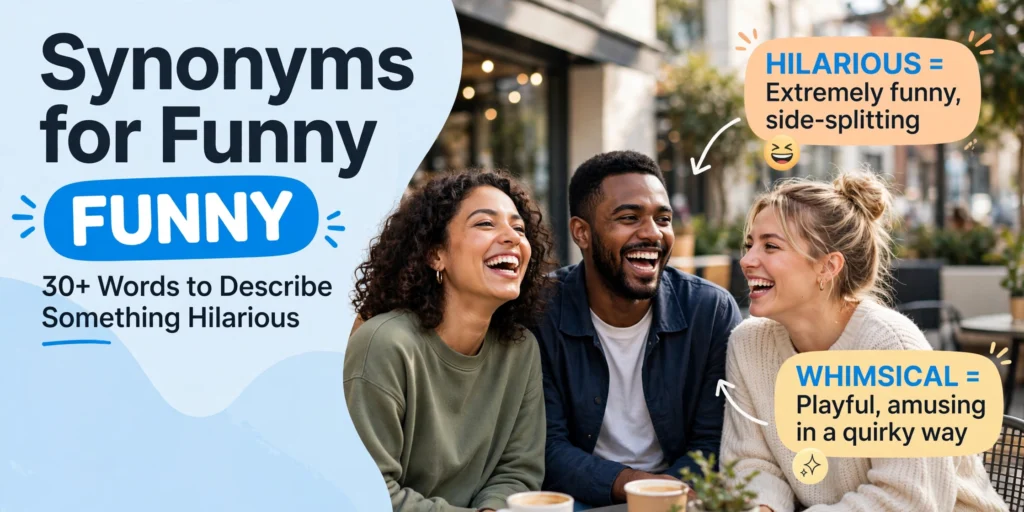
Synonyms for Funny: 30+ Words for Something Hilarious
Funny is one of those words we reach for again and again, yet it rarely tells the whole story. A joke can be funny, a friend can be funny, a situation can be funny, and a strange coincidence can be funny too — but each of those moments feels different. If you always use the same word, your writing starts to sound flat, and your reader never quite knows whether you mean mildly amusing, genuinely hilarious, or simply odd.
That is why having a wider set of synonyms for funny matters. The right word does more than decorate a sentence: it sets the strength of the humour, the tone of the moment, and the reaction you expect from your reader. Amusing is gentle. Witty is clever. Hilarious is loud and impossible to ignore. Choosing well makes your writing clearer, more vivid, and more enjoyable to read.
In this guide, you will find more than 30 synonyms for funny, grouped by strength so you can pick the one that fits. You will also learn the difference between funny-ha-ha and funny-strange, see example sentences for each group, and avoid the most common mistakes people make with these words.
Quick Answer
The best synonyms for funny are amusing, hilarious, comical, witty, humorous, entertaining, laughable, droll, side-splitting, and rib-tickling. Use amusing for something gently funny, witty for clever humour, and hilarious or side-splitting for something extremely funny. For the other meaning of funny — strange or odd — use peculiar, odd, or curious instead.
Mildly Amusing: Gentle Synonyms for Funny
Not everything funny makes you laugh out loud. Sometimes a remark is simply pleasant, light, or quietly entertaining. These gentler synonyms are ideal for polite conversation, everyday writing, and situations where the humour is soft rather than loud.
Amusing is the closest and safest synonym for funny. It describes something that entertains or pleases you in a light way. For example: “The children found the puppet show very amusing.” It works well in both formal and informal writing.
Entertaining suggests something that holds your attention and gives you pleasure. A film, a speaker, or a story can be entertaining without being laugh-out-loud funny. For example: “She gave an entertaining talk about her travels in Scotland.”
Pleasant and delightful are not exact synonyms for funny, but they can describe a light, enjoyable moment with a touch of humour. For example: “We spent a delightful afternoon listening to his stories.” Use them when the mood matters as much as the joke.
Light-hearted describes humour that is cheerful and not serious. It is useful when you want to show that something was fun without suggesting it was hilarious. For example: “The meeting ended with a light-hearted joke about the office coffee machine.”
Charming can also work when the humour comes from someone’s personality rather than a joke. For example: “He told the story in a charming, self-deprecating way.” Other useful words in this group include playful, cheerful, and whimsical, which suggests something funny because it is unusual or fanciful.
These words are especially helpful when you are writing about books, films, or people. Instead of saying “It was a funny book” every time, you can say it was amusing, entertaining, or light-hearted — and your reader will immediately understand the level of humour you mean.
Funny: Everyday Synonyms That Hit the Middle Ground
This is the largest and most useful group. These words describe something clearly funny — a joke that works, a remark that makes people smile, or a situation that is genuinely comic — without going as far as hilarious.
Humorous is the more formal cousin of funny. It is common in essays, reviews, and professional writing. For example: “The novel is a humorous look at family life in a small town.” If you want to sound polished, humorous is often a better choice than funny.
Comical describes something that makes you laugh because it is absurd or ridiculous in a visual or obvious way. For example: “The dog’s comical expression made everyone in the room laugh.” It often suits situations and appearances rather than clever wordplay.
Witty is a more specific word: it means funny because it is clever. A witty person makes quick, intelligent jokes, often with wordplay. For example: “Her witty reply left the whole table laughing.” Do not use witty for simple slapstick humour — it belongs to clever humour.
Droll describes dry, understated humour — the kind of joke delivered with a straight face. For example: “He made a droll comment about the weather, and it took a moment for everyone to realise it was a joke.” Droll is a lovely British English word, and it adds variety to your writing.
Laughable needs care. It can mean funny in a light way, but it often means ridiculous or worthy of being laughed at, not with. For example: “The idea that the train would arrive on time was laughable.” Only use laughable when you mean something silly or absurd, not when you mean something joyfully funny.
Other strong choices in this group include amusing, entertaining, jocular (cheerful and joking), jolly, and merry. For example: “The pub was full of jolly, laughing faces on Christmas Eve.” If you are describing a person rather than a joke, funny, humorous, and witty are usually the most natural choices.
When you are choosing between these words, ask yourself one question: is the humour clever, visual, or gentle? Clever humour is witty. Visual or absurd humour is comical. Gentle humour is amusing. That one question will usually point you to the right word.
Hilarious: The Strongest Synonyms for Funny
Sometimes funny is not strong enough. When something makes you laugh until your stomach hurts, you need a word that matches that feeling. These are the strongest synonyms for funny, so save them for moments that truly deserve them.
Hilarious is the most common strong synonym. It means extremely funny. For example: “The comedian’s final story was absolutely hilarious.” Because it is used so often, it can lose some of its force — so use it only when something really was very funny.
Side-splitting is more vivid. It suggests laughter so hard that it almost hurts. For example: “His impression of the head teacher was side-splitting.” It is informal and best used in casual writing or speech.
Rib-tickling is similar: it describes something that makes you laugh a lot. For example: “The sitcom’s latest episode was rib-tickling from start to finish.” Like side-splitting, it is informal and playful.
Uproarious describes laughter that is loud and uncontrolled, often from a whole group. For example: “The audience gave an uproarious response to the opening scene.” It works well for performances, speeches, and parties.
Belly laugh is a noun phrase rather than a single word, but it is useful: “The film gave us all a proper belly laugh.” Other vivid options include priceless (“Her reaction was priceless”), scream in the informal sense (“The whole evening was a scream”), and knee-slapping for old-fashioned, hearty humour.
A good rule is to keep your strongest words in reserve. If every joke in your writing is hilarious, none of them feels hilarious. Use amusing or entertaining for the smaller moments, and save hilarious, side-splitting, and uproarious for the ones that genuinely earned them.
Funny-Ha-Ha vs Funny-Strange: Don’t Mix Them Up
Funny has two very different meanings in English, and confusing them is one of the most common mistakes learners make. “That’s funny” can mean “That makes me laugh” — or it can mean “That’s strange.” The context usually makes the meaning clear in speech, but in writing, the wrong synonym can change your meaning completely.
For funny-ha-ha — something that makes you laugh — use amusing, hilarious, comical, witty, humorous, entertaining, droll, or side-splitting. For example: “It was a funny story” means the story made people laugh, so you could write: “It was a hilarious story.”
For funny-strange — something odd, suspicious, or unexpected — use odd, peculiar, strange, curious, weird, or suspicious. For example: “There was a funny smell in the kitchen” does not mean the smell was amusing. It means the smell was odd. The correct rewrite is: “There was a peculiar smell in the kitchen.”
Here are a few more examples to make the difference clear:
- “That’s funny — I thought I left my keys here.” (strange) → “That’s odd — I thought I left my keys here.”
- “He has a funny way of walking.” (unusual) → “He has a peculiar way of walking.”
- “The car is making a funny noise.” (worrying) → “The car is making a strange noise.”
- “That joke was so funny!” (amusing) → “That joke was so hilarious!”
If you are ever unsure, replace funny with odd and see if the sentence still makes sense. If it does, you meant funny-strange. If the sentence becomes nonsense, you meant funny-ha-ha. This simple test will save you from many embarrassing mistakes, especially in formal writing.
Choosing the right word here also helps your reader. When you write “peculiar” instead of “funny” for something strange, your reader knows at once that you mean odd, not amusing — and your writing becomes clearer with no extra effort.
How to Use These Synonyms in Real Sentences
Knowing a list of words is not enough; you need to know how they behave in sentences. Some synonyms for funny describe people, some describe jokes or stories, and some describe situations. Using the wrong one can sound unnatural, even if the dictionary meaning is close.
Words that describe people include witty, humorous, funny, amusing, and droll. For example: “Our teacher is witty and always has a clever answer ready.” You would not usually say “Our teacher is side-splitting” — that word describes a joke or a performance, not a person.
Words that describe jokes, stories, films, and performances include hilarious, side-splitting, rib-tickling, comical, entertaining, and uproarious. For example: “The play was entertaining, but the final scene was truly hilarious.” Notice how the two words work together: entertaining sets the general tone, and hilarious marks the high point.
Words that describe situations include comical, absurd, laughable, and ridiculous. For example: “It was comical watching three adults try to fit into a tiny car.” These words often carry a gentle judgement: the situation was funny because it was silly or badly planned.
It also helps to learn the common word partnerships, called collocations. We say “a witty remark”, “a hilarious mistake”, “an amusing story”, “a droll observation”, and “a side-splitting performance”. Learning these natural pairs will make your English sound much more fluent.
If you enjoy building your vocabulary this way, you may also like our guide to synonyms for interesting, which follows the same grouping method and will help you stop repeating the same tired adjectives. You can also explore synonyms for amazing for stronger alternatives when something impresses you, and synonyms for love for warmer, more precise ways to describe affection.
Common Mistakes
Wrong: “The comedian was very hilarious person.”
Right: “The comedian was a very hilarious person.” / “The comedian was hilarious.”
Hilarious is an adjective, so it needs the right article and word order. Do not put “very” before a noun in this way.
Wrong: “That joke was funny-strange.”
Right: “That joke was hilarious.” / “That smell was peculiar.”
Do not mix the two meanings of funny. A joke is funny-ha-ha; a smell is funny-strange. Use hilarious for the joke and peculiar for the smell.
Wrong: “She told a witty slapstick routine.”
Right: “She told a witty anecdote.” / “He performed a comical slapstick routine.”
Witty means clever, so it suits wordplay and smart remarks. Slapstick is physical and visual, so comical is the better word.
Wrong: “Everything he says is hilarious.”
Right: “Some of his stories are hilarious; most are just amusing.”
Overusing hilarious weakens it. Save your strongest words for the strongest moments, and use amusing or entertaining for the rest.
Wrong: “It was a laughable film — I loved every minute.”
Right: “It was a hilarious film — I loved every minute.”
Laughable often means ridiculous or silly in a negative way, not joyfully funny. If you enjoyed the film, hilarious or entertaining is clearer.
Frequently Asked Questions
What is the best synonym for funny?
The best synonym depends on what you mean. For general use, amusing is the safest choice. For clever humour, use witty. For something extremely funny, use hilarious. For something strange rather than amusing, use peculiar or odd instead.
What is a more formal word for funny?
Humorous is the most useful formal synonym for funny. It works well in essays, reports, and professional writing. Amusing is also fairly neutral and polite. For example: “The speaker gave a humorous account of his first year in business.” Avoid side-splitting and rib-tickling in formal writing, as both are informal.
What is the difference between funny and hilarious?
Funny is the general word for something that makes you laugh or smile. Hilarious is much stronger: it means extremely funny, the kind of humour that makes you laugh out loud and struggle to stop. If a joke makes you smile, it is funny. If it makes you laugh until your sides hurt, it is hilarious.
Can funny mean strange?
Yes. Funny has two meanings in English: funny-ha-ha (amusing) and funny-strange (odd or peculiar). For example, “a funny smell” means a strange smell, not an amusing one. When you write, use peculiar, odd, or strange for the second meaning so your reader is never confused.
Next time you reach for the word funny, pause for a second and ask how funny it really was. With amusing, witty, comical, droll, hilarious, and side-splitting in your toolkit, you will always have a better word ready — and your writing will be sharper for it.

Join the conversation