Synonyms for Different: 40+ Words to Use Instead
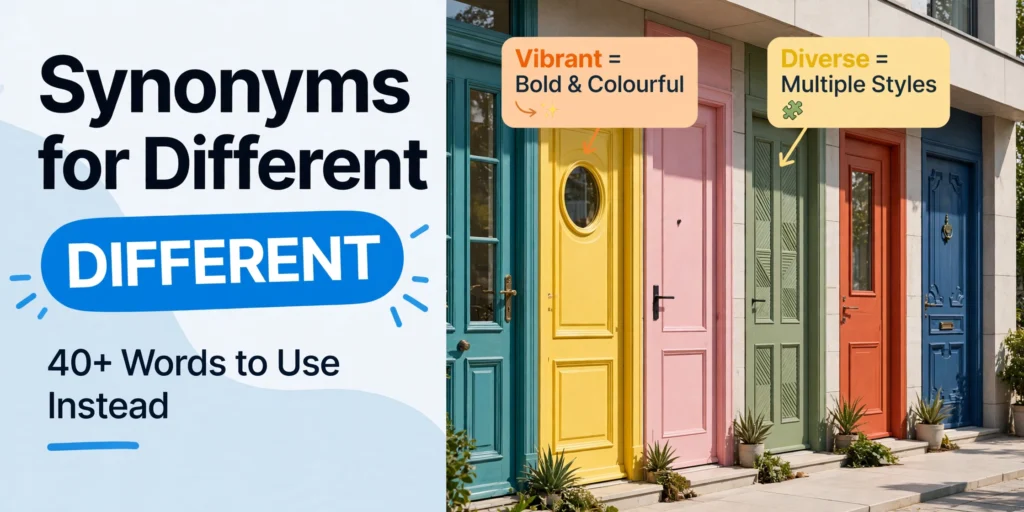
“Different” is one of the most overused words in English. We reach for it when things are not the same, when a group is varied, when something is unusual, and when two items are simply separate — four quite separate jobs for one small word. No wonder it can feel vague: it tells the reader that something differs, without explaining how.
Just as there are plenty of synonyms for good, English offers a rich set of alternatives for “different”, each with its own shade of meaning. Distinct is not quite the same as distinctive, and diverse is not quite the same as varied, so choosing carefully makes your writing clearer and more precise. This guide groups more than 40 synonyms by the sense you actually mean, with examples to help you use each one with confidence.
Whether you are writing an essay, a work email, or a story, the right replacement will sharpen your meaning. Use the lists below to find the word that fits your sentence, not just a word that is roughly similar.
Quick Answer
If you need a quick replacement for “different”, try distinct for things that are clearly not the same, diverse or varied for a mixed group, and distinctive or unique for something unusual or one of a kind. For things kept apart, separate or individual usually fits best. The right choice depends on whether you mean “not the same”, “varied”, “unusual”, or “kept apart”.
Words That Mean “Not the Same”
Use this group when you want to say that two or more things are unlike each other. These words are the closest direct replacements for “different” in its most common sense.
- Distinct, dissimilar, unlike: these three stress a clear lack of sameness. Example: “The twins have distinct personalities, and their tastes in music are quite dissimilar.”
- Contrasting, divergent, opposite: use these when the difference is sharp, or when things move in different directions. Example: “Their contrasting views led to a long debate, and their careers took divergent paths.”
- Disparate, unrelated, incompatible: these suit things with little or nothing in common. Example: “The report draws on disparate sources, from medieval poetry to modern statistics.”
- Differing, alternative: “differing” works well for opinions or approaches, while “alternative” means another option rather than the same one. Example: “After hearing differing opinions, the committee chose an alternative plan.”
Words for Variety and Range
When “different” describes a group made up of many kinds, reach for a word that captures that mixture. These words describe range, not just a contrast between two things.
- Diverse, varied, various: the most useful all-round choices for a mixed group. Example: “The festival attracts a diverse audience, with varied acts performing on various stages.”
- Assorted, mixed, miscellaneous: these suggest a collection of odds and ends, often in no particular order. Example: “The box contained an assorted mix of old photographs and miscellaneous letters.”
- Wide-ranging, heterogeneous, eclectic: use these for a deliberately broad or scholarly range. Example: “Her eclectic reading covers everything from astronomy to folk tales.”
- Motley, multifarious: “motley” is slightly playful and suggests a ragtag mixture, while “multifarious” is formal. Example: “A motley crew of volunteers turned up to clear the hall.”
Words for Unusual or Unique
Sometimes “different” really means “not ordinary”. Just as synonyms for beautiful go far beyond “pretty”, this group goes beyond simply being unlike something else, and describes something that stands out.
- Distinctive, singular, one-of-a-kind: these describe a recognisable quality that sets something apart. Example: “The singer’s distinctive voice made her instantly recognisable.”
- Unique, one-off: “unique” strictly means the only one of its kind, so save it for something genuinely without equal. Example: “Each handmade vase is unique, with no two exactly alike.”
- Unconventional, original, novel: these praise fresh thinking or an unusual approach. Example: “The architect proposed an original design with a novel use of recycled materials.”
- Uncommon, unusual, rare, extraordinary, exceptional: use these in order of strength, from mildly out of the ordinary to truly remarkable. Example: “It was an exceptional performance, far beyond the usual standard.”
Words for Separate or Individual
In phrases such as “three different issues”, the real meaning is often “separate”. These words make that meaning explicit and avoid confusion.
- Separate, discrete: use these when things are kept apart or counted individually. Example: “The course is divided into three discrete modules, each assessed separately.”
- Individual, standalone, self-contained: these describe single units that work on their own. Example: “Each flat is a self-contained unit with its own kitchen.”
- Independent, autonomous, detached, solo: these add a sense of freedom or self-direction. Example: “After years in a team, she decided to work as an independent consultant.”
Choosing the Right Word: Near-Synonyms Explained
Distinct and distinctive are easy to confuse, but they are not interchangeable. Distinct means clearly separate or recognisably unlike something else, as in “two distinct problems”. Distinctive means having a special quality that makes something recognisable, as in “a distinctive style”. A problem can be distinct without being distinctive.
Diverse and varied are also close but not identical. Diverse emphasises a range of different types within a group, such as backgrounds or species, while varied simply means showing change or variety. A menu can be varied without being diverse, and a workforce can be diverse in a way that goes beyond mere variety.
Finally, remember that unique is stronger than unusual. Something unusual is merely out of the ordinary, while something unique is the only one of its kind. If several things share the same quality, “unusual” is the honest choice and “unique” is an exaggeration.
Common Mistakes
- Wrong: “It was a very unique experience.” Right: “It was a truly unusual experience.” Unique means one of a kind, so it cannot be graded with “very” or “more”.
- Wrong: “They have a distinctive accent from each other.” Right: “They have distinct accents.” Distinct means unlike; distinctive means recognisably characteristic.
- Wrong: “We hired a diverse candidate.” Right: “We hired candidates from diverse backgrounds.” Diverse describes a group with variety, not a single person.
- Wrong: “This is different than the last one.” Right: “This is different from the last one.” In British English, “different from” is standard, and “different to” is also accepted; “different than” is chiefly American.
- Wrong: “The two brothers are very distinct.” Right: “The two brothers are very different.” Distinct means clearly separate or noticeable, not simply “different”, so it does not pair naturally with “very” in this sense.
Frequently Asked Questions
What is the best synonym for different?
There is no single best synonym, because it depends on your meaning. For things that are not the same, use distinct. For a mixed group, use diverse or varied. For something unusual, use distinctive or unique. Match the word to the sense, not just to the word “different”.
What is the difference between distinct and distinctive?
Distinct means clearly separate or unlike something else, as in “two distinct issues”. Distinctive means having a quality that makes something recognisable, as in “a distinctive laugh”. Use distinct for separation and distinctive for character.
Can I say “different than”?
In British English, “different from” is the standard form, and “different to” is widely accepted in everyday use. “Different than” is common in American English but sounds less natural in British writing, so prefer “different from” in formal work.
Is unique a synonym for different?
Only in a loose sense. Unique means the only one of its kind, which is much stronger than simply being different. If something is merely unusual or unlike something else, “distinctive” or “unusual” is usually more accurate than “unique”.
Related reading: if you found this guide useful, explore our list of synonyms for important for another everyday word with dozens of stronger alternatives.


Comments (1)