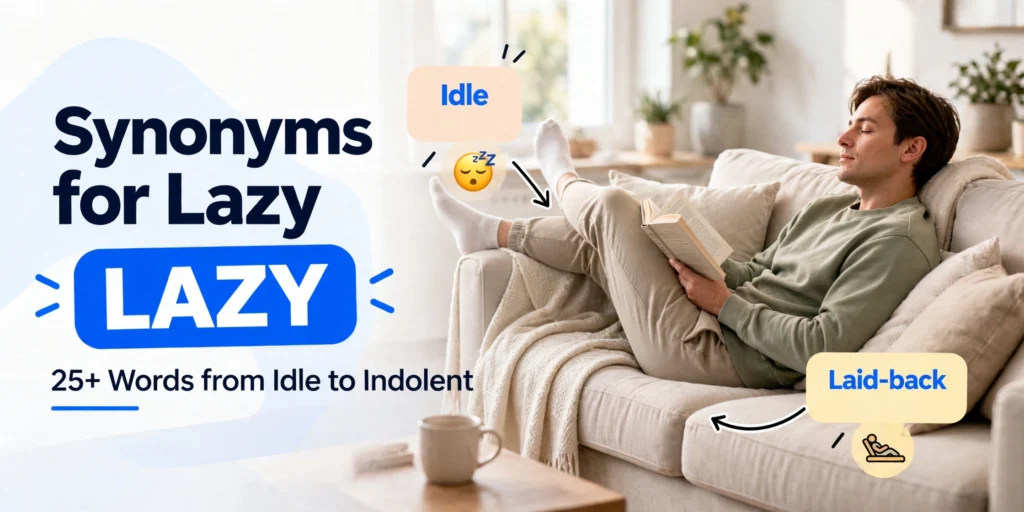
Synonyms for Lazy: 25+ Words from Idle to Indolent
“Lazy” is one of those words we reach for without thinking. A colleague misses a deadline, a teenager leaves the washing-up in the sink, or we spend a whole Sunday on the sofa — and “lazy” is the label that springs to mind. It is short, familiar and easy to understand, which is exactly why it appears so often in everyday speech and writing.
The trouble is that “lazy” is a blunt instrument. It suggests that someone is unwilling to work or use effort, and it carries a judgement with it: not just that a task went undone, but that the person chose not to do it. Sometimes that is what we mean. Often, though, we mean something softer, more specific or simply more accurate — that someone is tired, slow to get going, relaxed, unmotivated or temporarily inactive.
That is where synonyms earn their keep. English has a rich stock of words for low energy and inactivity, from the gentle “idle” and “unhurried” to the formal “indolent” and “slothful”. This guide explains more than 25 of them, with their shades of meaning, example sentences and advice on which word fits which situation.
Quick Answer
The best synonyms for lazy include idle, sluggish, lethargic, indolent, unmotivated, lackadaisical and slothful. Use idle for someone temporarily doing nothing, sluggish or lethargic for slow, low-energy movement, and indolent or slothful for a more formal, critical tone. For a gentler option, try unmotivated or laid-back — but remember that lazy is a judgement, not a fact, so choose your word with care.
What Does “Lazy” Actually Mean?
At its simplest, “lazy” means unwilling to work or use effort. Dictionaries generally define it as an aversion to work, activity or exertion, and it is usually applied to people rather than things. We might call a student lazy for never revising, or describe ourselves as feeling lazy on a day when we avoid every chore on the list.
Yet the word is often doing more work than we realise. When we call someone lazy, we are usually making an assumption about their motives — that they could have acted but chose not to. That assumption may be wrong. The person might be exhausted, unwell, overwhelmed, bored or unsure where to start. A more precise synonym avoids that unfair leap and says what we actually observed.
The word also has a second, looser use. We talk about a “lazy afternoon”, a “lazy river” or a “lazy summer”, where nothing critical is meant at all — the word simply suggests slowness, ease and a lack of urgency. In that sense, many of its synonyms describe a mood or a pace rather than a character flaw, and choosing between them is a matter of tone as much as meaning.
Gentle and Neutral Synonyms for Lazy
When you want to describe inactivity without sounding critical, start with the gentler end of the scale. These words describe what someone is doing — or not doing — without accusing them of a character flaw.
Idle is the most useful neutral option. It simply means not working or not in use, with no judgement attached. A machine can be idle, a worker can be idle between jobs, and a person can sit idle for an afternoon. “The factory stood idle over the holiday weekend” and “She sat idle by the window, watching the rain” both sound matter-of-fact rather than disapproving.
Unhurried and leisurely describe a slow, relaxed pace, and both carry a pleasant tone. A leisurely breakfast or an unhurried walk suggests someone enjoying their time rather than avoiding work. Similarly, laid-back describes a relaxed, easy-going attitude: “He has a laid-back approach to weekends, with no plans and no rush.”
Other gentle options include:
- Inactive — not doing anything at the moment: “After his injury, he was inactive for six weeks.”
- At leisure — free from work, with time to spare: “She spent the morning at leisure, reading in the garden.”
- Unoccupied — with nothing to do right now: “He found himself unoccupied for the first time in years.”
- Resting — taking a break, often deserved: “After a long week, she spent Sunday resting.”
These words are ideal when you want to be fair. Saying someone is idle or at leisure states a fact; saying they are lazy states an opinion. If you are writing about yourself, they are kinder too — “I had an idle afternoon” sounds like a choice well made, while “I was lazy all afternoon” sounds like a confession.
Formal and Stronger Synonyms for Lazy
Formal writing calls for more precise and often more forceful words. These synonyms suit essays, reports and literature, where “lazy” can sound too casual or too vague.
Indolent is the classic formal synonym. It means avoiding work through a love of ease, and it has a literary, slightly old-fashioned flavour. “The indolent aristocrat spent his days in idle pleasure” sounds like a sentence from a nineteenth-century novel — and that is exactly the register in which indolent still thrives.
Slothful is stronger still, and it carries a moral weight: sloth is one of the seven deadly sins, so the word implies a serious failing rather than a passing mood. Use it sparingly, and expect it to sound severe. “Slothful” suits deliberate criticism, not casual description.
Lethargic and sluggish describe low energy rather than unwillingness, which makes them useful when the cause is physical. A lethargic person feels drowsy and heavy, often because of illness, heat or exhaustion — much like the feeling described in our guide to synonyms for tired. Sluggish can describe people, but it also describes things: a sluggish economy, a sluggish computer, a sluggish start to the day.
Two more formal options round out the list:
- Languid — slow and relaxed, often with a dreamy quality: “She moved with languid grace through the warm afternoon.”
- Torpid — mentally or physically inactive, almost numb: “The heat left the whole town torpid by midday.”
These words are precise but they are not interchangeable. Indolent and slothful judge a person’s character; lethargic and sluggish describe their energy; languid and torpid describe a mood or a state. Pick the one that matches what you actually mean.
Casual and Everyday Ways to Say Lazy
In conversation and informal writing, nobody says “indolent”. We reach for phrases that sound like real speech — and English has plenty of them.
Can’t be bothered is the most common British way to express laziness, and it is wonderfully honest: “I can’t be bothered to cook tonight — let’s order in.” It describes a specific moment rather than a permanent trait, which is why it sounds less judgemental than “lazy”. Unmotivated works in a similar way, and it is the kinder choice when talking about work or study: “He felt unmotivated after months without a promotion.”
Lackadaisical describes someone who is carelessly lazy, showing little enthusiasm or effort. It is a lovely word, slightly formal in origin but common in everyday use: “Her lackadaisical attitude towards revision worried her teacher.” Its meaning is close to lazy, but it emphasises a lack of care and energy rather than a refusal to work.
Other everyday options include:
- Bone idle — a blunt British idiom for extremely lazy: “He’s bone idle — he hasn’t lifted a finger all week.”
- Work-shy — reluctant to work, often used critically: “The report described a work-shy attitude among some staff.”
- Slow off the mark — slow to start or react: “The team was slow off the mark after the break.”
- Couch potato — a humorous noun for someone who spends hours sitting and watching television: “After a long week, he happily became a couch potato.”
Notice how different these feel. “Can’t be bothered” is sympathetic, “bone idle” is insulting, and “couch potato” is affectionate teasing. The right casual synonym depends as much on your relationship with the person as on the meaning.
How to Choose the Right Synonym
The best synonym depends on three things: what you observed, how formal the setting is, and how kind you want to be. A quick way to decide is to ask yourself which of these you mean.
- Temporarily doing nothing: idle, inactive, at leisure, resting.
- Slow or low in energy: sluggish, lethargic, languid, torpid.
- Relaxed and unbothered: laid-back, unhurried, leisurely.
- Lacking motivation: unmotivated, lackadaisical, can’t be bothered.
- Formally critical: indolent, slothful, work-shy.
Register matters too. In an essay or a formal report, “indolent” or “lethargic” will look at home; in a text to a friend, they will sound stiff and strange. Conversely, “can’t be bothered” is perfect in conversation but has no place in an academic paper.
Finally, remember that most of these words are judgements. Calling someone lazy — or indolent, or work-shy — says something about their character, and it can sting. If you are writing about a real person, consider describing the behaviour instead: “He hasn’t started the report yet” is fairer and more accurate than “He’s too lazy to start the report.” The gentler synonyms in this guide exist precisely for that reason, and using them well is a mark of a thoughtful writer. As with the words for low mood in our guide to synonyms for sad, a little precision goes a long way.
Common Mistakes
Many of these synonyms look interchangeable, but swapping them carelessly changes the meaning. Here are the mix-ups to avoid.
- Wrong: “She was too lazy to get out of bed with flu.” Right: “She was too lethargic to get out of bed with flu.” Lethargic describes illness and low energy; lazy suggests unwillingness, which is unfair when someone is unwell.
- Wrong: “The lazy machine sat in the corner of the factory.” Right: “The idle machine sat in the corner of the factory.” Machines cannot be lazy — idle simply means not in use.
- Wrong: “His lazy attitude makes him great fun at parties.” Right: “His laid-back attitude makes him great fun at parties.” Laid-back means relaxed and easy-going, which is a compliment; lazy is almost never one.
- Wrong: “The lazy economy grew by only 0.1% last quarter.” Right: “The sluggish economy grew by only 0.1% last quarter.” Sluggish describes slow movement in systems and economies; lazy describes a person’s attitude to work.
- Wrong: “She is lazy because she hates her job.” Right: “She is unmotivated because she hates her job.” Unmotivated explains the cause — a lack of motivation — while lazy blames her character for it.
Frequently Asked Questions
What is the best synonym for lazy?
There is no single best synonym, because it depends on what you mean. Idle is the best all-round replacement for a temporary state, unmotivated is the kindest choice for a person, and indolent is the best option in formal writing. If you mean slow and low in energy rather than unwilling, try sluggish or lethargic instead.
What is a polite way to say someone is lazy?
Describe the behaviour rather than judging the person. Try “unmotivated”, “laid-back”, “idle at the moment” or “slow to get going” — all of these are softer than lazy. You can also reframe the sentence entirely: “He hasn’t found his rhythm yet” or “She is taking things at her own pace” says much the same thing without the sting.
Is “indolent” the same as “lazy”?
Almost, but not quite. Indolent means avoiding work through a love of ease, and it is more formal and more literary than lazy. It also sounds more deliberate, as if the person has chosen comfort over effort. In most everyday contexts, “lazy” is the natural word; save indolent for formal writing or when you want a deliberately old-fashioned tone.
What is the opposite of lazy?
The most direct opposite is industrious, meaning hard-working and diligent. Other good antonyms include energetic, active, motivated, diligent and hard-working. For a lighter mood, the contrast might simply be “full of beans” — as cheerful and energetic as the words in our guide to synonyms for funny are light-hearted.
Related reading: if you enjoyed this guide, explore our synonyms for tired and synonyms for kind for more precise, everyday alternatives.

Join the conversation