Synonyms for Busy: 25+ Words to Describe a Packed Day
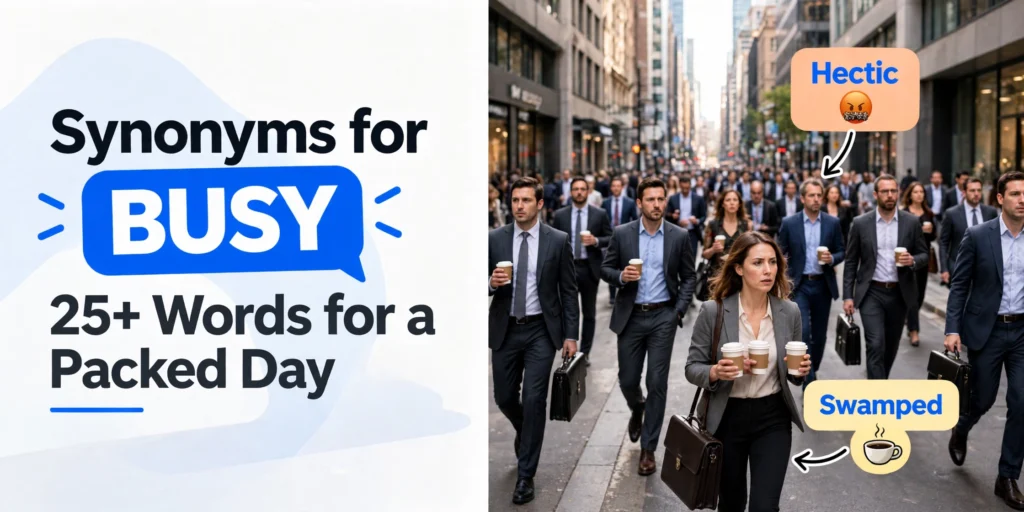
Busy is one of the most overused words in English. We say we are busy at work, that our weekends are busy, that the high street is busy, and that our phones never stop buzzing. The word does a lot of heavy lifting, but because it covers so many different situations, it often tells the reader very little. A busy day at the office is not the same as a busy market square, and a busy person is not necessarily a hard-working one.
That is why it pays to know a good range of synonyms for busy. The right alternative adds precision, colour, and variety to your writing, whether you are drafting a work email, writing a story, or simply trying to sound less repetitive. In this guide, you will find more than 25 synonyms for busy, grouped by meaning, with example sentences and clear guidance on when each one fits best.
Quick Answer
The best synonym for busy depends on what you mean. Use hectic, swamped, or overloaded for a packed schedule; bustling, crowded, or buzzing for a lively place; and industrious, hard-working, or engaged for someone working diligently. Choose the word that matches the situation, not just any word that means roughly the same thing.
What Does “Busy” Really Mean?
Before reaching for a synonym, it helps to pin down what busy actually means in your sentence. At its simplest, busy describes someone who has a lot to do, or a time or place filled with activity. But the word shifts its meaning depending on the context. A busy schedule is full of appointments; a busy street is full of people and traffic; a busy person might be overwhelmed, or simply productive and focused.
This flexibility is exactly why busy can feel vague. When you write “I had a busy day,” your reader does not know whether you were rushed off your feet, calmly productive, or quietly drowning in emails. A more precise word removes that guesswork. Swamped suggests you had too much to handle; industrious suggests you worked steadily and well; bustling suggests energy and movement rather than stress. Each synonym carries its own shade of meaning, and choosing well is what separates clear writing from lazy writing.
It also matters whether you are describing a person, a place, or a period of time. Some synonyms work for all three, but many do not. You can describe a market as bustling, but you would not usually call a person bustling. Likewise, a person can be engaged, but a Tuesday afternoon cannot. The sections below group synonyms by the situation they suit, so you can find the right word quickly.
Synonyms for Busy When Your Schedule Is Packed
When your diary is full and your to-do list keeps growing, these synonyms capture the feeling of having too much to do and too little time:
- Hectic — full of frantic, rushed activity. “It has been a hectic week, with back-to-back meetings every day.”
- Swamped — overwhelmed with work, as if buried under it. “She was swamped with emails after her holiday.”
- Overloaded — carrying more work than you can reasonably manage. “The team felt overloaded during the Christmas rush.”
- Snowed under — buried in tasks, usually temporarily. “I am snowed under with marking this term.”
- Jammed-packed / jam-packed — a schedule with no gaps at all. “His diary is jam-packed until Friday.”
- Full-on — intense and non-stop, common in informal British English. “It was a full-on day from start to finish.”
- Manic — wildly busy, often with a sense of chaos. “The office was manic on the morning of the launch.”
- Non-stop — without a break. “She worked non-stop from nine until six.”
These words work best when you want to convey pressure or urgency. Hectic and manic suggest a loss of calm, while swamped and snowed under suggest volume rather than speed. If you want to sound professional rather than frazzled, overloaded is a safer choice than manic in a work email. For more ways to sharpen your word choice, see our guide to synonyms for smart, which follows the same principle of matching the word to the meaning.
Synonyms for Busy When a Place Is Full of Life
When you are describing a place rather than a person, busy usually means crowded, lively, or full of movement. These alternatives are more vivid:
- Bustling — full of energetic, purposeful activity. “The market was bustling with shoppers on Saturday morning.”
- Crowded — filled with people, sometimes uncomfortably so. “The train was crowded, and every seat was taken.”
- Buzzing — lively and full of excitement. “The pub was buzzing after the match.”
- Teeming — swarming with people or activity. “The streets were teeming with festival-goers.”
- Humming — quietly active and thriving. “The café was humming with conversation.”
- Thriving — busy in a healthy, successful way. “The little bookshop is thriving despite the competition.”
- Packed — completely full. “The beach was packed on the hottest day of the year.”
Notice how the tone changes with each word. Bustling and buzzing are positive, suggesting energy and enjoyment. Crowded and packed are neutral or slightly negative, hinting that there might be too many people. Teeming is dramatic and works well in descriptive writing, while thriving suits a business or a community that is doing well. Choosing between them is a matter of deciding whether the crowd is a good thing or a problem. If you enjoy building a richer vocabulary, our list of synonyms for funny shows how the same approach works for another everyday word.
Synonyms for Busy When You Mean Hard-Working
Sometimes busy is a compliment in disguise. When you call someone busy, you might really mean that they work hard, stay focused, and get things done. These synonyms make that meaning clear:
- Industrious — working hard and steadily. “She is an industrious student who never misses a deadline.”
- Hard-working — putting in sustained effort. “The team is hard-working and reliable.”
- Diligent — careful, steady, and persistent. “His diligent preparation paid off in the exam.”
- Engaged — actively involved in a task. “The children were fully engaged in the project all afternoon.”
- Occupied — currently involved in something. “He is occupied with the accounts at the moment.”
- Productive — achieving a lot in the time available. “It was a productive morning; I cleared my whole inbox.”
- Assiduous — showing constant, careful attention to work. “Her assiduous research impressed the whole department.”
Industrious, diligent, and assiduous are more formal and suit written English, references, and academic contexts. Hard-working and productive are natural in everyday speech and work emails. Occupied is useful when you want to be polite: saying “she is occupied” sounds gentler than “she is busy” when explaining why someone cannot take a call. For positive words with a similar uplifting feel, see our guide to synonyms for amazing.
Choosing the Right Synonym for the Situation
With so many options, how do you pick? Start by asking yourself three questions. First, who or what is busy — a person, a place, or a period of time? Second, is the busyness positive, negative, or neutral? Third, how formal is the setting?
For a formal email, occupied, engaged, and overloaded are safe and professional. In a story or a blog post, bustling, teeming, and hectic add colour and atmosphere. In casual conversation, swamped, snowed under, and full-on sound natural and honest. The same day could be described as hectic by someone who felt stressed, productive by someone who felt satisfied, or jam-packed by someone who simply had no free time. The word you choose tells the reader how you felt about it, not just what happened.
A useful habit is to replace busy with a more specific word whenever you catch yourself using it twice in the same piece of writing. Variety keeps readers engaged, and precision makes your meaning clearer. If you are unsure whether a synonym fits, try it in a sentence and read it aloud. If it sounds natural, it probably is. If it sounds stiff or odd, try another from the same group. Like our guide to synonyms for strong, this is a skill that improves quickly with practice.
Common Mistakes
Even good writers slip up with synonyms for busy. Here are the most common mistakes, with corrections:
- Wrong: “The library was industrious today.” Right: “The library was bustling today.” — Industrious describes people, not places.
- Wrong: “I am very busy, so the shop was crowded.” Right: “I am very busy, so the shop was bustling.” — Mixing two ideas in one sentence confuses the reader; keep each description separate.
- Wrong: “He is a hectic worker.” Right: “He is a hard-working employee.” — Hectic describes a schedule or a period of time, not a person’s character.
- Wrong: “She was swamped with happiness.” Right: “She was overwhelmed with happiness.” — Swamped refers to work or tasks, not emotions.
- Wrong: “The meeting was busy.” Right: “The meeting was packed.” — A meeting cannot be busy; use packed, full, or hectic instead, depending on what you mean.
The pattern behind these mistakes is simple: synonyms for busy are not interchangeable. Each one belongs to a particular subject — a person, a place, or a time — and to a particular tone. Check the subject of your sentence before you swap the word in, and you will avoid most errors.
Frequently Asked Questions
What is the best synonym for busy at work?
It depends on what you want to say. Occupied and engaged are polite and professional for emails, while swamped and overloaded are honest when you have too much on. If you want to sound positive, productive or industrious works better than busy.
What is a formal synonym for busy?
Occupied, engaged, and industrious are the most formal options. Diligent and assiduous also suit formal and academic writing. Avoid slang such as snowed under or full-on in formal documents.
What is the opposite of busy?
The most common opposites are free, idle, quiet, and unoccupied. A free afternoon has no plans, an idle worker has nothing to do, and a quiet café has few customers. The right opposite depends on the same context as the synonym.
Can I use “hectic” to describe a person?
Not usually. Hectic describes a time, a schedule, or an atmosphere, such as a hectic week or a hectic morning. To describe a person, use busy, hard-working, or industrious instead. Saying “she had a hectic day” is correct; saying “she is hectic” sounds odd.
For more word-choice guides that make your writing sharper, explore our synonyms for great and our other vocabulary articles on grammarfix.co.uk.


Join the conversation