50 Ways to Say Sorry: Formal and Casual Alternatives
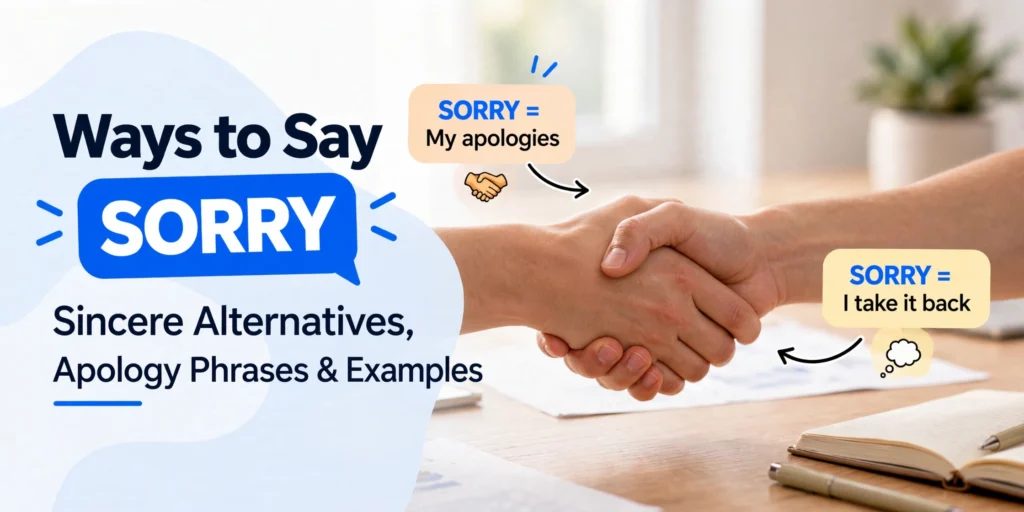
Sorry is one of the most powerful words in English, but repeating it endlessly can make even the most sincere apology sound flat. Whether you have missed a deadline, forgotten a birthday, or accidentally bumped into someone on the Tube, the phrase you reach for matters. A thoughtfully chosen apology shows that you understand what went wrong, while a careless one can make the situation worse.
The good news is that English offers a rich vocabulary of ways to say sorry, ranging from short and casual to deeply formal. Some phrases acknowledge blame directly, others express regret, and a few are best reserved for the most serious occasions. The trick is matching the right words to the right moment.
In this guide, you will find dozens of practical alternatives to “I’m sorry”, grouped by situation and formality. Each one comes with an example sentence, so you can see exactly how it works in real conversation. By the end, you will never be stuck repeating the same tired apology again.
Quick Answer
Ways to say sorry include casual options like “my bad”, “I owe you an apology”, and “I didn’t mean that”; formal phrases such as “please accept my sincerest apologies”, “I take full responsibility”, and “I sincerely regret”; and written forms like “I apologise for the inconvenience”. Choose a phrase that matches the seriousness of the mistake and say it once, clearly and sincerely.
Casual Ways to Say Sorry
For small, everyday mistakes — a missed text, a bumped elbow, a minor mix-up — a light apology is usually enough. Overdoing it can feel strange, so keep these short and natural.
- My bad. Very informal and best for trivial slip-ups. Example: “Oh, that’s my coffee — my bad.”
- Oops, sorry about that. A friendly, throwaway apology. Example: “Oops, sorry about that — I didn’t see you there.”
- I didn’t mean that. Useful when your words came out wrong. Example: “That sounded harsh — I didn’t mean it like that.”
- My mistake. Slightly more grown-up than “my bad”, still casual. Example: “I booked the wrong day — my mistake.”
- I owe you one. For when you want to make it up to someone. Example: “Thanks for covering for me — I owe you one.”
- Sorry, didn’t catch that. Polite and practical when you misheard. Example: “Sorry, didn’t catch that — could you repeat it?”
- No harm done, I hope? Said after a tiny mishap, checking nothing is wrong. Example: “I took the wrong umbrella — no harm done, I hope?”
- Pardon me. A classic British option for small accidents. Example: “Pardon me — I didn’t realise you were behind me.”
- Sorry to keep you waiting. For minor lateness. Example: “Sorry to keep you waiting — the bus was late.”
- I take it back. For withdrawing a comment. Example: “That was unfair — I take it back.”
Formal Ways to Say Sorry
Serious situations call for serious language. If the mistake had real consequences — a damaged relationship, a lost opportunity, a significant error at work — these phrases carry the weight the moment deserves.
- Please accept my sincerest apologies. The classic formal apology, ideal for letters and emails. Example: “Please accept my sincerest apologies for the error in your invoice.”
- I take full responsibility. Shows ownership without hiding behind excuses. Example: “The delay was caused by my team, and I take full responsibility.”
- I sincerely regret… Expresses genuine remorse in formal contexts. Example: “I sincerely regret any confusion this may have caused.”
- I apologise for the inconvenience. A standard professional phrase, common in customer service. Example: “I apologise for the inconvenience and assure you it will not happen again.”
- There is no excuse for my behaviour, and I am deeply sorry. For personal apologies that need to sound genuinely heartfelt. Example: “There is no excuse for my behaviour last night, and I am deeply sorry.”
- I hope you can forgive me. A humble, old-fashioned-sounding request. Example: “I let you down, and I hope you can forgive me.”
- I am truly sorry for the hurt I have caused. Direct and emotional, for when someone has really been hurt. Example: “I am truly sorry for the hurt I have caused you.”
Ways to Say Sorry at Work
Professional apologies need to be clear, accountable, and forward-looking. Managers and colleagues respect an apology that acknowledges the problem and explains what will change. Notice how similar skills to choosing the right words for any situation — just as you might pick from our list of ways to say no — matter here too.
- That was my oversight — here is how I will fix it. Pairs accountability with action. Example: “That was my oversight — I have already corrected the figures.”
- Thank you for flagging this; I will put it right. Gracious and solution-focused. Example: “Thank you for flagging this; I will have the revised report to you by noon.”
- I appreciate your patience while I sort this out. Good when the fix takes time. Example: “I appreciate your patience while I sort this out with IT.”
- You were right, and I should have listened. Powerful after dismissing a colleague’s warning. Example: “You were right about the deadline, and I should have listened.”
- Let me make this right. Short, professional, action-oriented. Example: “The order was wrong — let me make this right.”
Written Ways to Say Sorry
In emails, messages, and cards, you lose tone of voice and body language, so your wording has to do all the work. Be specific about what you are apologising for, and keep the message focused on the other person rather than on your own feelings. If you are looking for broader vocabulary upgrades, our guide to an other word for things shows how small word choices change the feel of a sentence.
- I owe you an apology. A strong opener for a written message. Example: “I owe you an apology — I was wrong to cancel at the last minute.”
- Reading your message made me realise I was out of line. Shows you have reflected. Example: “Reading your message made me realise I was out of line.”
- I wanted to write and say how sorry I am. Formal and considered. Example: “I wanted to write and say how sorry I am for missing your graduation.”
- This falls short of the standard you deserved. Professional and dignified. Example: “This falls short of the standard you deserved, and I apologise.”
- I will not let this happen again. Ends an apology with a commitment. Example: “You deserved better communication, and I will not let this happen again.”
- Thank you for understanding. A gentle closer for an apology message. Example: “I am sorry for the short notice — thank you for understanding.”
Common Mistakes
Saying sorry is only half the battle — saying it badly can do more harm than good. Here are the most common apology mistakes to avoid.
- Wrong: “Sorry, but you started it.” → Right: “I am sorry for my part in the argument.” (Never pair an apology with blame; it cancels the apology out.)
- Wrong: “I’m sorry if you were offended.” → Right: “I am sorry that I offended you.” (“If” shifts responsibility onto the other person’s feelings. Own the action.)
- Wrong: “Sorry.” (said flatly, without eye contact) → Right: “I am really sorry — that was unfair of me.” (A one-word apology sounds dismissive. Add specifics and sincerity.)
- Wrong: “I apologise for whatever I did.” → Right: “I apologise for forgetting your birthday.” (Vague apologies show you have not thought about what went wrong. Name it.)
- Wrong: “Sorry not sorry.” → Right: Skip it entirely when you genuinely need to apologise. (The sarcastic phrase is fine as a joke between friends, but never as a real apology — it tells the other person you do not care.)
Frequently Asked Questions
What is the most sincere way to say sorry?
The most sincere apology names what you did wrong, takes responsibility without excuses, and says what you will do differently. “I am sorry I shouted at you — you did not deserve that, and I will think before I speak next time” is far more powerful than any single polished phrase.
Is “my apologies” the same as “I’m sorry”?
They are close, but not identical. “I’m sorry” expresses personal regret and emotion, while “my apologies” is slightly more detached and formal — common in business settings. For a personal apology, “I’m sorry” usually feels warmer; for a professional one, “my apologies” works well.
How do you say sorry without saying “sorry”?
Try “I was wrong”, “I take full responsibility”, “I owe you an apology”, or “I regret what I did”. These all convey remorse without using the word itself, and they can sound more thoughtful because they describe the situation rather than repeating a formula. For agreement phrases in similar situations, see our list of ways to say yes.
Should you apologise more than once for the same mistake?
Usually, one sincere apology is enough. Repeating it can make the other person feel pressured to comfort you instead of processing their own feelings. Apologise once, clearly, then give them space — and let your changed behaviour do the rest of the talking.
Mastering the art of the apology takes practice, but it pays off in every part of life — friendships, relationships, and careers all run more smoothly when people know how to own their mistakes gracefully. Next time the words stick in your throat, pick one of the phrases above, mean it, and move forward.

Comments (1)