Ways to Say Sorry for Your Loss: Kind, Simple Words for a Difficult Time
Losing someone is one of the hardest experiences a person can go through, and finding the right words in that moment can feel just as hard. Many of us worry about saying the wrong thing, sounding awkward, or making someone’s grief worse. The truth is, a few sincere, simple words are usually far more comforting than a long, polished speech.
Saying “sorry for your loss” is not about fixing anything. Nobody can take the pain away with a sentence. It is about showing that you care, that you are thinking of the person, and that they are not alone. In this guide, you will find gentle, respectful ways to express sympathy in a card, in a message, in person, and at work, as well as phrases to avoid.
Quick Answer
To say sorry for someone’s loss, keep it short, warm, and sincere. A simple message such as “I’m so sorry for your loss. I’m thinking of you and your family, and I’m here if you need anything” is almost always enough. Avoid explanations, advice, or comparisons, and follow up again in the weeks that follow, when support is often needed most.
What to Say in a Sympathy Card
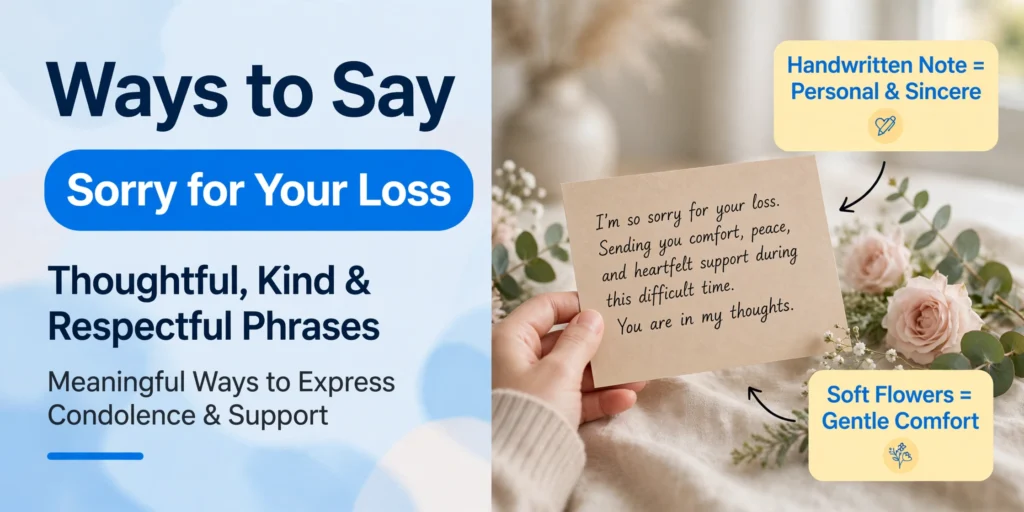
A sympathy card gives you time to choose your words carefully, and the person receiving it can read it again whenever they need comfort. Keep the message personal, but do not feel you have to write a great deal. A short, heartfelt note is often the most treasured kind.
You might begin with a simple opening, then add one personal detail if you knew the person who died. For example: “I was so sorry to hear about your mum. She was always so kind, and I will miss her warm welcome.” If you did not know them well, it is perfectly fine to keep it general: “I’m thinking of you at this very sad time, and sending you all my love.”
If you are looking for a broader range of sympathetic wording, these ways to say sorry can help you find a tone that feels natural to you. Whatever you choose, write it by hand if you can, sign your name clearly, and avoid crossing out or correcting too much — a card that feels genuine matters more than one that looks perfect.
- “I’m so sorry for your loss. Please know I’m thinking of you.”
- “Words feel inadequate, but I wanted you to know how much I care.”
- “Your dad meant a great deal to so many people, and he will be deeply missed.”
- “With deepest sympathy to you and your family at this difficult time.”
- “I’m here for you, now and in the months ahead.”
What to Say in a Message or Text
When you hear the news quickly, a short message or text is a kind and appropriate first step. The bereaved person may be overwhelmed with calls and arrangements, so do not expect an immediate reply, and do not worry if your message is brief.
Start with sympathy, then offer something specific rather than a vague “let me know if you need anything”. Practical help is often the most welcome kind. You could say: “I’m so sorry — I’ve just heard about your loss and I’m thinking of you. I can drop off a meal on Thursday, or help with the shopping, if that would help.”
Keep the tone calm and respectful, and avoid sending a long message full of questions. One or two sentences, sent promptly, show that you care without adding to the person’s burden. If you are sending condolences on behalf of a group, make that clear: “Everyone at the office is thinking of you, and we’re so sorry for your loss.”
- “I’m so sorry for your loss. I’m here for you whenever you’re ready to talk.”
- “Thinking of you and your family today. No need to reply — just wanted you to know I care.”
- “I’m very sorry to hear your sad news. Please accept my deepest condolences.”
- “I was so sorry to hear about your loss. I’m keeping you in my thoughts.”
What to Say in Person
Speaking to someone face to face after a bereavement can feel daunting, but your presence alone is often a comfort. You do not need to find the perfect words. A gentle greeting, a hug if it is welcome, and a simple expression of sympathy are enough.
Try something like: “I’m so sorry. I was very sad to hear about your loss.” Then listen. Let the person talk about their loved one if they wish, or sit quietly with them if they do not. Using the name of the person who died can be deeply comforting, because it shows they are remembered as a real person, not just a loss.
Avoid filling every silence. Grief is not a conversation that needs to be kept going. If you are unsure what to say, it is honest and kind to say so: “I don’t quite know what to say, but I’m here, and I’m so sorry you’re going through this.” That sincerity means far more than a rehearsed phrase.
What to Say at Work
At work, condolences need to be respectful, professional, and sensitive to privacy. A short card signed by colleagues, or a brief, private message from a manager, is usually the most appropriate approach. Avoid discussing details of the death with the wider team unless the bereaved person has shared them.
A suitable message might be: “On behalf of the whole team, I’m so sorry for your loss. Please take all the time you need, and let us know how we can support you on your return.” If you are a colleague rather than a manager, keep it personal and simple: “I’m really sorry to hear your news. I’m thinking of you, and I’m here if you need anything at work.”
When the person returns to work, a quiet welcome back is better than a big fuss. A simple “It’s good to see you — no need to talk about anything unless you’d like to” respects their boundaries while making it clear they are supported. Continued kindness in the weeks after the funeral matters just as much as the first message.
Common Mistakes
Most hurtful comments after a bereavement are not meant unkindly, but they can still sting. Here are common phrases to avoid, and gentler alternatives.
- Wrong: “They’re in a better place.” Right: “I’m so sorry. They will be greatly missed.”
- Wrong: “I know exactly how you feel.” Right: “I can’t imagine how hard this is, but I’m here for you.”
- Wrong: “At least they lived a long life.” Right: “What a wonderful life they lived — and how loved they were.”
- Wrong: “You need to stay strong.” Right: “Take all the time you need. There’s no right way to grieve.”
- Wrong: “Let me know if you need anything.” Right: “I’d like to bring round dinner on Friday — would that help?”
As a general rule, avoid giving advice, minimising the loss, comparing it with your own experience, or suggesting the person should be “over it” by a certain time. Grief has no timetable, and patience is one of the kindest things you can offer.
Frequently Asked Questions
Is it OK to just say “sorry for your loss”?
Yes, absolutely. It is a widely understood and respectful expression of sympathy. You do not need to add anything elaborate. If you want to say a little more, adding “I’m thinking of you” or “I’m here if you need anything” makes it feel warmer and more personal.
What should I write if I didn’t know the person who died?
Keep your message focused on the bereaved person. For example: “I’m so sorry for your loss. I’m thinking of you and your family at this sad time.” You do not need to pretend you knew them well, and a sincere, general message is always welcome.
How long after the death is it still appropriate to send condolences?
There is no strict deadline. A message sent a few weeks or even months later can be especially meaningful, because support often fades after the funeral. Saying “I’ve been thinking of you and wanted to check in” is a kind way to reach out later on. If you are looking for other gentle phrases for remembering someone, these beautiful ways to say rest in peace may also help.
What if I say the wrong thing?
Do not panic, and do not let fear stop you from reaching out altogether. A clumsy but sincere message is far better than silence. If you realise something you said was unhelpful, a simple apology — “I’m sorry, I didn’t express that very well. I just wanted you to know I care” — goes a long way.
For more gentle wording for difficult moments, you may also find these ways to say I miss you helpful when you want to tell someone they remain in your thoughts.


Join the conversation