25 Better Ways to Say ‘In Conclusion’ (Essay Closers)
Quick Answer
The best swaps for “in conclusion” are Ultimately (neutral), In summary (neutral), To summarize (neutral), All things considered (formal), and In the final analysis (formal). Match the closer to your essay’s tone — formal essays suit the last two, while casual pieces can use “To wrap up” or “All in all.”
If you have typed “in conclusion” at the start of one too many final paragraphs, you are not alone. It is the default closer for essays, reports, and speeches — and precisely because it is so common, it can make your ending feel flat and predictable. The good news is that English offers dozens of stronger ways to signal that you are wrapping up. Just as varying your dialogue tags (see these 40+ words to use instead of “said”) keeps fiction lively, varying your closers keeps essays crisp. Below you will find 25 alternatives ranked by tone, five full example closing sentences, the phrases to avoid, and answers to the most common questions.
25 Better Ways to Say “In Conclusion” (Ranked by Tone)
We have ranked these alternatives from the most formal to the most casual. Each one carries a tone label so you can match your closer to your audience: use formal closers in academic essays and reports, neutral ones in most essays and articles, and casual ones in blogs, speeches, and personal writing.
Formal closers (academic essays, dissertations, reports)
- In the final analysis — formal. Signals a carefully weighed judgment after presenting your evidence.
- All things considered — formal. Suggests you have balanced competing points before reaching a decision.
- In light of the evidence — formal. Anchors your conclusion directly in your findings and research.
- Taking everything into account — formal. Broad and measured; ideal for balanced, two-sided arguments.
- In summation — formal. A crisp, traditional closer that carries real weight in academic writing.
- It can be concluded that — formal. Impersonal and academic; keeps the focus on the argument rather than on you.
- The evidence suggests that — formal. Hedges just enough for cautious claims when your data is suggestive rather than decisive.
- Hence — formal. Short, sharp, and logical; works best at the end of analytical or philosophical writing.
Neutral closers (most essays, articles, business writing)
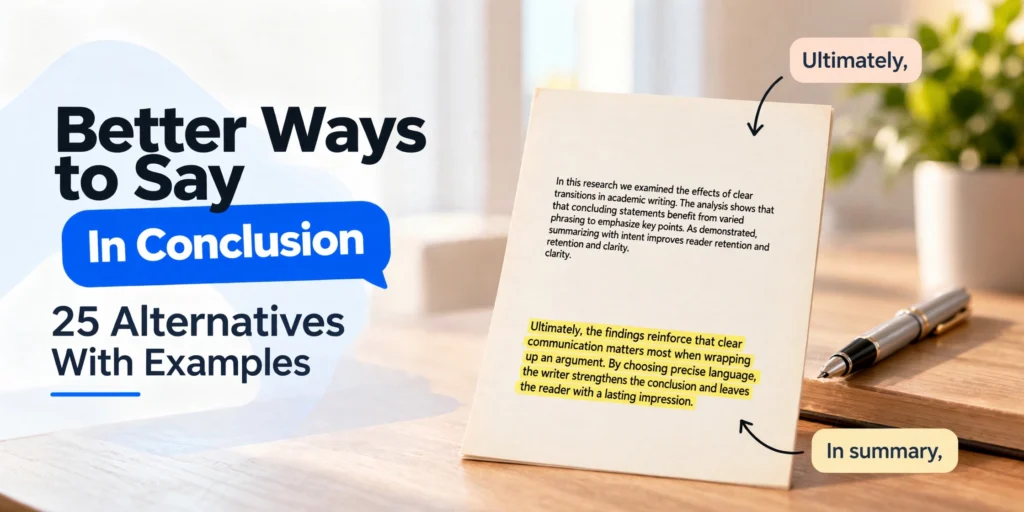
- Ultimately — neutral. The single most versatile replacement; it fits almost any essay and never sounds out of place.
- In summary — neutral. Direct and clear; it tells the reader a quick recap is coming.
- To summarize — neutral. Slightly more active than “in summary”; a safe default for school and university essays.
- In essence — neutral. Distills your argument down to its core idea in one elegant move.
- Overall — neutral. Simple and natural; works especially well in evaluations, reviews, and reports.
- In short — neutral. Brief and confident; signals that your point needs no further explanation.
- To sum up — neutral. Conversational but still acceptable in most essays and presentations.
- In closing — neutral. A polite, speech-like way to signal the end; popular in talks and lectures.
- As a result — neutral. Emphasizes cause and effect; great when your essay builds a chain of reasoning.
- Therefore — neutral. Logical and precise; pairs well with argumentative and persuasive essays.
Casual closers (blogs, speeches, personal writing)
- To wrap up — casual. Friendly and modern; a natural fit for blog posts and newsletters.
- All in all — casual. Relaxed and warm; best for personal reflections, reviews, and lifestyle writing.
- At the end of the day — casual. Conversational and idiomatic; use it sparingly in semi-formal writing.
- To put it simply — casual. Reframes your point in plain language, which readers always appreciate.
- In a nutshell — casual. Playful and compact; suits blogs, explainer pieces, and informal essays.
- Long story short — casual. A storytelling tone that works beautifully in personal essays and anecdotes.
- That is why — casual. A punchy closer that ties your final sentence directly back to your main point.
5 Full Example Closing Sentences
Seeing a closer inside a real sentence makes all the difference. Here are five you can adapt to your own essays:
- “Ultimately, the data shows that regular reading improves vocabulary more reliably than any single study technique.”
- “All things considered, the benefits of remote work outweigh the drawbacks for most knowledge workers.”
- “To summarize: plan your argument first, draft freely second, and edit ruthlessly last.”
- “In the final analysis, climate policy succeeds only when ambitious targets are paired with practical funding.”
- “At the end of the day, good writing is rewriting — and every draft you revise gets a little closer to the mark.”
Phrases to Avoid in Your Conclusion
A strong closer can be undone by what follows it. Steer clear of these common conclusion mistakes:
- “As I said before” / “As previously stated” — sounds defensive. Simply restate the point with fresh wording instead.
- “In my opinion, I think…” — redundant. Your whole essay already expresses your opinion; one of the two is enough.
- Apologizing (“sorry this was so long”) — never apologize for your own writing. End with confidence.
- Introducing new evidence — the conclusion summarizes your argument; it is not the place for brand-new points.
- Stacking closers (“in conclusion, in summary, ultimately…”) — pick one closer and commit to it.
- Ending on a quotation alone — a quote can support your ending, but your own final sentence should have the last word.
Frequently Asked Questions
Is “in conclusion” bad?
No — it is not wrong, just overused. Used once, it does its job perfectly well. The problem is habit: when every essay you write ends with the same phrase, your endings start to feel mechanical. Swapping in alternatives like “Ultimately” or “All things considered” keeps your reader engaged and shows stronger command of language.
What is the best closer for IELTS essays?
For IELTS Writing Task 2, neutral closers score best: “In summary,” “To summarize,” or “Ultimately” are all safe, natural choices that examiners expect. Avoid very casual options like “At the end of the day” or “Long story short,” which can drag down your lexical resource score, and avoid overly stiff phrases like “It can be concluded that” unless the rest of your essay matches that register.
Can I start a paragraph with “Ultimately”?
Yes. “Ultimately” works well at the start of a concluding paragraph, usually followed by a comma: “Ultimately, the evidence points to…” It also works mid-sentence. Because it is neutral in tone, it suits academic essays, business writing, and articles alike — which is exactly why it tops our list.
Related: 40+ Words to Use Instead of ‘Said’ (With Examples) — stop repeating “said” and try whispered, exclaimed, admitted, or argued instead.
Common Mistakes
Even writers who know the alternatives keep making the same five mistakes. Check your own essays for these before you submit:
1. Using “in conclusion” more than once
Wrong: “In conclusion, the first reason is cost. In conclusion, the second reason is time.”
Better: Use it once, at the start of your final paragraph only.
This phrase tells the reader the whole piece is ending, so repeating it is like shouting “the end” three times — it loses all meaning.
2. Dropping it into the middle of an essay
Wrong: “In conclusion, let us now turn to the causes of the problem.”
Better: “Turning now to the causes of the problem.”
Readers expect the essay to finish after “in conclusion”, so using it mid-essay leaves them confused when new points keep coming.
3. Mismatching the tone
Wrong: “It can be concluded that pizza is the greatest food ever invented.”
Better: “All in all, pizza is the greatest food ever invented.”
Stiff academic closers sound out of place in relaxed writing — match the phrase to your audience, not just to the sentence.
4. Swapping one habit for another
Wrong: Ending every single essay with “Ultimately,”.
Better: Rotate through two or three neutral options such as “Ultimately”, “In summary”, and “Overall”.
Replacing one overused phrase with another does not solve the repetition problem — variety is the whole point of learning alternatives.
5. Forgetting the comma
Wrong: “Ultimately the results were clear.”
Better: “Ultimately, the results were clear.”
When a closer opens your sentence, it is an introductory phrase and normally takes a comma — a small detail, but examiners do notice it.
Pro Tips
Once you have the alternatives, these five habits will make your endings genuinely stronger:
- Let the task choose your closer. IELTS essays favour neutral options like “In summary”. University essays can handle formal ones such as “In the final analysis”. Business emails rarely need a closer at all — “Overall,” or a plain summary sentence usually does the job better.
- Place it once, at the start of your final paragraph. A closer is a signpost, and signposts only work if they appear where the reader expects them — right at the beginning of the ending, never buried in the middle.
- You can close without any stock phrase. Restate your thesis in fresh words and answer “so what?”: “The evidence leaves little doubt that regular reading beats last-minute cramming.” No closer needed — the sentence itself signals the end.
- Put the weight on the sentence after the closer. “In summary” is just the doorway; your restated main point is the room. Make that sentence the clearest, strongest version of your argument, not a watered-down repeat.
- For speeches, prefer “In closing”. It sounds natural when spoken aloud to an audience, while “in conclusion” can feel stiff and written-down in a talk or presentation.
More Frequently Asked Questions
How many times can I use “in conclusion” in one essay?
Once — at the start of your final paragraph. If you catch yourself reaching for it a second time, that is usually a sign your essay is trying to end twice. Restructure so that everything after the first use genuinely wraps things up.
Should I put a comma after “Ultimately” or “In summary”?
Yes, when the phrase opens your sentence: “Ultimately, the data supports the theory.” No comma is needed when the word sits naturally mid-sentence: “The data ultimately supports the theory.”
Can I end my conclusion with a question?
Occasionally, in persuasive or blog writing, a rhetorical question can land well (“So what will you change first?”). In academic essays it is risky — examiners expect a firm final statement. When in doubt, end on your own conclusion, not a question mark.
Is “in conclusion” acceptable in a business email?
It is usually too heavy for an email. Try “Overall,” or skip the closer and state the outcome directly: “To confirm, we are going ahead with the March launch.” Save “in conclusion” for reports and formal documents.


Comments (8)