15 Other Ways to Say “For Example” (With Examples)
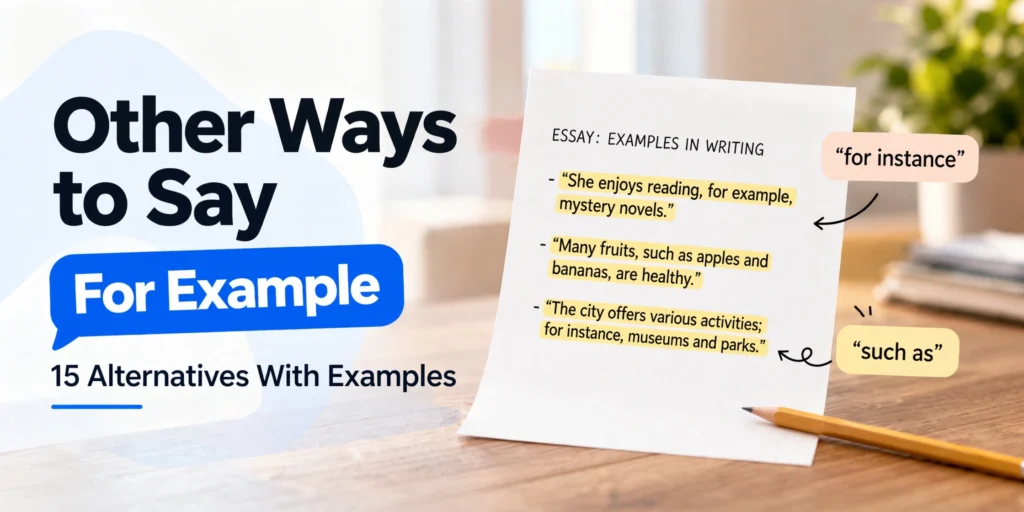
“For example” is one of the hardest-working phrases in English — and one of the most overused. Once you notice how often it appears in your own writing, it starts to feel like verbal wallpaper: present everywhere, interesting nowhere. Just as writers lean too heavily on “in conclusion” to close essays (see our guide to alternatives to “in conclusion”), they reach for “for example” every time an illustration is needed.
The good news is that English offers a rich shelf of substitutes, and choosing the right one is mostly a question of formality. A job application wants “for instance”; a message to a friend is fine with “say”. The wrong register — “e.g.” in a wedding speech, “picture this” in a dissertation — distracts the reader, while the right choice disappears neatly into the sentence.
Below are 15 alternatives grouped by formality, each with an example sentence so you can see it working in context. You will also find the essential e.g. vs i.e. distinction, punctuation rules, and the mistakes that catch even confident writers out.
Quick Answer
The best alternatives to “for example” depend on formality: use “for instance”, “such as” or “namely” in formal writing; “e.g.” or “like” in neutral contexts; and “say” or “take” in casual writing. Remember that “e.g.” introduces a partial list of examples, while “i.e.” means “that is” and restates something — the two are not interchangeable.
Formal Alternatives
- For instance — the closest like-for-like swap in formal writing; works at the start of a sentence or tucked inside one. Example: “Several firms have cut office space. For instance, two banks have gone fully remote.”
- Such as — introduces examples inside the sentence; no comma is needed when the examples are essential to the meaning. Example: “Renewable sources such as wind and solar now power a third of homes.”
- Namely — introduces a complete, specific list; use it when naming all the items, not just a sample. Example: “Two problems sank the project, namely the budget and the deadline.”
- Including — quietly folds examples into the sentence without breaking its rhythm. Example: “Many novelists, including Austen and Dickens, revised their manuscripts heavily.”
- As an illustration — a weighty, academic way to introduce a clarifying example. Example: “As an illustration, consider how quickly the rumour spread online.”
- To illustrate — similar, but slightly more active; it announces that an example is on its way. Example: “To illustrate, imagine a town where every car is electric.”
Neutral Alternatives
- E.g. — the compact Latin form, ideal for brackets and lists; mind the punctuation rules below. Example: “Bring waterproofs (e.g. a raincoat and boots) for the hike.”
- Like — the everyday workhorse; fine in speech and informal writing, but note the ambiguity warning in Common Mistakes. Example: “Cities like Paris and Rome live off tourism.”
- Case in point — introduces an example that proves the previous statement; slightly punchy. Example: “She says nobody reads instructions. Case in point: the returns desk is always busy.”
- As exemplified by — formal-leaning but at home in essays and reports. Example: “As exemplified by the 2020 lockdowns, remote work can succeed at scale.”
- In particular — singles out one example for special attention. Example: “He loves outdoor sports, in particular climbing and kayaking.”
Casual Alternatives
- Say — short for “let’s say”; perfect for conversation and informal writing. Example: “Pick a hobby, say gardening, and practise it for ten minutes a day.”
- Take — “take” plus a noun drops the reader straight into the example. Example: “Take my neighbour: she cycles to work every day, rain or shine.”
- Think of — invites the reader to picture the example themselves. Example: “Think of your favourite film — chances are you have seen it more than twice.”
- Picture this — the most dramatic option; use it sparingly, once per piece at most. Example: “Picture this: you wake up and the internet has vanished overnight.”
Choosing precise words is a habit that pays off everywhere in writing — from examples to dialogue tags.
E.g. vs I.e.: Meaning and Punctuation
These two abbreviations cause more confusion than any other pair on this page, so let’s settle them properly. E.g. stands for exempli gratia, Latin for “for example”: it introduces one or more examples taken from a longer, unstated list. I.e. stands for id est, Latin for “that is”: it restates or clarifies, and what follows is the whole thing, not a sample. A handy mnemonic: “e.g.” = “example given”; “i.e.” = “in other words”.
For punctuation, put full stops after each letter with no spaces: e.g., i.e. — the Purdue OWL confirms this as the standard form for lowercase abbreviations. In American English, a comma usually follows (“e.g., apples and pears”); British style often omits it (“e.g. apples and pears”). Either is acceptable — just be consistent. Never italicise them in modern style, and in speech say “for example” or “such as” rather than pronouncing “e.g.” letter by letter.
Common Mistakes
1. Mixing up i.e. and e.g.
Wrong: “She loves citrus fruits, i.e. oranges and lemons.” (She likes others too.)
Right: “She loves citrus fruits, e.g. oranges and lemons.”
2. Using e.g. for a complete list.
Wrong: “The two finalists, e.g. Ana and Ben, waited nervously.”
Right: “The two finalists, namely Ana and Ben, waited nervously.” (Or use i.e., since the list is exhaustive.)
3. Doubling up.
Wrong: “For example, e.g. the data shows a clear trend.”
Right: Pick one — they mean the same thing.
4. Sloppy punctuation.
Wrong: “Bring snacks, eg apples” in a formal essay.
Right: “Bring snacks, e.g. apples” (British) or “Bring snacks, e.g., apples” (American).
5. “Like” ambiguity in formal writing.
Wrong: “Writers like Austen shaped the novel.” (Comparison, or example?)
Right: “Writers such as Austen shaped the novel.”
Frequently Asked Questions
Can I start a sentence with “For example”?
Yes, absolutely — it is one of the most natural positions for it. Just follow it with a comma: “For example, the data shows a clear upward trend.” If you have already used it once nearby, swap in “For instance” to avoid repetition.
Should I write “eg” or “e.g.”?
Cambridge lists “e.g.” as the standard form with “eg” as an accepted variant, and some British newspapers do use “eg”. However, “e.g.” with full stops is understood everywhere and never looks wrong, so it is the safest choice. Whichever you pick, use it consistently.
What is the difference between “such as” and “like”?
“Such as” introduces examples that belong to a category; “like” can also mean “similar to”, which creates ambiguity — “cities like Paris” could mean example cities or cities similar to Paris. In formal writing, prefer “such as” whenever you mean examples.
Is “for example” too informal for academic essays?
Not at all — it is standard in academic writing. But examiners notice repetition, so rotate in “for instance”, “such as” and “namely” across your essay. The same principle applies to closings: varying your concluding phrases keeps essays feeling fresh.


Comments (5)