12 Other Ways to Say ‘On the Other Hand’
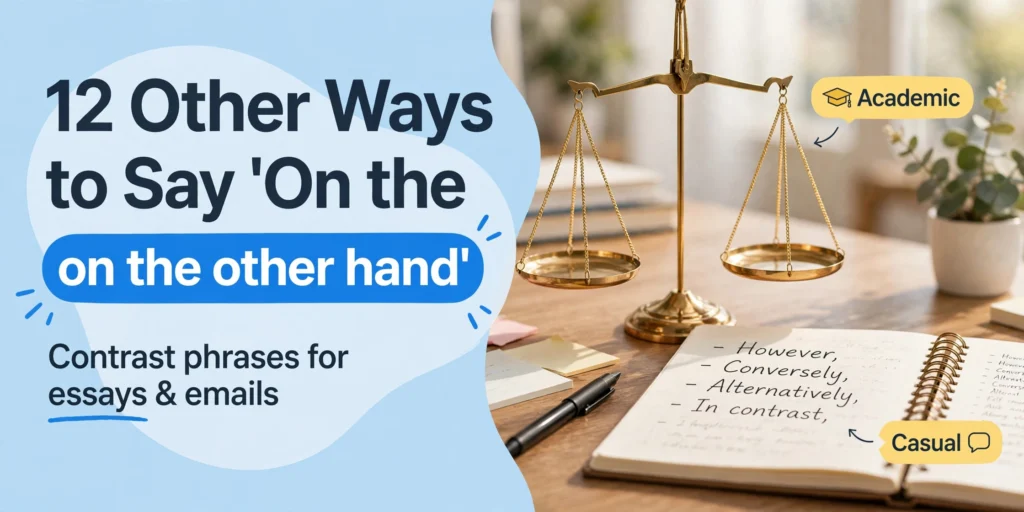
“On the other hand” is one of those phrases that sneaks into almost every essay, email, and discussion you write. It is a perfectly good transitional phrase, and it does exactly what you want: it signals that a contrasting point is coming. But when you use it five times in one piece of writing, it starts to feel repetitive — and your reader notices.
The good news is that English offers a rich set of alternatives, each with its own flavour. Some sound formal and academic, ideal for essays and reports. Others are light and conversational, better suited to emails, blogs, and everyday speech. Choosing the right one is not just about variety; it is about matching the tone of your writing and the exact kind of contrast you want to make.
In this guide, you will learn the best alternatives to “on the other hand”, grouped by formality, with sentence examples for each. You will also see when “on the other hand” itself is the right choice — and the common mistakes that make writers sound awkward when they try to replace it.
Quick Answer
The best formal alternatives to “on the other hand” include “by contrast”, “in contrast”, “conversely”, and “on the contrary”, which work well in essays and academic writing. For everyday writing, try “however”, “that said”, “then again”, or “on the flip side”. Choose the alternative that matches your tone and the exact shade of contrast you mean: use “in contrast” for direct opposites, “however” for mild reservations, and “that said” or “then again” for informal second thoughts.
What “On the Other Hand” Actually Means
Before replacing the phrase, it helps to understand exactly what it does. “On the other hand” introduces a point that balances or contrasts with what was just said. It is the spoken and written equivalent of weighing two things in your hands — one idea on this side, another idea on the other.
Notice that it does not always mean a total contradiction. Compare these two sentences:
- The job pays well. On the other hand, the hours are long.
- The job pays well. However, the hours are long.
Both are correct, but they feel slightly different. “On the other hand” presents the two facts as two sides of one picture — a balanced view. “However” simply introduces a reservation.
It is also worth knowing that the full idiom is “on the one hand … on the other hand”. Using just “on the other hand” on its own is completely standard and far more common in modern writing, but the paired version is useful when you want to give equal weight to both sides of an argument.
Formal and Academic Alternatives
In essays, dissertations, reports, and professional writing, “on the other hand” can sound a little conversational. These alternatives carry more weight and are the standard choices in academic style.
By contrast / In contrast
These two are the most direct formal replacements. They work best when you are comparing two things that differ sharply. “By contrast” usually stands on its own, while “in contrast” is often followed by “to” or “with”.
- Traditional classrooms reward memorisation. By contrast, project-based learning rewards problem-solving.
- In contrast to his brother, who spent everything he earned, Thomas saved diligently.
If you want to explore this one further, our guide to another way to say “in contrast” breaks down even more formal options for academic writing.
Conversely
“Conversely” signals an opposite situation or an inverted relationship. It is slightly stronger than “on the other hand” — use it when the second point reverses or mirrors the first, rather than merely adding a drawback.
- When prices rise, demand usually falls. Conversely, when prices drop, demand tends to rise.
- Many people assume city life is stressful. Conversely, some studies suggest it can be energising.
On the contrary
This is the strongest of the formal alternatives, and it means something slightly different: it directly contradicts the previous statement. Use it only when the second point refutes or denies the first — not for a gentle balancing of pros and cons.
- Some claim that multitasking improves productivity. On the contrary, research shows it reduces it.
Using “on the contrary” where you simply mean a drawback is a classic error (see Common Mistakes below).
Whereas / While
These subordinating conjunctions let you pack the contrast into a single sentence, which is often more elegant than splitting it across two.
- Whereas renewable energy costs have fallen sharply, fossil fuel prices remain volatile.
- While online shopping is convenient, local shops offer personal service.
Casual and Conversational Alternatives
In emails, blog posts, and everyday writing, formal alternatives can sound stiff. These options keep the same contrastive meaning but in a natural, spoken register.
That said
“That said” is the modern favourite for introducing a balancing point. It acknowledges everything you just said, then gently adds a reservation. It is polished enough for work emails but relaxed enough for conversation.
- The holiday was wonderful. That said, the hotel was further from the beach than we expected.
- She is clearly talented. That said, she still needs more experience.
Then again
“Then again” introduces a second thought or reconsideration — the feeling of talking yourself around. It is slightly more informal than “that said” and works beautifully in persuasive or opinionated writing.
- Living abroad sounds exciting. Then again, being far from family is not easy.
- Buying a car would give us freedom. Then again, the running costs are enormous.
On the flip side
This is the closest casual cousin of “on the other hand” — it uses the same “side” metaphor. It is friendly and vivid, perfect for blogs and informal essays, but too chatty for formal academic work.
- Working from home saves commuting time. On the flip side, it can feel lonely.
- The new phone is expensive. On the flip side, the camera is outstanding.
Choosing the Right Alternative: A Quick Guide
With so many options, how do you choose? Match the alternative to two things: your tone, and the strength of the contrast.
- Direct opposites in formal writing: by contrast, in contrast, conversely
- Refuting the previous point: on the contrary
- Mild reservations in neutral writing: however, nevertheless
- Balancing pros and cons: on the other hand, on the flip side (casual)
- Acknowledging then adding a caveat: that said, having said that
- Second thoughts in informal writing: then again, mind you
“However” deserves a special mention because it is the safest universal substitute. It fits formal and informal writing alike, and it works in almost any contrastive sentence. If you are unsure which alternative to pick, “however” will rarely be wrong. For a full breakdown of how to use it naturally, see our guide to other ways to say “however”.
One more tip: variety matters less than precision. Replacing every “on the other hand” with a different synonym just for the sake of variety can make your writing feel scattered. It is better to use two or three alternatives well — and correctly — than to cycle through ten.
Common Mistakes
Wrong: On the contrary, the software is also quite slow.
Right: On the other hand, the software is also quite slow. (“On the contrary” must contradict the previous point, not merely add a drawback.)
Wrong: On one hand, remote work is flexible.
Right: On the one hand, remote work is flexible. (The idiom requires “the” — “on the one hand”, never “on one hand”.)
Wrong: The results were impressive, on the other hand.
Right: The results were impressive. On the other hand, the sample size was small. (“On the other hand” introduces the contrasting point — it must be followed by one.)
Wrong: She loves hiking, on the flip side she hates camping.
Right: She loves hiking; on the flip side, she hates camping. (Joining two independent clauses with just a comma is a comma splice — use a semicolon or a full stop.)
Wrong: However the tickets are expensive, the show is worth seeing.
Right: The tickets are expensive; however, the show is worth seeing. (When “however” means “on the other hand” mid-sentence, it needs proper punctuation around it.)
Frequently Asked Questions
Is it okay to start a sentence with “on the other hand”?
Yes, absolutely. Starting a sentence with “on the other hand” is standard in both formal and informal writing. Just make sure a contrasting point came before it — the phrase only makes sense when there is something to contrast with.
Can I use “on the other hand” in academic essays?
You can, but sparingly. Many examiners and tutors find it overused. In academic writing, “by contrast”, “in contrast”, “conversely”, and “however” are usually stronger choices because they sound more precise and formal.
What is the difference between “on the other hand” and “however”?
“On the other hand” frames the contrast as two balanced sides of one picture, like weighing pros and cons. “However” simply introduces a reservation or exception. In practice they overlap a great deal, and “however” works in nearly every sentence where “on the other hand” does.
What can I say instead of “on the other hand” in a conclusion?
In conclusions, “in contrast”, “conversely”, and “nevertheless” all work well for a final balancing point. If you are wrapping up an argument, you might also consider signposting phrases from our list of alternatives to “in conclusion” to vary your closing sentences.
Keep practising these contrastive phrases, and you will find your writing sounding more natural and varied — and for more ways to sharpen your linking words, explore our other ways to say “for example”.

Join the conversation