Synonyms for Bad: 40+ Words to Use Instead
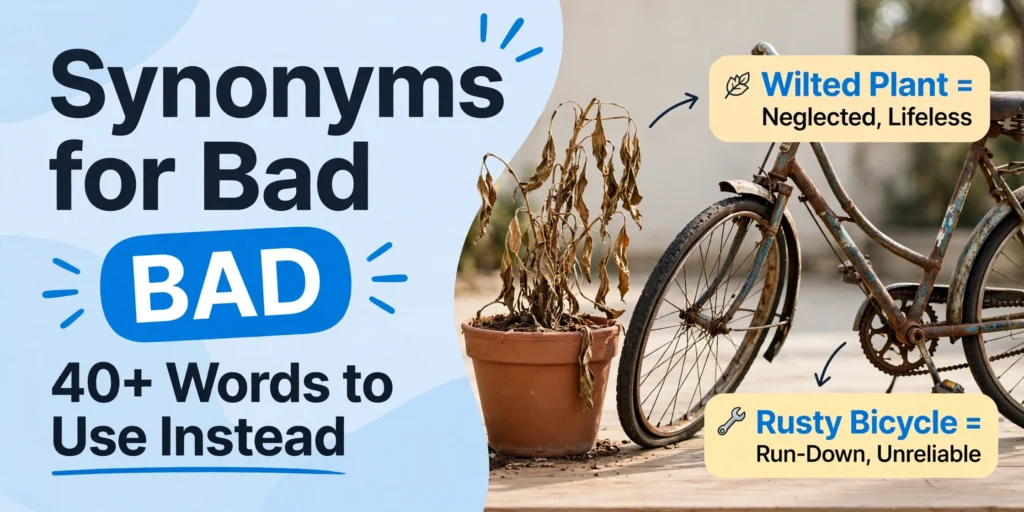
Bad is one of the most overused words in English. It can describe a disappointing film, a painful injury, a cruel action, or a meal that tastes awful, yet it tells the reader very little about which meaning you intend. A precise word does more work in a sentence, creates a stronger picture, and helps your writing sound more confident.
In this guide, you will find more than forty alternatives grouped by meaning, with example sentences and notes on strength and register. Awful is not the same as disappointing, and harmful is not the same as immoral, so understanding those differences helps you replace bad with a word that fits exactly.
It also helps to think about synonyms in pairs. Just as writers look for synonyms for good when they want to praise something precisely, learning the negative side of the vocabulary gives you the same control when you need to criticise, warn, or describe a problem honestly.
Quick Answer
The best synonym for bad depends on what you mean. For poor quality, use words such as poor, weak, or substandard. For something unpleasant, try awful, dreadful, or nasty. For harm, use damaging or harmful, and for morally wrong behaviour, use wrong, unethical, or wicked. Choosing a more precise word makes your meaning clearer than repeating bad.
Synonyms for Bad When Something Is Poor Quality
When bad means low in quality, you are judging how well something was made, performed, or written. These words work well for work, products, and services that fail to meet a reasonable standard.
- Poor: a general word for low quality, as in a poor performance.
- Weak: suggests a lack of strength, effect, or convincing detail.
- Substandard: a formal word for below the expected standard.
- Shoddy: describes careless or badly finished work.
- Slipshod: similar to shoddy, with an emphasis on careless method.
- Second-rate: suggests something is clearly below the best available.
- Inferior: a formal comparison word, often used for materials or products.
- Deficient: means lacking something needed to be satisfactory.
- Unsatisfactory: a polite, formal way to say not good enough.
- Mediocre: means only average, and often implies disappointment.
- Disappointing: focuses on the gap between expectation and reality.
- Lousy: informal, and best kept for casual speech rather than formal writing.
For example: The report was disappointing because the evidence was weak and the conclusion was poorly organised. That tells the reader what went wrong, which simply saying the report was bad does not.
Watch the register here. Substandard, inferior, and unsatisfactory suit formal reports and letters, while lousy and second-rate belong in conversation or informal reviews. Mediocre sits in the middle, but it can sound dismissive, so use it only when average really is the problem.
Synonyms for Bad When Something Is Unpleasant
Sometimes bad describes an experience, a taste, a smell, or a feeling that is hard to enjoy. These words are stronger and more vivid, and they help the reader imagine the experience.
- Awful: very unpleasant, and one of the strongest everyday choices.
- Dreadful: similar to awful, often used for weather, experiences, or news.
- Terrible: a strong general word for something very unpleasant.
- Horrible: suggests something that causes disgust or distress.
- Nasty: often used for tastes, smells, injuries, or unpleasant behaviour.
- Disgusting: a strong word for something that causes revulsion.
- Unpleasant: a milder, more polite alternative to awful or horrible.
- Unbearable: means so unpleasant that it is difficult to endure.
- Grim: suggests something bleak, depressing, or harsh.
- Miserable: often describes weather, a mood, or an unhappy experience.
For example: We had a miserable journey home in dreadful weather, and the food at the service station was awful. Miserable describes the mood, dreadful describes the weather, and awful describes the food.
Do not use the strongest words for every small annoyance. If a meal was simply dull, unpleasant or disappointing is more accurate than disgusting. Save awful, horrible, and terrible for experiences that really were severe.
Synonyms for Bad When Something Is Harmful or Damaging
In health, safety, and environmental writing, bad often means harmful rather than unpleasant. These synonyms make the type of harm clear, which matters when you are giving advice or explaining a risk.
- Harmful: a general word for something that causes damage or injury.
- Damaging: emphasises the damage caused, especially to reputation, health, or property.
- Destructive: suggests serious, widespread damage.
- Detrimental: a formal word for harmful to health, progress, or wellbeing.
- Injurious: a formal word, often used in legal or medical contexts.
- Toxic: describes something poisonous or severely harmful, literally or figuratively.
- Adverse: a formal word for harmful effects, often used for side effects.
- Unhealthy: a clear, everyday word for something bad for health.
- Perilous: means dangerous, with a risk of serious harm.
- Risky: suggests that harm is possible, even if it has not yet happened.
For example: Smoking is harmful to health, and a lack of sleep can have a detrimental effect on concentration. Neither sentence needs the word bad, and both are clearer because they name the kind of harm involved.
Choose harmful or damaging for most general writing, and detrimental, adverse, or injurious in formal or technical contexts. Avoid toxic unless the harm is severe or poisonous, because overusing it weakens its force. The same care helps when weighing positive effects, so also study synonyms for important alongside negative words.
Synonyms for Bad When Behaviour Is Morally Wrong
When bad describes a person, an action, or a decision, it often carries a moral judgement. These words range from mild disapproval to serious condemnation, so choose them with care.
- Wrong: the simplest word for morally or legally incorrect behaviour.
- Immoral: describes behaviour that breaks accepted moral principles.
- Unethical: a formal word for behaviour that breaks professional or moral standards.
- Corrupt: suggests dishonesty, especially by someone in a position of power.
- Deceitful: describes behaviour that deliberately misleads others.
- Wicked: a strong, old-fashioned word for deliberately cruel or evil behaviour.
- Cruel: means deliberately causing pain or suffering.
- Shameful: describes behaviour that deserves public disapproval.
- Disgraceful: a strong word for behaviour that brings shame.
- Reprehensible: a formal word for behaviour that deserves strong criticism.
For example: It was wrong to take credit for someone else’s work, and hiding the mistake was deceitful. The first word makes the moral judgement, while the second explains how the wrong was done.
Use strong moral words only when the evidence supports them. Calling a small mistake wicked or reprehensible sounds unfair and weakens your argument. In most everyday writing, wrong, unfair, or unethical is enough; save corrupt, cruel, and disgraceful for genuinely serious behaviour.
How to Choose the Right Word
Start by asking what kind of bad you mean: poor quality, unpleasant, harmful, or morally wrong? That question narrows your choice immediately. Next, consider strength. Disappointing, unpleasant, and unsatisfactory are mild, while awful, dreadful, destructive, and disgraceful are strong. A strong word for a mild problem sounds exaggerated, while a mild word for a serious problem sounds evasive.
Also consider audience and register. A formal report might call a result unsatisfactory or detrimental, a friendly email might call a day miserable, and a novel might call a villain cruel. Finally, check grammar: most of these synonyms are adjectives and can replace bad directly, as in a poor result or a dreadful day, but some related words can also be nouns or verbs, so read the sentence aloud to catch an awkward replacement.
Building this habit takes practice. Writers who describe positive feelings precisely, for example with synonyms for happy, usually find it easier to describe negative experiences precisely too, because both skills rely on noticing small differences in meaning.
Common Mistakes
These are the errors writers most often make when replacing bad with a stronger word.
- Wrong: The food was disgusting. Right: The food was disappointing. Use disgusting only when food truly causes revulsion, not when it is merely dull.
- Wrong: He made a wicked mistake. Right: He made a serious mistake. Wicked describes cruel intent, not an ordinary error.
- Wrong: The weather was toxic. Right: The weather was dreadful. Toxic means poisonous or severely harmful, not simply unpleasant.
- Wrong: Her performance was lousy in the formal report. Right: Her performance was unsatisfactory in the formal report. Lousy is too informal for formal writing.
- Wrong: The policy had a bad effect on morale. Right: The policy had a detrimental effect on morale. In formal writing, detrimental is more precise than bad, and it names the type of harm.
Frequently Asked Questions
What is the best synonym for bad in formal writing?
It depends on the meaning, but unsatisfactory, detrimental, and adverse are safe formal choices: unsatisfactory for poor quality, detrimental for harmful effects, and adverse for unwanted results.
What is a polite way to say something is bad?
Try disappointing, unsatisfactory, or not ideal. These words express criticism without sounding harsh. For example, you can say the service was disappointing rather than awful, which softens the judgement while still making your point clear.
Is awful stronger than bad?
Yes. Bad is a general, mild word, while awful suggests something very unpleasant or severe. That is why awful works well for a terrible experience, but can sound exaggerated if you use it for a minor problem.
Can I use bad in academic writing?
You can, but it is usually better to replace it. Academic writing values precision, so choose a word that names the problem, such as weak evidence, flawed method, or detrimental effect.
For more precise vocabulary, see our guides to synonyms for good, synonyms for important, and synonyms for happy.

Join the conversation