Ways to Say Yes: 30+ Alternatives for Every Conversation
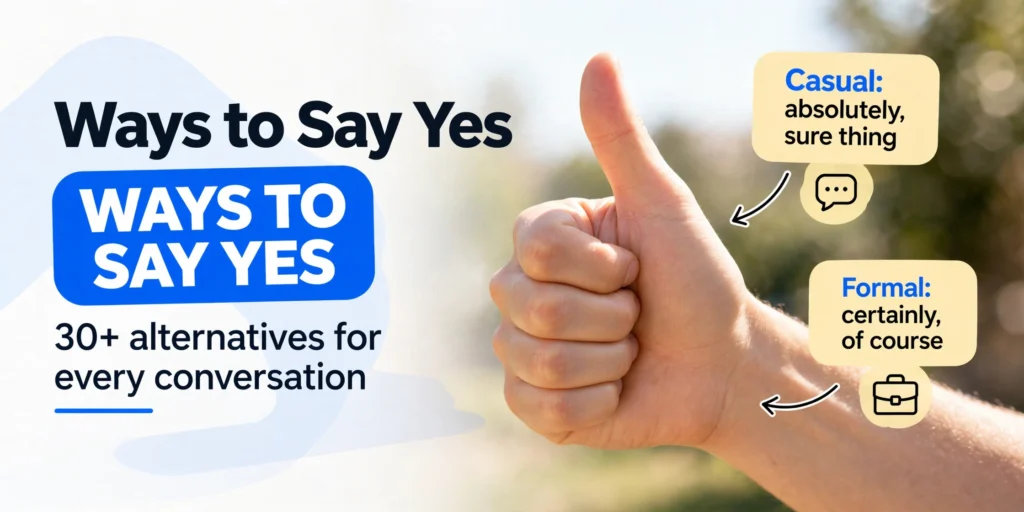
Yes is one of the most useful words in English — and one of the most overused. We reach for it in meetings, in text messages, at the dinner table, and in job interviews. There is nothing wrong with a simple yes, but saying it on autopilot can make you sound flat, bored, or even reluctant.
That is where variety matters. Swapping “yes” for the right alternative does more than keep your language fresh: it signals tone. “Certainly” sounds polished in a formal email; “absolutely” brings energy to a lively discussion; “sure thing” keeps things friendly among friends. Choosing well is a small skill with a big payoff — it shows confidence, warmth, and real control of the language.
In this guide you will find more than 30 ways to say yes, grouped by situation: formal, casual, professional, and enthusiastic. Every alternative comes with examples so you know exactly when to use it — and when not to. By the end, you will never have to settle for a dull, automatic “yes” again.
Quick Answer
The best alternatives to “yes” depend on the setting: use “certainly”, “of course”, or “absolutely” in formal and professional situations; “yeah”, “sure”, or “for sure” in casual conversation; and “100%”, “I’m in”, or “couldn’t agree more” when you want to sound enthusiastic. Match your choice to your audience, and you will always sound natural and confident.
Polite and Formal Alternatives
Formal situations call for answers that sound respectful and composed. These alternatives work well with teachers, customers, interviewers, and anyone you do not know well. They are especially useful in British English, where politeness is often conveyed through small word choices rather than grand gestures.
Certainly — “Could you send me the report by Friday?” “Certainly, I’ll have it ready by Thursday.” This is the gold standard of formal affirmatives in British English.
Of course — “Would you like some help with your bags?” “Of course, that would be lovely.” Friendly yet polite; it suggests the request was never in doubt.
Absolutely — “Do you agree with the proposal?” “Absolutely.” Short, confident, and perfectly at home in both formal meetings and everyday speech.
Gladly — “Could you cover my shift on Saturday?” “Gladly.” Implies you are happy to help, not merely willing.
By all means — “May I borrow your pen?” “By all means.” A touch traditional, but still common in British English, especially in polite written exchanges.
Affirmative — “Is everyone ready?” “Affirmative.” Borrowed from military and aviation language; use it sparingly, ideally with a smile, unless you actually work in one of those fields.
Indeed — “You enjoyed the lecture, I trust?” “Indeed, it was fascinating.” Formal and slightly literary; best for written English or very formal conversation.
Most certainly — “Will you be attending the ceremony?” “Most certainly.” Adds extra emphasis when a plain “certainly” does not feel strong enough.
Casual and Everyday Alternatives
With friends, family, and colleagues you know well, a stiff “certainly” can sound oddly distant. These relaxed options fit texts, chats, and kitchen-table conversation, where warmth matters more than ceremony. If you ever need the opposite skill, our guide to ways to say no covers the softer side of declining without sounding rude.
Yeah — “Fancy a cuppa?” “Yeah, go on then.” The default casual yes; avoid it in job interviews and formal emails.
Yep — “Are you coming tonight?” “Yep, see you at eight.” Slightly chirpier than “yeah”.
Sure — “Can you pass the salt?” “Sure.” Simple and friendly, though on its own it can occasionally sound flat — tone of voice does the heavy lifting.
Sure thing — “Thanks for helping me move.” “Sure thing, anytime.” Warmer than a bare “sure”; a favourite among friends.
For sure — “Will it rain tomorrow?” “For sure.” Emphatic and casual; very common among younger speakers.
You bet — “Thanks for the lift.” “You bet.” A warm American import, now widely used in Britain; strictly informal.
Totally — “That film was brilliant, wasn’t it?” “Totally.” Expresses complete agreement in relaxed settings.
Definitely — “Are you free on Saturday?” “Definitely.” Works in both casual chat and semi-formal speech, which makes it a handy all-rounder.
Professional and Business Alternatives
At work, your yes often carries a commitment, so clarity matters as much as politeness. These options confirm clearly while sounding capable and cooperative — ideal for emails, meetings, and calls with clients.
I’d be happy to — “Could you present the findings on Thursday?” “I’d be happy to.” Polite, positive, and safe for any professional context.
That works for me — “Shall we meet at ten?” “That works for me.” Confirms a suggestion without fuss.
Agreed — “So we’ll launch in March?” “Agreed.” Crisp and decisive; common in meeting minutes and email threads.
Count me in — “We’re organising a team lunch on Friday.” “Count me in.” Friendly enthusiasm for voluntary activities.
Sounds good — “I’ll send the draft over this afternoon.” “Sounds good.” Acknowledges and approves in one breath.
Will do — “Please update the spreadsheet.” “Will do.” Confirms you will carry out an instruction; more useful than a bare “yes” because it promises action.
Consider it done — “We need those figures by noon.” “Consider it done.” Confident and reassuring; only use it when you genuinely mean it.
Understood — “The deadline is non-negotiable.” “Understood.” Confirms you have heard and accepted, without over-promising.
Enthusiastic and Expressive Alternatives
Sometimes “yes” is not enough — you want to show excitement, passion, or total conviction. These carry real energy, so save them for moments that deserve it. Used sparingly, they make your agreement memorable; used constantly, they lose their punch.
Absolutely! — “Would you recommend this restaurant?” “Absolutely!” The exclamation mark is doing half the work.
100% — “Are you sure about this?” “100%.” Short, modern, and unambiguous.
Without a doubt — “Is she the right person for the job?” “Without a doubt.” Adds weight when your opinion genuinely matters.
I’m in / I’m all in — “Road trip this weekend?” “I’m all in.” Shows wholehearted commitment to a plan.
Couldn’t agree more — “This needs to change.” “Couldn’t agree more.” The strongest way to agree with someone’s opinion.
Let’s do it — “Shall we start the project today?” “Let’s do it.” Turns agreement into momentum.
You had me at hello — playful and dramatic; best reserved for light-hearted moments when you want to make someone laugh.
Hell yes — strictly informal and mildly rude in polite company; keep it for close friends and never for work.
How to Choose the Right Alternative
Think of these alternatives as a sliding scale from formal to informal. At the formal end sit “certainly”, “of course”, and “gladly”; in the middle live the professional workhorses like “sounds good” and “that works for me”; at the casual end you will find “yeah”, “yep”, and “for sure”. When in doubt, move one step more formal than feels necessary — it is easier to relax your tone later than to recover from sounding too casual.
Context matters as much as vocabulary. A written “Yep” in an email to a new client reads as careless, while “Certainly” said to your best mate over a pint sounds like a joke. Match the alternative to the relationship, the medium, and the moment, and listen to how native speakers around you phrase things.
Finally, remember that a good yes often comes with a little extra. Adding a detail — “Yes, I’d love to, what time?” — beats any single-word answer, however well chosen. Variety gives you options; warmth makes them land.
Common Mistakes
Even simple affirmatives can go wrong. Watch out for these classic errors:
Wrong: Answering “Do you want tea or coffee?” with “Yes, please.” Right: Choose one — “Tea, please.” A bare yes does not answer an either/or question.
Wrong: Saying “Yeah” in a job interview. Right: Use “Yes” or “Certainly” when the setting is formal; save “yeah” for friends.
Wrong: Replying “Sure” to your manager’s urgent request in a flat tone. Right: Say “Of course — I’ll get on it straight away.” “Sure” alone can sound reluctant.
Wrong: Answering “No problem” to mean yes. Right: “No problem” means the task is no trouble, not that you agree — pair it with a clear yes: “Yes, no problem at all.”
Wrong: Using “I agree” when someone gives you an instruction. Right: Instructions need action, not agreement — “Will do” or “Understood” fits better.
Frequently Asked Questions
What is the most formal way to say yes?
“Certainly” is the safest formal choice in British English, closely followed by “of course” and “gladly”. “Affirmative” is even more formal but belongs to military, aviation, and official contexts — it can sound stiff or jokey elsewhere.
What is a polite way to say yes in an email?
“I’d be happy to” and “Certainly” work beautifully in emails, as does “That works for me” when confirming arrangements. Avoid “yeah”, “yep”, and “for sure” in professional writing — they read as too casual, much like overusing “said” without variety, which is why our list of words to use instead of “said” is a handy companion for written English.
What are some slang ways to say yes?
Common slang affirmatives include “yep”, “yeah”, “for sure”, “totally”, and “100%”. They are perfect for friends and informal chats but should stay out of interviews, exams, and formal writing.
How can I say yes more enthusiastically?
Try “Absolutely!”, “100%!”, “I’m all in”, or “Couldn’t agree more” when you want real energy. Pairing your yes with a detail — “Yes, I’d love to!” — also makes it sound warmer and more genuine.
Keep expanding your vocabulary with our related guides: ways to say no, other ways to say “for example”, and words to use instead of “said”.
Comments (2)