15 Polite Ways to Say “No” (With Examples)
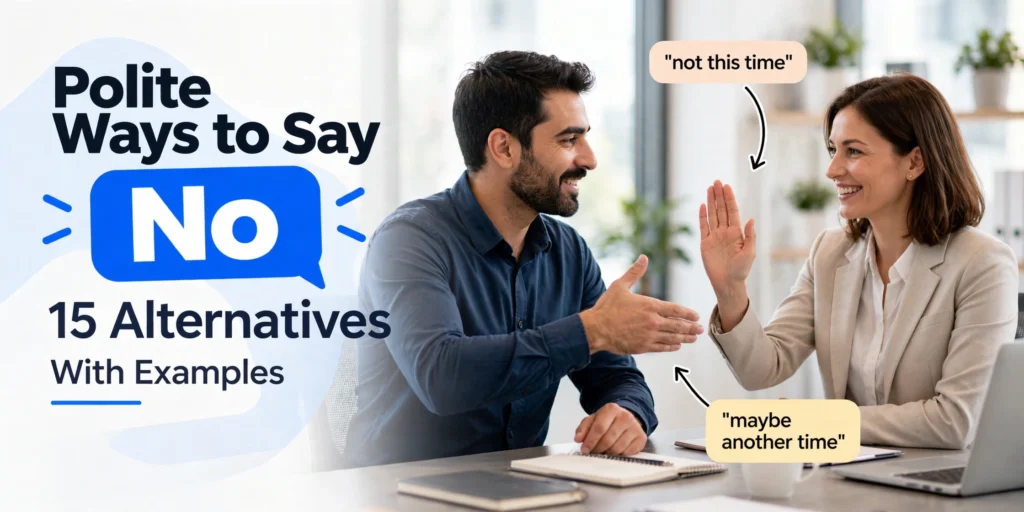
Saying no is one of the smallest words in English and one of the hardest to use. Most of us would rather overcommit, lose sleep, and quietly resent it than risk disappointing someone with a refusal. But every reluctant yes has a cost — your time, your energy, and eventually your goodwill towards the person you couldn’t refuse.
The good news is that “no” doesn’t have to sound harsh. What matters is everything around the word: a little warmth, a brief reason, and where possible, an alternative. Done well, a polite no can actually strengthen a relationship, because people trust someone who is honest about their limits. The words you choose shape how your refusal lands — the same is true in writing, where swapping a tired verb can transform a whole sentence (see our guide to words to use instead of “said”).
Below you’ll find 15 polite ways to say no, grouped by the situations where they work best: at work, social invitations, requests for favours, and salespeople. Each one comes with an example sentence you can adapt word for word.
Quick Answer
The politest way to say no is to be brief, warm and honest: thank the person, give a short reason, and offer an alternative where you can. For example: “Thanks for thinking of me — I can’t take that on this week, but have you tried asking Priya?” Avoid over-apologising or saying “maybe” when you mean no; a clear no is kinder than a vague yes.
The “Positive No” Technique
The most reliable formula for a polite refusal has three parts: no + reason + alternative. You decline clearly, you give just enough reason to sound human rather than robotic, and you soften the landing by pointing to another option. Negotiation expert William Ury calls this the “positive no” — a no that also says yes to something, whether that’s your own priorities or the other person’s underlying need.
It works because it answers the unspoken question behind every request: “What do I do now?” Compare “No, I can’t help you move” with “I can’t help you move this weekend — but I can lend you my van on Friday.” Same refusal, completely different feeling. Keep the reason to one line — long excuses sound invented and invite negotiation — and only offer an alternative you genuinely mean. This applies in writing too: when you turn someone down by email, a warm closing line softens the whole message — our list of alternatives to “in conclusion” has professional sign-offs that end emails gracefully.
15 Polite Ways to Say “No”
Pick the version that fits your situation — and make it your own.
At Work
“I’m not able to take that on right now.” Direct, professional, and blame-free. Example: “Thanks for thinking of me, but I’m not able to take that on right now — my deadline is Friday.”
“Let me check my priorities and get back to you.” A holding reply that buys thinking time. Example: “Let me check my priorities and get back to you by tomorrow morning.” Only use it if you genuinely will follow up.
“That’s not something I can commit to this week.” Useful when the timing is the problem, not the task. Example: “That’s not something I can commit to this week, but I can send you the files you’ll need to start.”
“I’d like to help, but my plate is full at the moment.” Shows goodwill while holding the line. Example: “I’d like to help with the launch, but my plate is full at the moment.”
“Can we revisit this next quarter?” A no that keeps the door open. Example: “It’s a good idea, but can we revisit this next quarter when things calm down?”
Social Invitations
“Thanks for thinking of me — I can’t make it this time.” Warm and final. Example: “Thanks for thinking of me — I can’t make it this time, but I hope you all have a wonderful evening.”
“I’d love to, but I already have plans.” The classic for a reason: it’s kind and needs no further detail. Example: “I’d love to come, but I already have plans that weekend.”
“That sounds lovely, but I’ll have to pass.” Gentle and slightly formal — good for invitations from acquaintances. Example: “That sounds lovely, but I’ll have to pass — I’m taking a quiet weekend.”
“I won’t be able to come, but have a great time!” Ends on enthusiasm, so the no stings less. Example: “I won’t be able to come on Saturday, but have a great time — and send me photos!”
Requests for Favours
“I wish I could, but I can’t swing it this time.” Honest and human. Example: “I wish I could help you move, but I can’t swing it this time — my back is still playing up.”
“That’s not something I can help with, unfortunately.” Clear without over-explaining. Example: “That’s not something I can help with, unfortunately — but have you tried the community forum?”
“I’m afraid that’s beyond what I can do.” For bigger asks where a simple no feels too light. Example: “I’m afraid lending you the car is beyond what I can do, but I can give you a lift to the station.”
Salespeople and Unwanted Offers
“No thank you, I’m not interested.” Short, polite, and closed — exactly what you want with cold callers. Example: “No thank you, I’m not interested — but I hope the rest of your day goes well.”
“I appreciate the offer, but I’ll pass.” Courteous and final. Example: “I appreciate the offer, but I’ll pass — we’re happy with our current provider.”
“Thanks, but I’m all set.” Friendly and casual, perfect for street fundraisers and market stalls. Example: “Thanks, but I’m all set — I already have one at home.”
Common Mistakes
1. Over-apologising.
Wrong: “I’m SO sorry, I feel terrible, please forgive me — I just can’t, I’m really, really sorry.”
Right: “Thanks for asking — I can’t this time.”
One brief apology is plenty. A flood of sorrys makes the refusal about your guilt rather than their request, and it puts pressure on them to comfort you.
2. Saying “maybe” when you mean no.
Wrong: “Maybe — I’ll let you know!” (and then never replying).
Right: “I won’t be able to — but thanks for thinking of me.”
A vague maybe wastes everyone’s time and keeps the other person hanging. A clear no is kinder than a slow fade.
3. Giving a long, detailed excuse.
Wrong: “Well, the thing is, my aunt is visiting, and then the car needs its MOT, and honestly I’ve been feeling a bit run down…”
Right: “I can’t make it this time.”
Short reasons sound honest; long ones sound invented — and every extra detail is something the other person can argue with.
4. Saying yes and resenting it.
Wrong: agreeing on the spot, then cancelling at the last minute.
Right: a prompt, polite no.
A reluctant yes that collapses into a last-minute cancellation damages trust far more than an honest no upfront.
5. Caving the moment someone pushes back.
Wrong: “No, I really can’t… well, I suppose I could manage…”
Right: “I understand it’s urgent, but my answer is still no — have you tried asking Sam?”
If you fold under pressure, people learn that your no means maybe. Repeat your refusal once, warmly and unchanged, and don’t invent new excuses.
Frequently Asked Questions
Is it rude to say no without giving a reason?
No. A brief “I can’t this time” is perfectly polite, and you don’t owe anyone a detailed explanation. In fact, short reasons sound more honest than long ones, and “no” is a complete sentence when it’s delivered kindly.
How do I say no to my boss?
Be respectful and solution-focused: acknowledge the request, name the trade-off, and suggest an alternative. For example: “I can take this on, but the Friday report would slip — would you like me to prioritise this instead, or should I ask Jamie to help?” If the no has to go in an email, keep the message short and close it cleanly — see our alternatives to “in conclusion” for professional sign-offs.
What if someone keeps pushing after I’ve said no?
Repeat your refusal once, warmly but word-for-word: “I understand, but I can’t.” Don’t add new reasons — each one is a fresh thing to argue with. This “broken record” technique is a classic assertiveness tool: calm repetition signals that the decision is final without turning the conversation into a debate.
Should I say no by text or in person?
Match the medium to the weight of the request. For significant asks — a job offer, a close friend’s favour — a call or face-to-face conversation shows respect. For casual invitations and everyday requests, a text is perfectly fine. Just avoid delivering a no in a group chat, where it can embarrass the person in front of others.
Comments (2)