25 Romantic Ways to Say “I Love You” (With Examples)
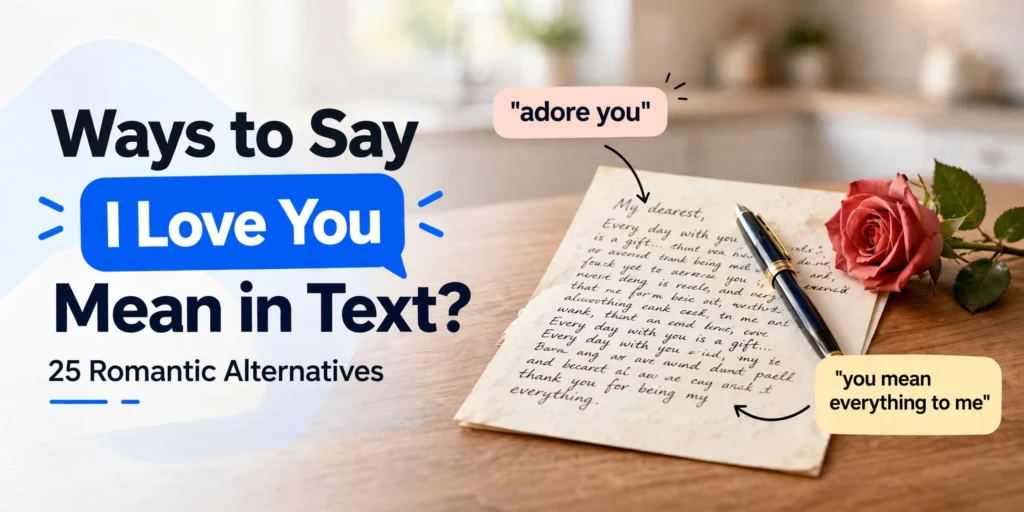
“I love you” may be the most powerful three words in the English language — and also the most repeated. When a phrase is said on autopilot every morning, it can start to sound automatic rather than heartfelt, even when every syllable is meant.
The good news is that love has a far richer vocabulary than those three words. A well-chosen alternative can say exactly what you feel in a particular moment: gratitude on an ordinary Tuesday, devotion on an anniversary, or playfulness over Sunday breakfast. Below you will find 25 romantic ways to say “I love you”, grouped by tone, each with an example sentence — plus guidance on choosing the right one and the mistakes to avoid.
Even the most powerful phrase can lose its shine through repetition — much like the way writers go searching for alternatives to “in conclusion” when their essays start to sound mechanical. Variety keeps the meaning alive.
Quick Answer
The best alternative to “I love you” depends on the moment. “I’m so grateful for you” suits quiet, everyday affection; “You mean the world to me” fits grand romantic gestures; and playful options like “You’re my favourite person” keep things light. Match the words to the tone — sincere for serious moments, playful when you’re joking — and always say them like you mean them.
25 Romantic Ways to Say “I Love You”
Romantic
For anniversaries, quiet evenings, and moments when you want the full weight of the feeling.
- You mean the world to me. — “You mean the world to me, and I wanted you to hear it today.”
- I’m completely devoted to you. — “After all these years, I’m completely devoted to you.”
- You are the love of my life. — “Whatever happens next, you are the love of my life.”
- My heart belongs to you. — “My heart belongs to you — it has since the day we met.”
- I adore you. — “I adore you, even when you steal the duvet.”
- You are my everything. — “You are my everything, and I don’t say it nearly enough.”
- I’m yours, completely. — “I’m yours, completely — today, tomorrow, always.”
Sweet and Casual
For everyday affection — warm without being heavy.
- You’re my favourite person. — “You’re my favourite person to do absolutely nothing with.”
- I’m so lucky to have you. — “I’m so lucky to have you in my corner.”
- You make me so happy. — “You make me so happy, it’s honestly a bit ridiculous.”
- I love spending time with you. — “I love spending time with you, even on a supermarket run.”
- You mean so much to me. — “You mean so much to me — I hope you know that.”
- I’m grateful for you every day. — “I’m grateful for you every day, especially on the hard ones.”
Deep and Serious
For the moments that matter most — commitments, hard times, and honest conversations.
- I cherish you. — “I cherish you more deeply than I can put into words.”
- You have my whole heart. — “You have my whole heart, and you always will.”
- I can’t imagine my life without you. — “I can’t imagine my life without you in it.”
- You are my home. — “Wherever we end up living, you are my home.”
- I choose you, every day. — “Love isn’t just a feeling — I choose you, every day.”
- You make me want to be a better person. — “You make me want to be a better person, and that is the greatest gift.”
Playful
For couples who flirt, tease, and laugh together.
- You’re my person. — “You’re my person — don’t ever forget it.”
- I’m stuck on you. — “I’m stuck on you, and I’m not even trying to get unstuck.”
- You’re the peanut butter to my jam. — “You’re the peanut butter to my jam — an odd pairing that just works.”
- I love you more than pizza. — “I love you more than pizza, and that is saying something.”
- You’re stuck with me. — “You’re stuck with me now — no returns.”
- I’d pick you in every lifetime. — “I’d pick you in every lifetime, no hesitation.”
How to Choose the Right Words for the Moment
Match the weight of the words to the weight of the moment. Early in a relationship, lighter options like “I’m so glad I met you” feel honest without applying pressure; save “You are the love of my life” for when you truly mean the forever part. Setting matters too — a whispered “You are my home” lands differently in private than shouted across a crowded room.
Specificity beats grandeur. “I love the way you laugh at your own jokes before you’ve finished them” will move most people more than any stock romantic line, because it proves you are paying attention. And if you are writing your feelings down — a letter, a card, or a wedding speech — the words around your declaration matter as well; our guide to words to use instead of “said” can help your dialogue tags keep up with the emotion.
Common Mistakes
1. Saying it before you mean it.
Wrong: Declaring deep love on a third date because the evening felt magical.
Right: Use lighter alternatives early on — “I really like spending time with you” — and save the heavyweight phrases for when they are true.
2. Using grand language for a casual moment.
Wrong: Texting “You are my everything” about what to have for dinner.
Right: Match the scale: playful lines for everyday chat, serious ones for serious moments.
3. Only saying it during make-ups.
Wrong: “I love you” appearing mainly after arguments, where it starts to sound like an apology.
Right: Say it most often in calm, happy moments — that is when it builds trust.
4. Repeating it on autopilot.
Wrong: A mumbled “love you, bye” every morning without looking up.
Right: Occasionally pause, make eye contact, and choose one of the alternatives above — deliberately.
5. Borrowing words that aren’t yours.
Wrong: Reciting a grand film speech when you are naturally a quiet, understated person.
Right: Sincerity always beats poetry. Pick phrasing that sounds like you on your best day.
Frequently Asked Questions
Is it okay to say “I love you” every day?
Yes — daily affection is healthy. The trick is to keep it deliberate rather than automatic: vary the wording, and occasionally say it with full attention instead of in passing. A fresh phrase now and then keeps the familiar one meaningful too.
What is a good alternative in the early stages of dating?
Stick with warm but low-pressure options: “I really enjoy spending time with you”, “I’m so glad we met”, or “You make me smile more than anyone”. They express genuine feeling without implying a commitment you may not be ready to name.
What should I do if they don’t say it back?
Don’t panic. People process and express emotion at different speeds, and silence in the moment doesn’t equal indifference. Give it time, and if it weighs on you, have an honest conversation later — calmly, not as an ultimatum.
How do I write “I love you” in a wedding speech or anniversary card?
Keep it personal and specific: one genuine memory beats a page of generic romance. Open with a line like “You are my home”, follow it with the story only the two of you share, and close simply. Short and true always wins over long and flowery.

Comments (8)