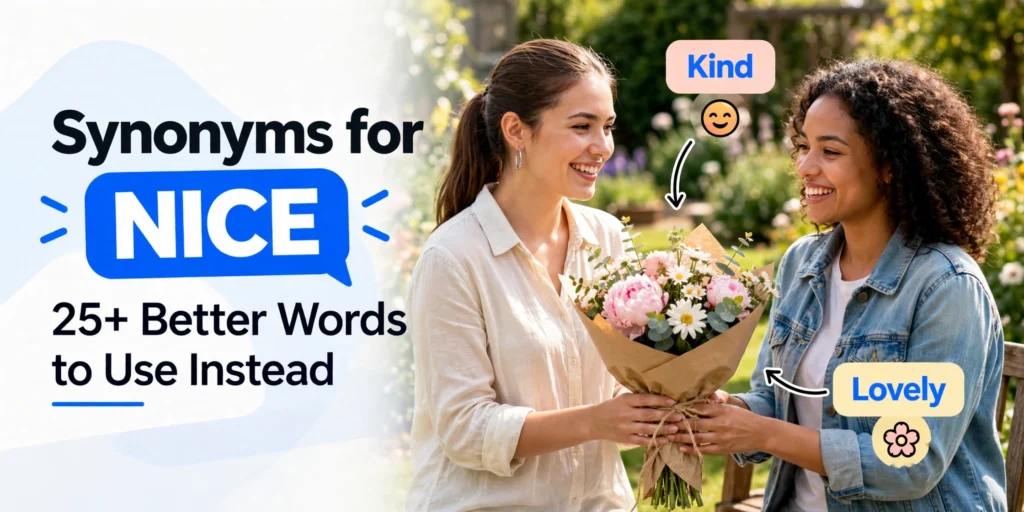
Synonyms for Nice: 25+ Better Words to Use Instead
“Nice” is one of the most overused words in English. We describe a nice day, a nice person, a nice meal, a nice dress and a nice holiday — and after a while, the word says almost nothing at all. It is not wrong, exactly. It is simply vague. When a single word is asked to cover kindness, beauty, pleasant weather, good manners and general approval, it ends up meaning very little in any of those contexts.
The good news is that English offers a rich supply of more precise alternatives. A “kind” colleague, a “delightful” afternoon, a “charming” village and a “pleasant” surprise are all things we might lazily call “nice” — but each of those words paints a clearer picture. Choosing the right synonym is not about sounding clever or formal. It is about saying what you actually mean, so your reader feels it too.
In this guide, you will find more than 25 synonyms for “nice”, grouped by the meaning you actually intend, with example sentences and practical advice on which word fits which situation. Whether you are writing an essay, an email, a story or a simple message to a friend, a sharper word is waiting.
Quick Answer
The best synonym for “nice” depends on what you mean. Use “kind” or “friendly” for a good-hearted person, “pleasant” or “lovely” for an enjoyable experience, “delightful” or “charming” for something that gives real pleasure, and “agreeable” for something satisfactory or easy to get along with. Replacing vague “nice” with a precise synonym makes your writing clearer, warmer and more convincing.
Why “Nice” Is So Vague
The trouble with “nice” is that it has stretched to cover too many meanings. Centuries ago it meant something closer to “precise” or “careful”, but today it is a general-purpose word of approval. That flexibility is exactly what makes it weak. When you write “We had a nice time”, your reader learns only that the time was good in some unspecified way. Was it relaxing? Funny? Peaceful? Exciting? The word “nice” hides the answer instead of revealing it.
Strong writing is specific writing. Compare these two sentences:
- “She is a nice person.” — True, but tells us almost nothing about her.
- “She is a kind person who always makes time for new colleagues.” — Now we can picture her.
The second sentence works because “kind” names a particular quality: warmth towards others. The same principle applies everywhere. A “nice meal” could be delicious, generous, beautifully presented or simply eaten in good company. Naming the quality you mean is what turns flat writing into writing people remember.
None of this means you should banish “nice” from your vocabulary. In casual speech it is perfectly natural, and sometimes it is exactly the low-key word you want. The aim is simply to notice when you are using it as a placeholder — and to reach for something better when the moment deserves it.
Synonyms for a Kind or Friendly Person
When “nice” means that someone is good-hearted, warm or easy to be around, these words say it far better:
- Kind — caring and generous towards others. “Our neighbour is kind; she checks on us every winter.”
- Friendly — warm and welcoming in manner. “The staff at the café were friendly and remembered our order.”
- Warm-hearted — genuinely affectionate and caring. “He is a warm-hearted man who never forgets a birthday.”
- Considerate — thoughtful about other people’s feelings and needs. “It was considerate of her to bring soup when I was ill.”
- Compassionate — moved by others’ suffering and keen to help. “The nurse’s compassionate manner put every patient at ease.”
- Gracious — courteous, kind and pleasant, often in a formal or generous way. “She was gracious in defeat and congratulated the winner warmly.”
- Amiable — good-natured and easy to like. “Our new manager is amiable and approachable.”
- Caring — showing concern and affection. “He is a caring father who reads to his children every night.”
If you are writing about someone’s character, you can find more ideas in our guide to synonyms for kind, which explores the many shades of kindness in detail.
Synonyms for Something Pleasant or Enjoyable
When “nice” means that an experience, place or thing was enjoyable, try one of these:
- Pleasant — enjoyable and agreeable, without being dramatic. “We spent a pleasant afternoon walking by the river.”
- Lovely — beautiful or delightful in a warm, gentle way. “What a lovely garden — the roses smell wonderful.”
- Delightful — giving great pleasure, often with a touch of surprise. “The little bookshop was delightful, full of dusty shelves and old maps.”
- Enjoyable — giving pleasure or satisfaction. “The concert was thoroughly enjoyable from start to finish.”
- Charming — attractive in a way that wins you over. “We stayed in a charming cottage with a thatched roof.”
- Wonderful — extremely good or marvellous. “We had a wonderful holiday in the Lake District.”
- Agreeable — pleasant and easy to accept or enjoy. “The weather was agreeable, with sunshine and a light breeze.”
- Refreshing — pleasantly new or different, especially after something dull or tiring. “A refreshing change from the usual office lunch.”
Notice how each word changes the feeling of the sentence. “A pleasant evening” sounds calm and relaxed, while “a delightful evening” suggests something unexpectedly special. Matching the word to the feeling is the whole skill.
Synonyms for Something Beautiful or Appealing
Sometimes “nice” is really a compliment about how something looks, sounds or feels. In that case, these words are far more vivid:
- Beautiful — pleasing to the senses or the mind. “She wore a beautiful blue dress to the wedding.”
- Attractive — pleasing in appearance. “The town has an attractive market square lined with cafés.”
- Appealing — attractive or interesting. “The job offer was appealing, with flexible hours and good pay.”
- Elegant — graceful and stylish. “The hotel lobby was elegant, with marble floors and soft lighting.”
- Exquisite — extremely beautiful and delicate. “The jeweller showed us an exquisite silver necklace.”
- Picturesque — attractively scenic, like a picture. “We drove through picturesque villages all the way to the coast.”
For more words that describe things people love, our guide to synonyms for amazing covers stronger praise for truly impressive things, while our list of synonyms for great is useful when “nice” is doing the work of a general compliment.
How to Choose the Right Synonym
With so many options, how do you pick the right one? Ask yourself three quick questions before you write.
1. What do I actually mean? Pin down the quality first. Is the person kind, funny, generous, polite or easy-going? Is the day sunny, relaxing, exciting or peaceful? Once you know the quality, the word usually follows.
2. How strong is the feeling? Synonyms for “nice” sit on a scale. “Pleasant” is mild and calm; “lovely” is warmer; “delightful” and “wonderful” are stronger still. If the experience was genuinely special, a stronger word is honest. If it was simply fine, a mild word is more accurate — and more believable.
3. Who am I writing for? Register matters. “Amiable” and “gracious” suit formal writing; “lovely” and “friendly” suit almost anything; “delightful” works beautifully in stories and reviews. In a casual text to a friend, “lovely” is natural, while “exquisite” might sound overdone. In an essay or a job application, a precise word like “considerate” or “agreeable” shows care and control.
A useful habit is to read the sentence aloud with your chosen word. If it sounds natural and says exactly what you mean, keep it. If it sounds stiff or exaggerated, step one notch down the scale — from “wonderful” to “lovely”, or from “exquisite” to “beautiful”. Precision and naturalness go together.
Common Mistakes
Wrong: “The weather was nice, and the food was nice, and the hotel was nice.”
Right: “The weather was sunny, the food was delicious, and the hotel was charming.”
Repeating “nice” three times in one sentence flattens everything. Give each thing its own precise word.
Wrong: “He gave a nice speech at the wedding.”
Right: “He gave a heartfelt speech at the wedding.”
If the speech moved people, say so. “Heartfelt” tells the reader how it felt; “nice” does not.
Wrong: “She is a nice boss because she is strict.”
Right: “She is a fair boss because she is strict but consistent.”
Strictness is not the same as kindness. If you mean “fair”, write “fair”. Mismatched praise confuses the reader.
Wrong: “It was a nice tragedy.”
Right: “It was a moving tragedy.”
“Nice” clashes with serious or sad subjects. For powerful art or events, use words like “moving”, “powerful” or “haunting” instead.
Wrong: “The exquisite sandwich was nice.”
Right: “The sandwich was delicious.”
Do not pile a grand word and a vague word together. One accurate word — “delicious” — beats two mismatched ones.
Frequently Asked Questions
What is the best synonym for “nice”?
There is no single best synonym, because “nice” covers so many meanings. For a person, “kind” or “friendly” is usually best. For an experience, “pleasant” or “lovely” fits well. For something truly special, “delightful” or “wonderful” is stronger. Always match the word to the meaning you intend.
Is “nice” a bad word to use in writing?
No — “nice” is not wrong, and it is perfectly natural in everyday speech. The problem is only that it is vague. In writing that aims to be clear, vivid or persuasive, a precise synonym usually does a better job. Use “nice” when a low-key, general word is genuinely what you want, and replace it when you have something specific to say.
What is a more formal synonym for “nice”?
For formal writing, try “pleasant”, “agreeable”, “gracious”, “amiable” or “considerate”, depending on the context. “Pleasant” suits experiences and conditions, “gracious” suits behaviour and manners, and “considerate” suits people who think of others. Avoid very grand words like “exquisite” unless the subject truly deserves them.
How can I stop overusing the word “nice”?
Build the habit of pausing when you write “nice” and asking, “What do I actually mean?” Keep a short list of your favourite alternatives — kind, lovely, pleasant, delightful, charming — and practise swapping one in. Over time, the precise word will come to mind first, and your writing will become clearer and more interesting without any extra effort.
For more ways to sharpen your vocabulary, explore our guides to synonyms for love and synonyms for interesting — and keep replacing vague words with precise ones, one sentence at a time.


Join the conversation