Another Way to Say Additionally: 15 Formal, Neutral and Spoken Alternatives
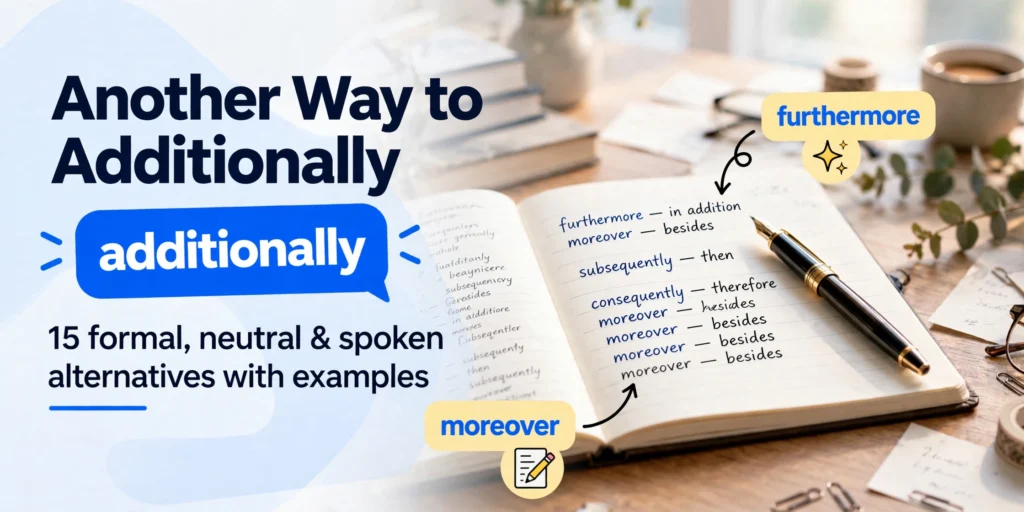
If you find yourself writing “additionally” at the start of every paragraph, you are not alone. It is a perfectly good transitional adverb, but overusing it makes writing feel repetitive and mechanical. Whether you are drafting an essay, a report, or a professional email, having another way to say additionally in your vocabulary will make your writing sharper and more varied.
Fortunately, English offers a rich stock of alternatives, from formal academic connectors to casual spoken fillers. The trick is knowing which substitute fits the situation: “moreover” can sound stiff in a text message, while “plus” may look careless in a dissertation. This guide lists fifteen alternatives grouped by register, with examples, punctuation guidance, and the mistakes to avoid.
Quick Answer
Another way to say additionally in formal writing is “furthermore,” “moreover,” or “in addition.” For neutral contexts, use “also,” “as well as,” or “besides.” In speech and casual writing, “plus” and “and another thing” work well. Most of these alternatives should be followed by a comma when they open a sentence.
Formal Alternatives for Essays and Reports
Academic and professional writing demands precise, authoritative transitions. These are the strongest formal substitutes for “additionally”:
- Furthermore — “The data supports the theory. Furthermore, the replication study confirms the effect.”
- Moreover — “The policy is cost-effective. Moreover, it enjoys broad public support.”
- In addition — “The course covers grammar. In addition, students receive personalised feedback.”
- What is more — “The software is free. What is more, it requires no installation.”
- Besides (formal sense) — “The proposal cuts costs. Besides, it reduces waiting times for patients.”
Use these sparingly — one or two per page is plenty. Stacking “furthermore” and “moreover” in consecutive paragraphs is just as repetitive as overusing “additionally.” For more formal transition techniques, see our guide to alternatives to “in conclusion”, which covers closing sentences in the same register.
Neutral Alternatives for Everyday Writing
For general writing — blog posts, emails, instructions — these neutral options keep the tone natural without sounding academic:
- Also — “She speaks French and also reads Spanish.” Place “also” mid-sentence for the most natural feel.
- As well as — “The app tracks spending as well as savings.”
- On top of that — “Rent has risen, and on top of that, energy bills are up.”
- Not to mention — “The hotel is central, not to mention affordable.”
- Equally — “The first draft was excellent. Equally, the revision impressed the editors.”
One useful habit is pairing a neutral connector with a varied sentence structure. Instead of always placing the connector at the start — “Also, the report includes charts” — try weaving it in: “The report, in addition to its text analysis, includes charts.” Small shifts like this keep paragraphs flowing without drawing attention to the transitions themselves.
Also note that “also” can change meaning depending on position. “She also designed the website” means designing was one of her activities; “Also, she designed the website” simply adds a fact. The difference is subtle, but in precise writing it matters.
Spoken and Texting Alternatives
In conversation, nobody says “furthermore” — these informal options sound natural when you speak:
- Plus — “It’s cheap, plus it lasts for years.”
- And another thing — “The food was great, and another thing — the service was excellent.”
- On top of everything — “I lost my keys, and on top of everything, my phone died.”
- What’s more (casual) — “He speaks three languages — what’s more, he’s only nineteen.”
In rapid conversation, short connectors win. Native speakers often stack tiny additions with “and” plus a phrase rather than a single adverb: “It’s near the station and, honestly, really affordable.” If you are learning English for speaking, practise “plus,” “also,” and “as well” — they cover nearly every situation without sounding like a textbook.
Note that “additionally” itself is rare in speech; native speakers almost always reach for “also,” “plus,” or “as well” instead.
Punctuation and Grammar Guidance
Most alternatives to “additionally” follow the same punctuation rules as the original word:
- At the start of a sentence, follow with a comma: “Furthermore, the results were inconclusive.” “In addition, we received fifty applications.”
- Use a semicolon before and a comma after when joining two independent clauses: “The plan was ambitious; moreover, it was underfunded.”
- Mid-sentence placement needs no commas around “also”: “He also brought dessert.” — but “what is more” always takes a comma after it: “What is more, the tickets are free.”
- “As well as” is a coordinating phrase, not a sentence starter: write “The gym offers yoga as well as boxing,” never “As well as, the gym offers yoga.”
If transition words trip you up elsewhere, our page on other ways to say “for example” covers the same comma rules for another overused phrase.
Choosing the Right Word: Register Guide
Matching the alternative to the situation is what separates polished writing from merely correct writing:
- Academic essays and dissertations: furthermore, moreover, in addition. Avoid “plus” and “on top of that.”
- Business reports and proposals: furthermore, in addition, also. “Moreover” is acceptable but slightly old-fashioned in modern business style.
- Professional emails: also, in addition, as well as. Keep it simple — “furthermore” in an email can sound pompous.
- Blog posts and journalism: on top of that, not to mention, equally. These keep the voice lively.
- Speaking and messaging: plus, and another thing, also. Never use “furthermore” aloud unless you are giving a formal lecture.
When in doubt, downgrade the formality. A slightly plain connector in a formal essay (“also” instead of “moreover”) is a minor stylistic choice; a stiff connector in a casual email (“furthermore, lunch is at noon”) is jarring. Readers forgive simplicity; they notice mismatch.
Common Mistakes
- Wrong: “As well as, we need a backup plan.” Right: “We also need a backup plan.” (“As well as” cannot open a sentence as a connector.)
- Wrong: “The results were clear furthermore they were significant.” Right: “The results were clear; furthermore, they were significant.” (A connector is not a conjunction — you need a semicolon or full stop.)
- Wrong: “Furthermore the committee approved the budget.” Right: “Furthermore, the committee approved the budget.” (Comma after sentence-opening connectors.)
- Wrong: “The package was cheap, plus quick to arrive.” Right: “The package was cheap and quick to arrive.” (Do not force “plus” into a parallel list — use “and” for adjective pairs.)
- Wrong: “In addition of the new features, the price dropped.” Right: “In addition to the new features, the price dropped.” (The fixed preposition is “to,” not “of.”)
Frequently Asked Questions
What is the most formal alternative to “additionally”?
“Furthermore” and “moreover” are the most formal. Use them in academic essays, legal documents, and formal reports. Both take a comma when they open a sentence.
Can I use “also” instead of “additionally”?
Yes — “also” is the most versatile substitute. It works in almost any register, from essays to text messages. Place it mid-sentence (“She also attended”) for the most natural sound, and avoid stacking several “also” sentences in a row.
Is “additionally” too formal for emails?
It is acceptable but slightly stiff. In professional emails, “also,” “in addition,” or “as well as” usually read more naturally. For more guidance on phrasing in reports and citations, see other ways to say “according to”. Mastering these small connectors pays off across every type of writing, from exam answers to cover letters.
What’s the difference between “furthermore” and “moreover”?
They are near-synonyms, but “furthermore” simply adds information, while “moreover” often introduces a point that is stronger or more surprising than what came before. In practice, they are interchangeable in most formal writing.
Related reading: if you liked expanding your transition vocabulary, our guides to other ways to say “for example” and alternatives to “in conclusion” will give your essays and emails the same variety from the first sentence to the last.
Comments (2)