Different Ways to Say Grandma
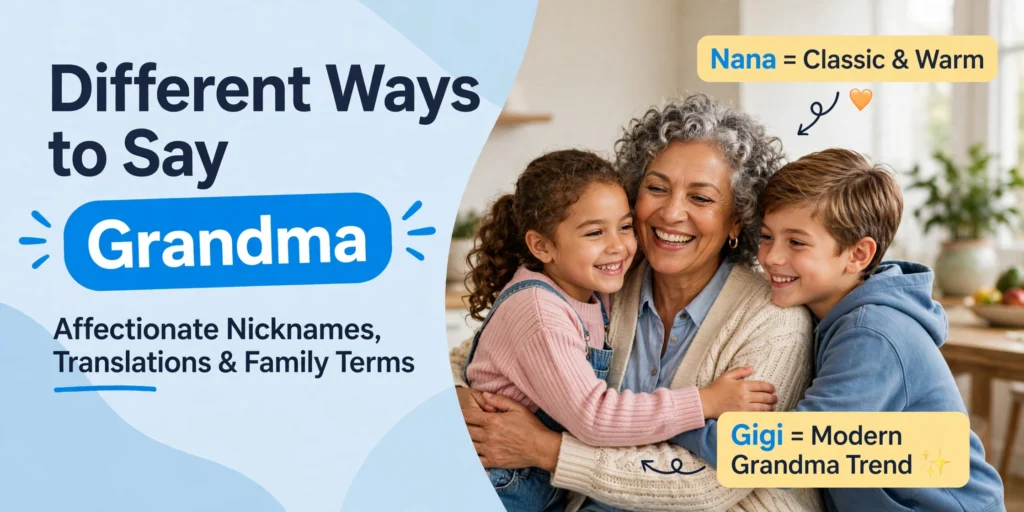
Every family seems to have its own special word for grandma. For some children, she is Gran from the very first word they learn. For others, she is Nana, Granny, or a name borrowed from another language and carried lovingly across generations. These names rarely come from a dictionary. They grow out of baby talk, family jokes, cultural tradition, and the simple fact that a grandmother often holds a unique place in a child’s life.
That is why choosing — or simply discovering — the right name can feel more important than it sounds. A grandmother’s name is used every day, in birthday cards, in stories, and in the excited shout when she walks through the door. It becomes part of her identity within the family, and it often stays with grandchildren long after they have grown up.
This guide looks at the most familiar English names for grandma, along with playful variants and names from other languages and cultures. It also offers gentle advice on choosing a name that suits your family, and on what to do when grandma herself has a clear preference.
Quick Answer
The most common ways to say grandma in British English are Granny, Gran, Nana, and Nanna. Granny and Gran are widely used and warm without being overly formal, while Nana and Nanna often feel softer and more affectionate. The best choice is usually the name your family already uses naturally, or the one grandma herself prefers.
Classic Names: Granny, Gran, Nana, Nanna, and Grandma
Grandma is the full, familiar form of grandmother, and it is understood everywhere in the English-speaking world. It is friendly, clear, and suitable in almost any setting, from a school form to a Mother’s Day card. Many families use Grandma as the standard name, especially when there are two grandmothers and a distinction is needed, such as Grandma Rose and Grandma Patel.
Granny is one of the oldest and most affectionate shortenings, with a storybook warmth. It is still widely used today, although some grandmothers feel it sounds a little old-fashioned.
Gran is shorter, punchier, and very common in modern British families. It feels relaxed and everyday, which is exactly why children often settle on it naturally. A child who struggles to say Grandma may shorten it to Gran all on their own, and the name simply sticks.
Nana and Nanna are close cousins, and both spellings are used in Britain. Nana is often associated with a warm, nurturing grandmother, while Nanna is a common alternative spelling in some families and regions. Neither spelling is more correct than the other in family use; what matters is consistency, so birthday cards and school records do not end up mixing the two. Like Gran, these names are often created by young children, which gives them a particular sweetness.
Grandmother is the more formal option, best reserved for writing or special occasions rather than everyday conversation.
Affectionate and Playful Variants
Beyond the classics, families invent endless affectionate variants. Some are shortened even further, such as Gram or Grams, which are more common in American English but are also heard in Britain. Others add a touch of playfulness, such as Gigi, Mimi, or Lala. These names often start as a toddler’s attempt at Grandma and then become a treasured family tradition.
Some grandmothers choose a name that reflects their personality rather than their age, such as G-Ma or Glamma, a blend of glamorous and grandma. These playful names work best when grandma chooses them herself. Double names are another lovely option: Grandma Jane or Nana Sue helps children tell two grandmothers apart without losing any warmth.
Names from Other Languages and Cultures
Many British families use a grandmother’s name from another language, often because it honours their heritage. These names should be used with respect for their original language and culture, and it is always worth checking pronunciation and spelling with family members who know the language well.
- Abuela — Spanish for grandmother, widely used in Spanish-speaking families and understood by many English speakers.
- Nonna — Italian for grandmother, a warm and widely recognised name in Italian families.
- Yaya — Greek for grandmother, pronounced yah-YAH, and used with great affection in Greek families.
- Mémé — a French affectionate term for grandmother, pronounced may-MAY.
- Oma — Dutch and German for grandmother, pronounced OH-mah.
- Babcia — Polish for grandmother, pronounced BAHB-chah, and often shortened to Babci in affectionate speech.
- Avó — Portuguese for grandmother, pronounced ah-VOH.
- Amma — used in several South Asian languages, including Tamil and Malayalam, where it can mean mother or grandmother depending on the family and context, so family usage should guide you.
- Dadi — used in Hindi, Urdu, and Punjabi families for a paternal grandmother, while Nani is used for a maternal grandmother. This distinction matters in those cultures, so it is best to follow the family’s own practice.
Using a name from another culture can help keep a language alive for the next generation. As with any family name, use the form the family itself uses, rather than guessing at a translation.
Choosing a Name That Suits Your Family
There is no single correct name, only the one that feels right for your family. Start by listening. What do older grandchildren already call her? What did she call her own grandmother? What name does she use when she talks about herself to the children? The answers usually point to the natural choice.
Practicality matters too. A name should be easy for a small child to say and spell, which is one reason short names such as Gran, Nana, and Gigi are so popular. Consider clarity as well: in families with two grandmothers, distinct names prevent confusion — one might be Granny, the other Nana, while a great-grandmother might be Great-Granny.
Finally, remember that names can evolve. A child who says Nana at three may say Gran at thirteen, and that is perfectly normal, not a rejection.
What to Do If Grandma Prefers a Particular Name
Sometimes grandma has a strong preference, and it deserves respect. She may dislike Granny because it makes her feel old, or love Nana because it was her own grandmother’s name. Whatever she chooses, using it is a simple act of kindness.
If a young child has already settled on a different name, do not force a sudden change. Gently model the preferred name yourself — “Let’s show Gran your picture” — and praise the child when they use it. Most children adapt quickly, especially when they see that the new name makes grandma smile.
If family members disagree — for example, one parent grew up saying Nanna and the other says Granny — grandma’s own choice should settle the matter. Above all, keep the conversation light: the love behind the name matters far more than the exact word.
Common Mistakes
Wrong: Calling her Granny when she has asked to be called Nana.
Right: Use the name grandma prefers, even if another name feels more natural to you.
Wrong: Mixing Nana and Nanna interchangeably on cards, gifts, and school forms.
Right: Pick one spelling as a family and use it consistently.
Wrong: Using Dadi for a maternal grandmother in a Hindi, Urdu, or Punjabi family.
Right: Follow the family’s own usage: Dadi for a paternal grandmother and Nani for a maternal grandmother.
Wrong: Correcting a toddler every time they say a name differently from the one you chose.
Right: Let young children shape the name naturally, and gently model the preferred form without making it a lesson.
Wrong: Assuming Grandmother is the best everyday name because it is the most formal.
Right: Reserve Grandmother for formal writing or special occasions, and use Grandma, Gran, or Nana in everyday conversation.
Frequently Asked Questions
What is the most common way to say grandma in the UK?
Granny, Gran, Nana, and Nanna are all very common in the UK, and Grandma itself is widely used too. Regional and family habits vary, so there is no single winner. The most common name in your family is the one your children already use and grandma happily answers to.
Is it Nana or Nanna?
Both spellings are used, and both are correct in family use. Nana is the more widely seen spelling, while Nanna is also common in Britain. Choose the spelling your family already uses, keep it consistent, and do not worry about which one a dictionary prefers, since this is a family name rather than a formal term.
What should children call two grandmothers?
Many families give each grandmother a different name, such as Granny and Nana, or add a first name, such as Grandma Jane and Grandma Sue. This helps children tell them apart and build a distinct relationship with each one. If both grandmothers prefer the same name, adding a first name is the simplest solution.
Can a grandma choose her own name?
Absolutely, and many do. Some grandmothers choose a classic name such as Nana, while others invent something playful such as Gigi or Mimi. Respecting her choice is the kindest approach, and children usually adopt a grandmother’s chosen name quickly when adults model it warmly and consistently.
Finding the right words for the people we love is part of everyday family life. If you enjoy exploring warm, everyday language, you might also like our guides to different ways to say hello and creative ways to say thank you, and for the most important message of all, see different ways to say I love you.

Join the conversation