Synonyms for Terrible: 25+ Better Words to Use
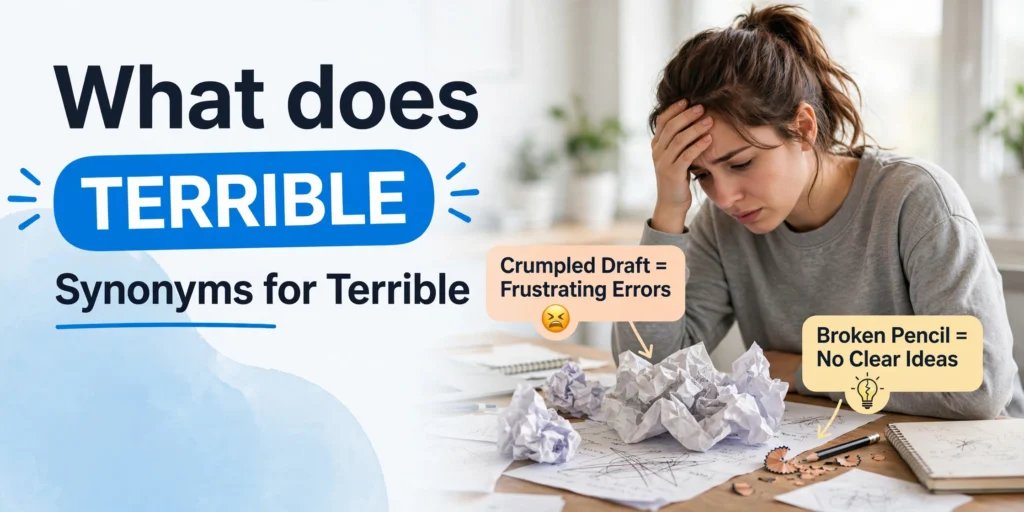
We all reach for the word terrible when something goes badly wrong, from a ruined dinner to a dreadful film. It is a useful word, but it is also overworked, and using it for everything soon makes your writing sound flat and repetitive. When every disappointment is terrible, none of them feels truly bad.
The good news is that English offers a rich shelf of alternatives, each with its own shade of meaning. Awful, dreadful, appalling and atrocious all overlap with terrible, yet none of them means exactly the same thing. Choosing the right one depends on what you are describing and whether you are writing formally or chatting with friends.
This guide groups the best synonyms for terrible by meaning and register, so you can pick the word that fits your sentence. You will find everyday options, stronger formal choices, and the common mistakes to avoid, with example sentences throughout.
Quick Answer
The best synonyms for terrible are awful, dreadful, horrible, appalling and atrocious. Use awful or dreadful for something of very poor quality, horrible or frightening for something that causes fear or distress, and appalling or atrocious when you want a stronger, more formal tone. The right choice depends on whether you mean bad quality, a shocking event, or something genuinely frightening.
What Does “Terrible” Mean?
Terrible has two main senses, and the synonyms you choose depend on which one you mean. The first, and most common, is very bad or of poor quality: a terrible meal, a terrible decision, a terrible film. The second is something that causes fear, shock or distress: a terrible accident, a terrible storm, terrible news. Many synonyms work for one sense but sound odd in the other, which is why grouping them by meaning matters.
Terrible comes from the Latin word terror, meaning fear, which explains its second sense. Over time, though, the quality sense has taken over in everyday speech, so we now call a dull meeting terrible without suggesting anyone was frightened. Keep both senses in mind as you work through the groups below, and your word choice will stay precise.
Synonyms for Terrible Meaning Very Bad Quality
When terrible means poor quality, these are the closest replacements. They all describe something that fails to meet a reasonable standard, but they differ in strength, from mildly disappointing to shockingly bad.
- Awful – “The service was awful; we waited an hour for cold food.” Awful is the nearest everyday match for terrible and works in almost any informal context.
- Dreadful – “The weather was dreadful all weekend, with rain and gale-force winds.” Dreadful adds a sense of gloom and is slightly more formal than awful.
- Atrocious – “His spelling was atrocious, with errors in almost every sentence.” Atrocious is stronger than awful and suggests something shockingly bad rather than merely disappointing.
- Abysmal – “The team’s abysmal performance left the fans furious.” Abysmal means extremely bad, as if at the bottom of a pit, and suits results, standards and performances.
- Appalling – “The appalling state of the roads made driving dangerous.” Appalling is strong and slightly formal, suggesting that something is bad enough to shock you.
- Poor – “The poor quality of the printing ruined an otherwise good book.” Poor is the mildest option here, useful when you want to criticise gently without sounding angry.
For more words in this family, see our guide to synonyms for bad, which covers milder options for everyday criticism.
Synonyms for Terrible Meaning Frightening or Distressing
When terrible describes something frightening, shocking or upsetting, quality words like poor and substandard no longer work. You need words that carry fear or distress.
- Horrible – “The horrible crash closed the motorway for hours.” Horrible covers both fear and disgust, making it one of the most flexible synonyms for terrible.
- Horrifying – “The horrifying photographs showed the scale of the damage.” Horrifying is stronger than horrible and describes something that fills you with horror.
- Terrifying – “It was a terrifying experience, and she still thinks about it now.” Terrifying focuses on fear itself, so use it when the main feeling is being scared.
- Frightful – “A frightful storm tore the roof from the house.” Frightful is slightly old-fashioned and literary, but it still works well for storms, accidents and sudden shocks.
- Shocking – “The shocking news left the whole office in silence.” Shocking suits events that stun or upset people, especially bad news and sudden revelations.
Horrible and shocking also work for bad quality in informal speech, but keep them in this group when fear or distress is the point.
Stronger and More Formal Alternatives
In formal writing, essays and reports, terrible can sound vague or emotional. These stronger words carry more weight and precision, but they also raise the tone, so save them for moments that deserve it.
- Deplorable – “The deplorable living conditions shocked the inspectors.” Deplorable is formal and suggests something worthy of strong disapproval.
- Dire – “The dire shortage of nurses worried the hospital managers.” Dire means extremely serious or urgent, and it suits warnings, shortages and consequences.
- Ghastly – “He made a ghastly mistake that cost the company thousands.” Ghastly is formal and dramatic, describing something very bad or unpleasant in a vivid way.
- Lamentable – “The lamentable state of the archives meant years of records were lost.” Lamentable is formal and suggests something regrettable and sad.
- Abominable – “The abominable weather forced the festival to close early.” Abominable is formal and literary, and it works for weather, behaviour and conditions.
Formal words lose their force if you use them too often, so keep one strong word per paragraph and save the rest for moments that genuinely deserve the emphasis.
Informal and Everyday Alternatives
In conversation and casual writing, terrible often sounds too heavy. These lighter options say the same thing without the drama.
- Rotten – “We had rotten luck with the weather all week.” Rotten is cheerful and informal, best for luck, days and small disappointments.
- Rubbish – “The film was rubbish, so we left halfway through.” Rubbish is a very British way to call something bad, and it sounds natural in everyday speech.
- Lousy – “The lousy Wi-Fi made working from the café impossible.” Lousy is casual and mildly comic, good for services and small frustrations.
- Hopeless – “He was hopeless at directions and got us lost twice.” Hopeless describes a person or attempt that fails badly, with a fond, joking tone.
- Dismal – “It was a dismal performance, and the crowd went quiet.” Dismal is informal enough for conversation but also works in writing, suggesting gloom as well as poor quality.
Informal words belong in informal places. Rubbish and lousy are perfect in a text to a friend, but they will look out of place in a job application or an academic essay.
Common Mistakes
These are the errors that appear most often when people reach for a stronger word than terrible. Each pair shows the mistake first, then the fix.
- Using atrocious for mild problems: Wrong: “The atrocious queue at the café took five minutes.” Right: “The long queue at the café took five minutes.” Atrocious means shockingly bad, so save it for failures that genuinely deserve the word.
- Confusing terrible with terrific: Wrong: “We had a terrible time at the party — the music was brilliant.” Right: “We had a terrific time at the party — the music was brilliant.” Terrible means very bad; terrific means excellent, so the two are near opposites.
- Using horrifying for ordinary bad news: Wrong: “The horrifying news was that the shop had sold out of milk.” Right: “The disappointing news was that the shop had sold out of milk.” Horrifying describes something that causes horror, not a small inconvenience.
- Using abysmal for things that are merely average: Wrong: “Her abysmal essay earned a B.” Right: “Her average essay earned a B.” Abysmal means extremely bad, so it clashes with a decent grade.
- Mixing the two senses: Wrong: “The terrible news about the flood was poor quality.” Right: “The terrible news about the flood left everyone shaken.” When terrible means frightening or distressing, pair it with words about feelings, not quality.
Frequently Asked Questions
What is the best synonym for terrible?
Awful is the best all-round synonym for terrible because it works in almost any context, from a bad meal to a disappointing result. Dreadful is a close second and sounds slightly more formal. For something truly shocking, use appalling or atrocious instead.
What is a formal synonym for terrible?
Deplorable, dire, lamentable and abominable are the most useful formal synonyms for terrible. Deplorable suits behaviour and conditions that deserve disapproval, while dire fits serious situations such as shortages, warnings and consequences. Ghastly is also formal but more dramatic.
What is the difference between terrible and horrible?
The two words overlap a great deal, but horrible leans slightly more towards fear and disgust, while terrible leans more towards poor quality. A horrible accident sounds frightening, whereas a terrible film sounds badly made. In everyday speech, though, most people use them interchangeably.
Can terrible ever mean something good?
Terrible itself almost always means very bad, so do not use it as praise. The adverb terribly, however, can simply mean very, as in “terribly kind” or “terribly clever”. This is an old-fashioned usage, and it is safer in modern writing to use very or extremely instead.
Once you can tell the two senses of terrible apart, the right synonym usually chooses itself. Keep practising with everyday examples, and explore our guide to synonyms for bad for more words to add to your vocabulary.


Join the conversation