Synonyms for Perfect: 25+ Better Words to Use
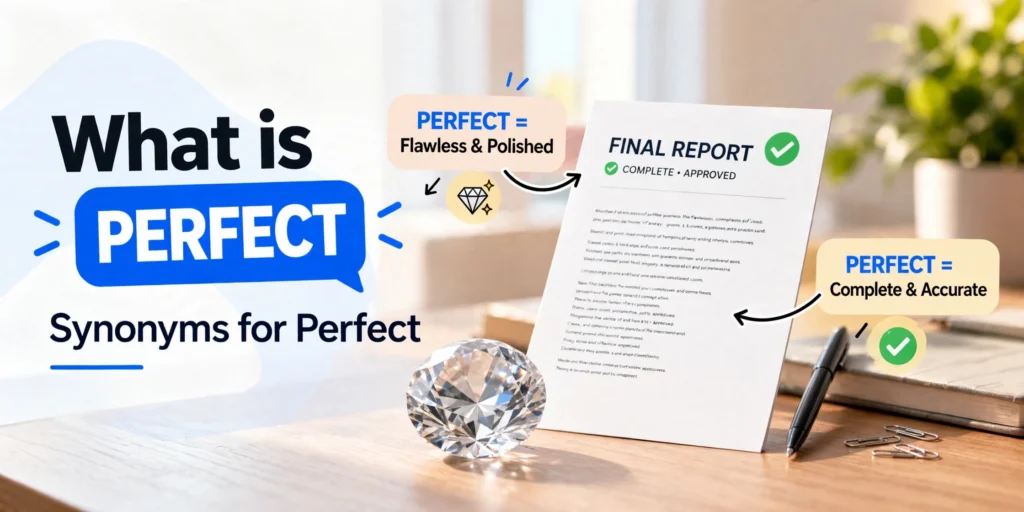
Introduction
Perfect is one of those words we reach for far too often. A meal was perfect, a day was perfect, a performance was perfect — and after a while, the word starts to lose its force. When everything is perfect, nothing sounds quite perfect any more. That is why having a wider range of synonyms matters: the right word does not just repeat the same idea, it sharpens it.
The best synonym for perfect depends on what you actually mean. A flawless diamond is not the same kind of perfect as an ideal holiday, and an exact copy is perfect in a different sense again. Some synonyms stress the absence of faults, others stress high quality, and others still stress completeness or precision. Choosing between them is a matter of nuance, not just variety.
In this guide, you will find more than 25 synonyms for perfect, grouped by meaning and register, with example sentences for each group. You will also learn which words suit formal writing, which work best in everyday speech, and which common mistakes to avoid when you use them.
Quick Answer
The best synonyms for perfect are flawless, ideal, impeccable, faultless and excellent. Use flawless or impeccable for something with no visible faults, ideal for the best possible option in a situation, and excellent or superb for very high quality. For completeness, use complete or whole, and for precision, use exact or precise.
Flawless, Impeccable and Faultless: Perfect With No Faults
When you describe something as flawless, you mean it has no faults, marks or imperfections at all. It is the most direct synonym for perfect in this sense, and it works well for physical things — skin, gemstones, performances and craftsmanship — as well as for more abstract ideas such as timing or technique.
Impeccable is a slightly more formal cousin of flawless. It suggests not just the absence of faults but a standard so high that criticism feels impossible. You might praise someone’s impeccable manners, impeccable taste or an impeccable record of service. It is a favourite in formal and professional writing because it sounds polished without sounding stiff.
Faultless carries a similar meaning but is often used for behaviour, work and performance. A faultless display, a faultless argument or a faultless driving test all suggest that nothing went wrong at any point. Immaculate is another useful option, especially when cleanliness or neatness is part of the perfection: an immaculate kitchen, an immaculate uniform, an immaculate garden.
Other words in this group include unblemished, spotless and pristine. Unblemished suits reputations and records, spotless suits rooms, clothes and conduct, and pristine suggests something in its original, untouched condition. Each one narrows the idea of perfection to a particular kind of faultlessness.
- Her performance in the final was flawless from start to finish.
- The hotel was known for its impeccable service and attention to detail.
- He gave a faultless presentation, answering every question with confidence.
- The cottage had an immaculate garden, with not a weed in sight.
- After twenty years in the job, she retired with an unblemished record.
Ideal, Exemplary and Model: Perfect as a Standard
Ideal is the right word when something is the best possible option in the circumstances, even if it is not literally faultless. An ideal candidate is not a flawless human being; they are the best fit for the role. An ideal location is not perfect in every imaginable way; it is the most suitable one available. This makes ideal one of the most useful and most frequently used synonyms for perfect.
Exemplary goes a step further: it describes something so good that it can serve as an example for others to follow. Exemplary behaviour, exemplary leadership and exemplary customer service all imply a standard worth copying. Model works in a similar way — a model pupil, a model employee, a model citizen — although it can sound a little formal or old-fashioned in casual writing.
Other words in this group include optimum and quintessential. Optimum belongs mainly to technical, scientific and business writing, where it means the most favourable conditions for a particular purpose. Quintessential is more literary: it describes the purest or most typical example of something, as in the quintessential English village or the quintessential summer afternoon.
- The cottage by the lake was the ideal place for a quiet weekend away.
- She was praised for her exemplary conduct during a difficult year.
- He is a model student, always prepared and always on time.
- The team searched for the optimum temperature for storing the samples.
- It was the quintessential village fete, complete with bunting and homemade jam.
Excellent, Superb and Outstanding: Perfect in Quality
Sometimes perfect simply means very, very good — and in that case, excellent is the most natural synonym. It is less absolute than flawless and less formal than impeccable, which makes it suitable for almost any context, from school reports to restaurant reviews. If you want still more variety, our guide to synonyms for great covers many of the same words in greater depth.
Superb is stronger and more enthusiastic than excellent. It suits praise for food, performances, scenery and achievements: a superb meal, a superb goal, a superb view. Outstanding is similar but carries a hint of standing out from the rest, which makes it a good choice for awards, results and achievements. First-rate and top-notch are more informal alternatives, useful when you want praise that sounds warm rather than formal.
Other words worth knowing in this group include magnificent, splendid and sterling. Magnificent suits grand occasions and impressive sights, splendid has a slightly old-fashioned, cheerful tone, and sterling is used mainly for qualities such as character, work or service. A sterling effort or sterling reputation suggests quality that can be relied on completely.
- The restaurant served excellent food at very reasonable prices.
- She gave a superb performance that earned a standing ovation.
- His exam results were outstanding, the best in the school.
- The hotel offered first-rate facilities and genuinely friendly staff.
- Their sterling work raised thousands of pounds for the charity.
Complete, Whole and Entire: Perfect as Finished or Unbroken
Perfect does not always mean faultless or excellent. Sometimes it means complete, finished or whole, with nothing missing. A perfect set is a set with every piece present; a perfect circle is one that is unbroken and fully formed. In this sense, the best synonyms are complete, whole, entire and intact.
This use appears often in fixed phrases. A perfect stranger is someone you have never met before, not someone with no faults. A perfect day may simply be a whole day spent happily, rather than a day without a single mishap. Understanding this sense helps you avoid choosing a synonym that changes the meaning: calling a set complete is accurate, while calling it flawless would be odd.
Intact is useful when something has survived whole and undamaged, while unbroken suits promises, records and silence. Undivided suggests complete attention or loyalty. Each of these words captures a different shade of wholeness, and each one is more precise than perfect when completeness is what you mean.
- The collection was finally complete, with every volume in place.
- After the move, the vase arrived entirely intact, without a single chip.
- They enjoyed a whole week by the sea, with no interruptions at all.
- Despite the pressure, she kept her promise unbroken.
- The audience listened in unbroken silence throughout the speech.
Exact, Precise and Accurate: Perfect in Detail
The final group covers perfection as precision. An exact copy, a precise measurement or an accurate description is perfect because it matches the original or the truth without error. Here, the synonyms are exact, precise, accurate and correct — and the differences between them matter.
Exact stresses that something matches something else completely, with no difference at all. Precise stresses fine detail and careful measurement: precise instructions, precise timings, precise language. Accurate stresses closeness to the truth or to a target, which is why we speak of accurate forecasts, accurate accounts and accurate aim. Correct is the plainest of the group, useful when you simply mean free from error.
Other words in this group include meticulous and rigorous, which describe the care behind the precision rather than the result itself. Meticulous work is done with extreme attention to detail, while rigorous standards are strict and thorough. Both are valuable in academic and professional writing, where precision is part of the point.
- Please send an exact copy of the document, not a summary.
- The recipe gave precise measurements for every ingredient.
- Her account of the meeting was accurate in every detail.
- The meticulous planning paid off on the day itself.
- The study followed rigorous methods and checked its results twice.
Common Mistakes
Perfect is an easy word to misuse, and its synonyms are no different. The most common errors come from choosing a word that sounds impressive but does not match the meaning, or from treating perfect as a word that can be graded. These five pairs show the mistakes to watch for.
- Wrong: The weather was more perfect than yesterday. Right: The weather was even better than yesterday. Perfect is an absolute: something either is perfect or it is not, so avoid more perfect and most perfect in careful writing.
- Wrong: He gave an impeccable excuse for being late. Right: He gave a convincing excuse for being late. Impeccable describes quality or conduct, not excuses; a convincing excuse is one that is believed.
- Wrong: She is the most ideal person for the job. Right: She is the ideal person for the job. Ideal already means the best possible, so most ideal is redundant in standard English.
- Wrong: The cake was a flawless recipe. Right: The cake was made from a flawless recipe, or the cake itself was flawless. A recipe can be excellent, but flawless usually describes the finished result rather than the instructions.
- Wrong: He kept a perfect silence during the whole film. Right: He kept complete silence during the whole film. When you mean unbroken or total, complete or unbroken is more natural than perfect.
Frequently Asked Questions
What is the best synonym for perfect?
It depends on your meaning. Flawless is the best general synonym for something with no faults, ideal is best for the most suitable option, and excellent is best for very high quality. For precision, choose exact or precise, and for completeness, choose complete or whole.
Is perfect an adjective or a noun?
Perfect is most often an adjective, as in a perfect day or a perfect score. It can also be a verb, meaning to make something as good as it can be, as in to perfect a recipe. In grammar, perfect tenses — such as the present perfect — describe actions completed in relation to another time, which is a separate use of the word.
Can you say more perfect in English?
In everyday speech, people do say more perfect, and it is usually understood. In careful or formal writing, however, perfect is treated as an absolute adjective, so more perfect and most perfect are best avoided. Use better, even better or closer to perfect instead.
What is a formal synonym for perfect?
Impeccable, exemplary and faultless are all strong formal choices. Impeccable suits service, manners and taste; exemplary suits behaviour and standards that others should follow; faultless suits work, performances and arguments. In academic writing, optimum and rigorous are also useful for precise, technical senses of perfection.
For more words that express high praise, see our guides to synonyms for amazing and synonyms for good — both offer fresh alternatives for everyday writing.



Join the conversation