Another Way to Say “At the Same Time”
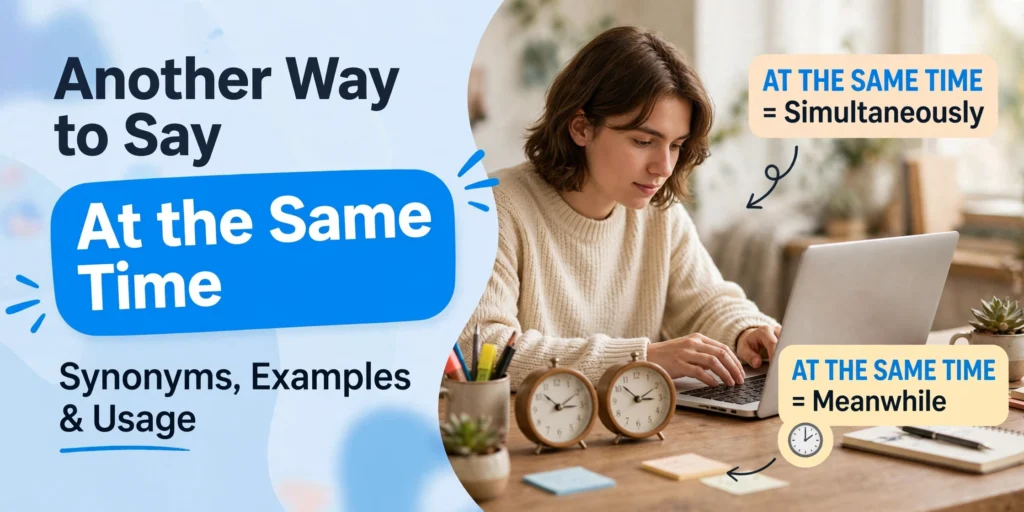
“At the same time” is one of those phrases that sneaks into everything we write. It describes something perfectly well — two things happening together — but because it fits almost everywhere, we end up using it again and again. Before long, an essay, email, or report is peppered with the same six words, and the writing starts to feel repetitive and flat.
The good news is that English offers a generous shelf of alternatives, each carrying a slightly different shade of meaning. Some are formal enough for academic essays and business reports; others are short and punchy enough for texts and captions. The trick is choosing the one that matches your tone, your meaning, and the sentence structure you’ve already built. In this guide, you’ll find twelve tested alternatives, organised by register, with real examples so you can slot them straight into your own writing.
Quick Answer
The best alternatives to “at the same time” depend on your tone. In formal writing, try simultaneously, concurrently, or in tandem. In neutral writing, meanwhile and at once work well. For casual writing, at the same go or simply while keep things light. Choose the option whose register matches the rest of your sentence, and avoid stacking two time phrases together.
Formal Alternatives for Essays and Reports
When you’re writing something academic or professional, you need substitutes that sound measured and precise. Simultaneously is the classic one-to-one replacement: “The system backs up the files simultaneously.” It means exactly the same thing as “at the same time” and never sounds out of place in a formal document.
Concurrently is a close cousin, often used in project management and computing: “Both phases were developed concurrently.” Then there’s in tandem, which adds a hint of cooperation: “The two departments worked in tandem to deliver the update.” Finally, contemporaneously appears in legal and historical writing — “The events occurred contemporaneously” — though it’s best reserved for moments when you genuinely need that level of formality, since it can sound heavy in everyday prose.
One caution: formal alternatives can make simple sentences feel stiff if overused. If your whole paragraph is already formal, a single simultaneously is fine; if the writing is plain and direct, reaching for contemporaneously will stick out like a sore thumb.
Neutral Alternatives That Work Almost Anywhere
The most versatile substitute is meanwhile. It carries exactly the same meaning and slips into almost any sentence: “Meanwhile, the team in Manchester was finalising the designs.” Because it opens sentences so naturally, it’s a favourite in news articles, blog posts, and business emails alike.
At once is another flexible option, though it leans slightly more dramatic: “She was laughing and crying at once.” It also doubles as a synonym for “immediately” in some contexts (“Come here at once!”), so read your sentence back to make sure the intended meaning is clear. The same caution applies to at the same moment, which is perfectly correct but a touch more poetic: “They both realised at the same moment that the train had left.”
If you’re listing several points in an argument, don’t forget that sequencing words can carry timing for you without a dedicated phrase. Pairing your clauses with while — “He was cooking while she set the table” — often removes the need for any substitute at all. For more ideas on linking ideas smoothly, see another way to say “as well as”.
Casual Alternatives for Everyday Writing
In texts, social media captions, and friendly emails, you want something short and natural. At the same go fits that bill: “I’ll sort the playlist and the food at the same go.” It’s informal but widely understood in British English.
While you’re at it works when one action piggybacks on another: “Grab some milk while you’re at it.” And in the simplest cases, plain and does the job: “She was singing and dancing” needs no time phrase whatsoever. Overwriting a casual message with concurrently would be like wearing a suit to a barbecue — technically fine, socially odd.
That said, casual alternatives have limits. In a job application, a presentation, or anything your manager will read, stick to the neutral or formal options above. Register matters: matching the formality of your substitute to the formality of your document is half the skill.
When “At the Same Time” Means Something Else
Here’s the part most guides skip: “at the same time” doesn’t always describe timing. Very often it means “however” or “on the other hand” — a contrast rather than a clock: “The film was brilliant; at the same time, it was far too long.” In this sense, the phrase is closer to a concession than a timestamp.
If that’s your meaning, the timing alternatives above won’t work. Instead, reach for contrast markers: however, on the other hand, that said, or having said that. “The film was brilliant; having said that, it was far too long.” Misreading which meaning you intend is one of the most common sources of clumsy writing with this phrase, so check before you substitute. If you need more contrast options, other ways to say “however” has you covered.
The phrase can also carry a soft concession meaning “admittedly”: “She was nervous, but at the same time excited.” Here, yet or but usually reads more naturally: “She was nervous, yet excited.”
Choosing the Right Substitute: A Quick Checklist
With twelve options on the table, a short decision process helps. Ask yourself three questions:
- What is my register? Formal document → simultaneously, concurrently. Everyday writing → meanwhile, at once. Texting a friend → at the same go, while.
- Do I mean timing or contrast? Timing → the words above. Contrast → however, on the other hand, having said that.
- Does the sentence still work if I delete the phrase? “She was singing and dancing” loses nothing. If it loses nothing, cut it — the best substitute is often no substitute.
One final tip: variety within a document matters more than variety within a sentence. It’s fine to use meanwhile in paragraph two and simultaneously in paragraph five. What’s jarring is meanwhile in every other sentence — which, of course, is exactly the trap “at the same time” set for you in the first place. For more ways to vary your linking phrases, read another way to say “additionally”.
Common Mistakes
- Wrong: “He spoke and listened at the same time simultaneously.” Right: “He spoke and listened simultaneously.” — Never stack two timing phrases; one is enough.
- Wrong: “Come here at the same time!” (intended as “come immediately”). Right: “Come here at once!” — At the same time describes simultaneity, not urgency.
- Wrong: “The product is expensive; simultaneously, it’s reliable.” Right: “The product is expensive; however, it’s reliable.” — Use contrast words for contrast meanings, not timing words.
- Wrong: “They both happened concurrent.” Right: “They both happened concurrently.” — Concurrent is an adjective; the adverb you need is concurrently.
- Wrong: “Meanwhile of the meeting, we agreed the budget.” Right: “During the meeting, we agreed the budget.” — Meanwhile can’t take an of phrase; use during or at the same time as instead.
Frequently Asked Questions
What is the most formal alternative to “at the same time”?
Simultaneously is the standard formal replacement and works in virtually any serious context, from essays to business reports. Concurrently suits technical and project-management writing, while contemporaneously is reserved for legal or historical texts where that extra weight is expected.
Can I use “meanwhile” at the start of a sentence?
Yes — that’s its most natural position. “Meanwhile, the rest of the team kept working” is perfectly correct in every register, and it’s one of the smoothest ways to avoid repeating “at the same time” across a paragraph.
Is “at the same time” always about timing?
No. It frequently means “however” or “on the other hand”, as in “It was expensive; at the same time, it was worth it.” Check which meaning you intend before choosing a substitute, because timing words like simultaneously won’t make sense in a contrast sentence.
How do I stop overusing “at the same time” in essays?
Rotate through alternatives matched to your register — simultaneously, meanwhile, at once — and use while clauses to fold the timing into the sentence itself. Often the cleanest fix is deletion: if the sentence makes sense without the phrase, leave it out.
For more ways to freshen up overused phrases, you might also enjoy another way to say “as well as” and other ways to say “however”.


Join the conversation