Other Ways to Say But: 30+ Alternatives for Better Writing
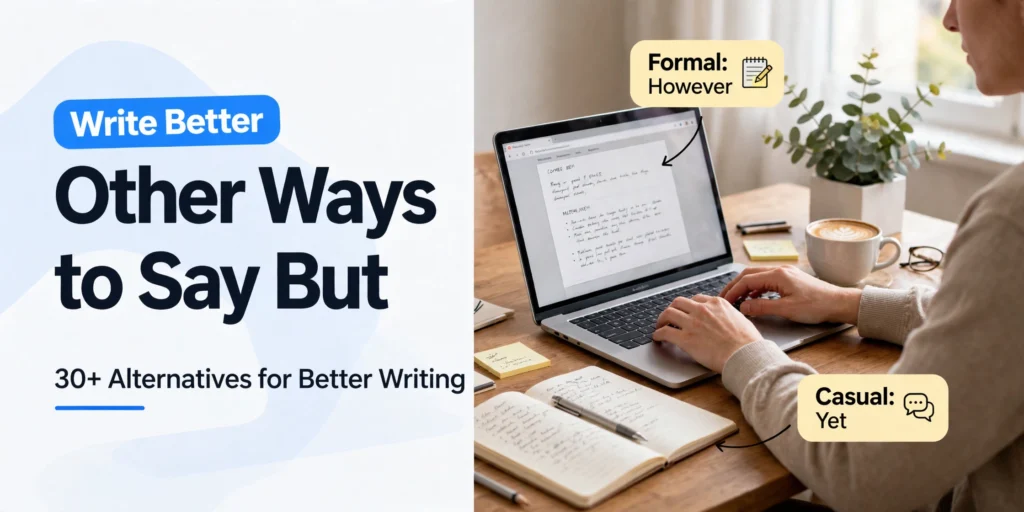
The word “but” does an enormous amount of work in English. It contrasts, qualifies, and contradicts, and most of us reach for it several times a day without a second thought. Yet when “but” appears in nearly every sentence, writing starts to sound repetitive and flat. If you are looking for other ways to say but, the good news is that English offers more than 30 alternatives, from however and yet to despite, whereas, and except.
The challenge is choosing the right one. Some substitutes express a mild qualification (“although it rained”), others signal a strong contrast (“nevertheless, we continued”), and a few change the meaning entirely: “everyone but Alice” does not contrast at all, it excludes. Pick the wrong replacement and your sentence will feel clumsy; pick the right one and your writing instantly sounds more precise and varied.
This guide groups more than 30 alternatives to “but” by what they actually mean, with real examples in every section, followed by the mistakes learners make most often when swapping them in. And if you tend to pile up linking words in general, learning another way to say also can tidy up sentences where you are adding ideas rather than contrasting them.
Quick Answer
The best alternative to “but” depends on your meaning. Use however, yet, or nevertheless to contrast two ideas; although, though, despite, or in spite of to concede a point; whereas, while, or on the other hand to compare two things; and except, apart from, or barring when you mean “with the exception of”. In formal writing, place however or nevertheless after a semicolon rather than starting sentences with “but”.
Alternatives That Contrast Two Ideas
When two facts pull in opposite directions, these are the closest direct replacements for “but”.
- However — the most versatile formal choice. It usually follows a semicolon or starts a new sentence: “The experiment succeeded; however, the results were inconclusive.” For a deeper dive, see our guide to other ways to say however.
- Yet — slightly literary, often carrying a hint of surprise: “He is only sixteen, yet he writes like a professional.”
- Nevertheless and nonetheless — formal and emphatic, ideal for essays and reports: “The journey was exhausting; nevertheless, nobody complained.”
- Still — conversational and natural in speech: “The course is expensive; still, it is worth every penny.”
- Even so, that said, and having said that — spoken-style transitions that soften the contrast: “The hotel was basic. Having said that, the staff were wonderful.”
Alternatives That Concede a Point
Use these for the classic “yes, but” move, where you admit one fact while asserting another.
- Although and though — both must be followed by a clause containing a verb: “Although it was midnight, the office was still busy.” “Though” is slightly less formal.
- Even though — stronger than “although”, stressing that the obstacle was serious: “Even though she was unwell, she delivered the presentation.”
- Despite and in spite of — followed by a noun or an -ing form, never a full clause: “Despite the delay, we arrived on time.” / “In spite of raining all morning, the match went ahead.”
- Notwithstanding — very formal, common in legal and academic writing: “Notwithstanding the criticism, the policy remained in place.”
- Regardless of — emphasises that the obstacle did not matter: “Regardless of the cost, safety comes first.”
Alternatives That Compare or Oppose
When you are setting two things against each other rather than qualifying a single point, reach for these.
- Whereas — the formal choice for direct comparison of two clauses: “She favours caution, whereas her brother takes risks.”
- While — can do the same job as “whereas”, though it is more ambiguous because it also means “at the same time”: “While I enjoy cities, my partner prefers the countryside.”
- On the other hand — for balanced comparisons: “City life is exciting; on the other hand, the countryside is peaceful.”
- By contrast and in contrast — formal favourites in academic writing: “By contrast, the second study found no effect at all.”
- Conversely — flips the statement around: “Wealth does not guarantee happiness; conversely, poverty does not guarantee misery.”
- On the contrary — corrects a false impression rather than merely contrasting: “The task was not difficult; on the contrary, it was straightforward.”
- Instead — presents the alternative outcome: “He did not complain; instead, he proposed a solution.”
Alternatives That Mean “Except”
Sometimes “but” does not contrast at all — it excludes, as in “everyone but Sam stayed late”. These substitutes keep exactly that meaning.
- Except and except for — the standard replacements: “Everyone except Sam stayed late.”
- Apart from — slightly softer, common in British English: “Apart from Sam, everyone stayed late.”
- Barring — formal, suggesting “unless something prevents it”: “Barring accidents, we will finish by Friday.”
- Save — literary and old-fashioned, best in creative writing: “They found nothing save a single letter.”
- With the exception of — the most formal option: “With the exception of Sam, everyone stayed late.”
- But for — a fixed idiom meaning “were it not for”: “But for your help, we would have failed.”
- Other than — neutral and flexible: “We discussed nothing other than the budget.”
Common Mistakes
Swapping in a fancier word only helps if the grammar still works. These are the errors learners make most often.
- Wrong: “She was exhausted, but however she kept working.” Right: “She was exhausted; however, she kept working.” (“However” already means “but”, so never use the two together.)
- Wrong: “Despite of the rain, the match continued.” Right: “Despite the rain, the match continued.” (“In spite of” takes “of”; “despite” never does.)
- Wrong: “Although the high prices, sales rose.” Right: “Although prices were high, sales rose.” (“Although” needs a clause with a verb; for a noun phrase, use “despite”: “Despite the high prices, sales rose.”)
- Wrong: “He left early, whereas because he was tired.” Right: “He left early because he was tired.” (“Whereas” compares two clauses; it cannot replace “because”.)
- Wrong: opening every paragraph of a formal essay with “But”. Right: vary it with “However” or “Nevertheless”, or restructure the sentence. (Starting with “but” is not a grammatical crime, but overuse looks informal in academic writing.)
Frequently Asked Questions
Can I start a sentence with “but”?
Yes. It is perfectly grammatical, and most modern style guides accept it in informal and even professional writing. In academic essays and formal reports, however, “however” or “nevertheless” usually reads better — especially if you have already used “but” nearby.
What is the most formal alternative to “but”?
“Nevertheless” (or “nonetheless”) is the strongest formal choice for contrast, while “notwithstanding” and “with the exception of” suit legal and academic contexts. In everyday formal writing, “however” covers almost every situation.
Is there a difference between “despite” and “in spite of”?
No meaningful difference. Both are followed by a noun or an -ing form, as in “despite the noise” and “in spite of the noise”. “Despite” is slightly more concise and more common in modern formal writing.
Why does “although the rain” sound wrong?
Because “although” must be followed by a clause containing a verb: “although it was raining”. For a noun phrase, use “despite” or “in spite of”: “despite the rain”. Mixing up the two patterns is one of the most frequent errors learners make.
Keep sharpening your sentences: once you have mastered these alternatives, explore other ways to say according to for essays that cite evidence without repeating the same phrase.

Join the conversation