Another Way to Say “In Contrast”: 12+ Alternatives with Examples
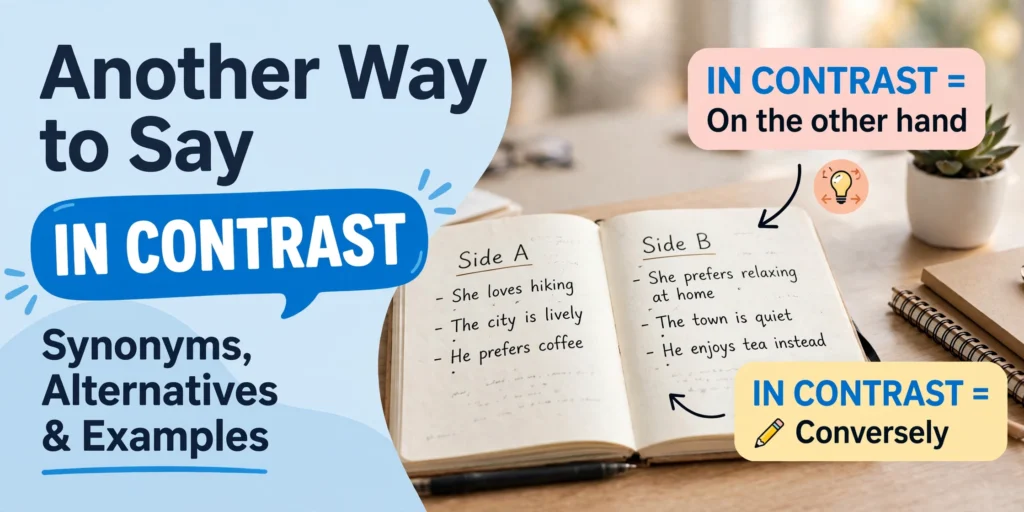
Few phrases in English do as much quiet work as “in contrast”. Whenever you need to set two ideas against each other — a success and a failure, a theory and a fact, a past and a present — it signals the turn before the reader even reaches the second half of the sentence. Teachers love it, examiners reward it, and it appears in everything from GCSE essays to government reports.
That popularity is also its weakness. Once “in contrast” becomes your default connector, it starts appearing in every other paragraph, and writing that repeats itself begins to feel dull and mechanical. Readers notice repetition even when they cannot name it, and in formal writing, a limited vocabulary can make otherwise strong arguments look thin.
Fortunately, English offers a generous shelf of alternatives. Some are more formal than “in contrast”, some are friendlier, and a few carry a slightly different shade of meaning that is worth knowing about. This guide collects more than a dozen options, grouped by tone, each with example sentences — plus the punctuation rules and the common mistakes that catch writers out.
Quick Answer
If you need another way to say “in contrast”, try “conversely”, “on the other hand” or “by contrast”. Formal writing suits “in comparison” or “whereas”; casual writing suits “but”, “unlike” or “meanwhile”. Choose the option that fits your tone, and remember the comma rules that come with each one.
What “In Contrast” Actually Means
Before swapping it out, it helps to pin down what the phrase actually does. “In contrast” introduces a difference between two things, people, ideas or situations. It tells the reader: what you are about to read differs from what you just read. The two halves may share a topic, but they disagree on the detail.
- “The north of the country enjoyed a warm spring. In contrast, the south endured weeks of rain.”
- “Her first novel was a commercial triumph. In contrast, her second barely sold.”
- “The experiment supported the hypothesis. In contrast, the field data told a different story.”
Notice that in each case the two statements are genuinely different — not merely two unrelated facts placed side by side. That difference is the engine of the phrase, and it is also the test that every alternative must pass.
It is also worth remembering that the alternatives below are not perfectly interchangeable. Each carries its own flavour: “conversely” suggests a reversal of the first statement, “meanwhile” adds a sense of simultaneity, and “on the contrary” flatly denies what came before. The examples in each section show these shades of meaning in action, so you can choose precisely rather than guessing.
Formal Alternatives for Essays and Reports
Academic and professional writing rewards precision, and several substitutes for “in contrast” carry a slightly more formal register:
- Conversely — perhaps the closest formal match. It introduces a statement that reverses or opposes the previous one. “The medication lowered blood pressure in most patients. Conversely, a small group showed no response at all.”
- By contrast — a near-synonym, marginally more formal than “in contrast” itself. “By contrast, the rural schools outperformed their urban counterparts.”
- In comparison — best when the difference involves measurable things. “The new model uses 30 per cent less fuel. In comparison, the previous model was heavy and inefficient.”
- Whereas — a formal conjunction that joins two clauses in a single sentence. “The marketing team favoured a bold relaunch, whereas the finance team preferred caution.”
- On the contrary — use this only when you are correcting or denying something, not merely comparing. “The merger was not a failure. On the contrary, it saved the company.” (More on this common mix-up below.)
- However — the classic formal connector, best placed mid-sentence or at the start of a new one. For a full guide to its many uses, see our article on other ways to say however.
Casual and Conversational Alternatives
Not every sentence needs a weighty connector. In emails, blogs and everyday writing, lighter options sound far more natural:
- On the other hand — the friendliest all-rounder, and our list of other ways to say on the other hand offers even more choices. “The flat is small. On the other hand, it is right in the city centre.”
- But — plain, short and almost always acceptable when the contrast is simple. “I wanted to stay, but the train was leaving.”
- Unlike — handy when comparing two named things directly. “Unlike her sister, Maya actually enjoys public speaking.”
- Meanwhile — adds a sense of things happening at the same time. “The developers shipped the update on Friday. Meanwhile, the support team braced for complaints.”
- That said — a conversational favourite that softens a disagreement. “The holiday was expensive. That said, we would do it all again.”
How to Punctuate “In Contrast” and Its Alternatives
Getting the punctuation right matters more than choosing the fanciest word:
- At the start of a sentence, follow the phrase with a comma: “In contrast, the second attempt succeeded.” The same rule applies to “conversely”, “by contrast”, “on the other hand” and “however”.
- Do not join two independent clauses with a comma alone. “The results were excellent, in contrast the survey disappointed” is a comma splice. Fix it with a full stop — “The results were excellent. In contrast, the survey disappointed.” — or with a semicolon before the connector.
- “Whereas” joins two clauses inside one sentence and takes no comma after it: “The north grew richer whereas the south stagnated.” (Some style guides allow a comma before “whereas”; whichever you choose, stay consistent.)
- “Unlike” is followed directly by a noun phrase, never a full clause: “Unlike the first draft, the revision was crisp.”
Common Mistakes
- Using “on the contrary” as a straight synonym. Wrong: “The café was busy. On the contrary, the restaurant was empty.” Right: “The café was busy. In contrast, the restaurant was empty.” Why: “On the contrary” denies or corrects a claim; it does not simply compare two situations.
- Creating a comma splice. Wrong: “Profits rose sharply, in contrast costs spiralled.” Right: “Profits rose sharply. In contrast, costs spiralled.”
- Contrasting things that are actually similar. Wrong: “The first film was a hit. In contrast, the sequel also did well.” Right: “The first film was a hit. Similarly, the sequel did well.” Why: If both things point the same way, a similarity connector fits better — see our guide to another way to say additionally for more options.
- Repeating “in contrast” in every paragraph. Wrong: Using the phrase four times in one page of an essay. Right: Rotating through “conversely”, “by contrast”, “on the other hand”, or restructuring the sentence so no connector is needed at all.
- Writing “in contrast of” or “in contrary to”. Wrong: “In contrast of last year, sales improved.” Right: “In contrast to last year, sales improved.” (Or more simply: “Unlike last year, sales improved.”)
Frequently Asked Questions
Is “in contrast” formal?
Yes — it sits comfortably in academic essays, reports and professional writing. In very casual contexts, such as text messages or chats, it can sound stiff; “but”, “though” or “on the other hand” usually fit better there.
What is the difference between “in contrast” and “on the contrary”?
“In contrast” compares two different things or situations, while “on the contrary” denies a statement and asserts the opposite. Using “on the contrary” when you only mean “in contrast” is one of the most common mistakes in this area — the examples in the Common Mistakes section above show the difference in practice.
Can I start a sentence with “in contrast”?
Absolutely. It is perfectly grammatical to begin a sentence with “in contrast”, “conversely” or “by contrast” — just follow the phrase with a comma and make sure the previous sentence sets up the comparison.
Which alternative is best for IELTS or academic essays?
Examiners value variety, so rotate through “conversely”, “by contrast” and “in comparison”, reserving “whereas” for sentences where you can fit both halves into a single clause. Avoid using any one connector more than once or twice per essay.
Related reading: explore other ways to say on the other hand, other ways to say however and another way to say additionally to keep your connecting phrases varied.
Join the conversation