15 Other Ways to Say “As Well As” (Formal + Informal)
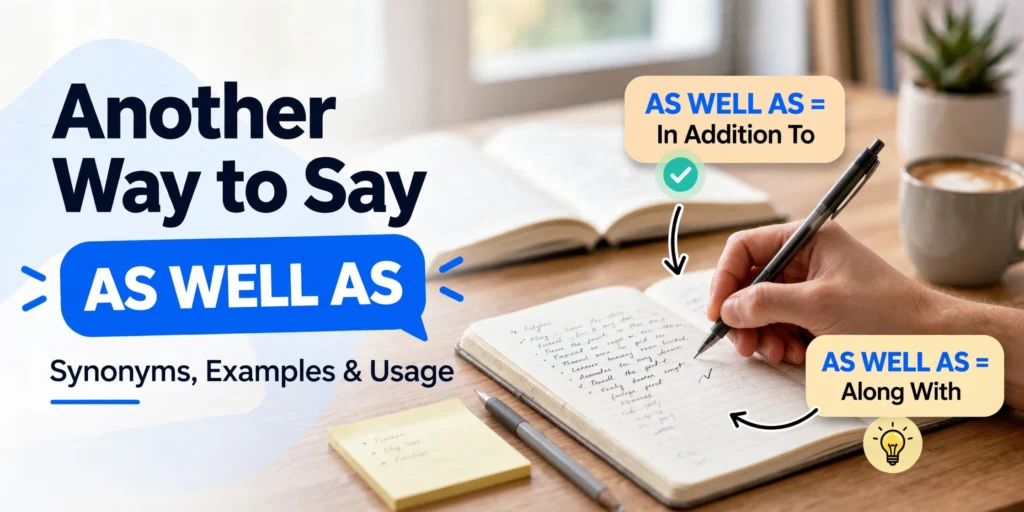
“As well as” is one of those phrases that quietly takes over your writing. You use it once in an email, then again in the next paragraph, then a third time before you even notice. It is not wrong — far from it — but when the same connector appears in every other sentence, your writing starts to sound flat and repetitive, no matter how good your ideas are.
The good news is that English is full of excellent alternatives. Some, like “in addition to” and “along with”, are perfect for formal essays, reports and job applications. Others, like “plus” or “not to mention”, belong in casual conversation and friendly emails. Knowing which to use — and how “as well as” itself behaves grammatically — will make your writing clearer, more varied and more confident.
In this guide, we will look at 15 alternatives to “as well as” with real example sentences, the verb-agreement rule most people get wrong, and the common mistakes to avoid. By the end, you will never be stuck repeating the same phrase again.
Quick Answer
The simplest ways to say “as well as” are “in addition to”, “along with”, “besides”, “plus” and “and also”. For formal writing, prefer “in addition to”, “furthermore” or “moreover” (the last two usually need a sentence restructure); for informal writing, “plus”, “too” and “not to mention” work well. The key grammar rule: when you keep “as well as”, the verb agrees with the first subject — “The manager, as well as the employees, is attending.”
Formal Alternatives to “As Well As”
When you are writing an essay, a cover letter, a business report or an academic paper, you want alternatives that sound polished without sounding stiff. These six are the safest formal replacements.
- In addition to — the closest formal equivalent. “In addition to the monthly report, she submitted a full market analysis.”
- Along with — works well when people or things accompany one another. “The director, along with the senior team, attended the conference.”
- Besides — slightly more economical in tone. “Besides the cost, the main concern was the tight deadline.”
- As well — use it at the end of a sentence instead of linking two nouns. “The proposal covers marketing as well.”
- Not to mention — adds emphasis to the second item. “The course is well structured, not to mention excellent value for money.”
- Including — ideal when the second item is part of a larger group. “The team, including the new recruits, completed the training.”
Notice that several of these — “in addition to”, “along with” and “besides” — can replace “as well as” without changing the sentence structure at all. That makes them easy swaps when you are editing a draft and spot repetition. If you want to expand your range of addition phrases more generally, our guide to other ways to say “in addition” covers the wider family of these connectors.
Informal and Conversational Alternatives
In texts, casual emails and friendly conversation, the formal options above can sound heavy. These alternatives keep things light and natural.
- Plus — short, friendly and very common in speech. “I packed the tent, plus a spare sleeping bag.”
- And also — simple and conversational. “She plays the piano and also the violin.”
- Too — place it at the end of the sentence. “We invited the neighbours too.”
- On top of that — adds a sense of accumulation, sometimes with mild complaint. “The train was delayed, and on top of that it started raining.”
- As well — perfectly at home in casual British English. “I will have the fish and chips as well.”
A quick note on tone: “plus” and “on top of that” are fine in informal writing, but most teachers and editors would mark them as too casual for academic essays. Match the alternative to the register of your writing — the same principle applies when choosing another way to say “also”, where context decides between options like “furthermore” and “too”.
The Verb-Agreement Rule Most People Get Wrong
This is the genuinely important grammar point behind “as well as”, and it is tested in exams more often than you might expect. When “as well as” joins two subjects, the verb agrees with the first subject only — the part after “as well as” is treated as a parenthetical addition, almost like an aside in commas.
- “The manager, as well as the employees, is attending the meeting.” (Not “are” — “manager” is singular.)
- “The employees, as well as the manager, are attending the meeting.” (Now the first subject is plural.)
- “My sister, as well as her friends, has volunteered.” (Not “have”.)
This is different from “and”. “The manager and the employees are attending” takes a plural verb because “and” creates a genuinely compound subject. With “as well as”, the second noun phrase is grammatically subordinate, so the verb follows the first noun alone. Many of the alternatives listed above behave the same way — “along with”, “besides” and “in addition to” all leave verb agreement with the first subject, which is another reason they make such clean swaps.
Choosing the Right Alternative for Your Sentence
Position and tone matter as much as meaning. A small shift in placement can change how formal your sentence sounds.
At the start of a sentence: “As well as”, “in addition to” and “besides” can all open a sentence naturally. “As well as English, she speaks fluent Spanish.” Just avoid opening too many consecutive sentences with any one of them — variety is the point.
In the middle of a sentence: this is the classic “as well as” position, and it is where “along with” and “not to mention” slot in most easily. “The hotel offers a pool, along with a fully equipped gym.”
At the end of a sentence: here “as well” and “too” are your friends, and “as well as” itself cannot go. You cannot say “The presentation covered sales as well as” — the phrase needs its second half. Use “The presentation covered sales as well.”
Formality ladder: from most formal to most casual, the scale runs roughly “furthermore / moreover” → “in addition to” → “as well as / along with” → “besides” → “and also / too” → “plus / on top of that”. Moving one step up or down the ladder is usually safe; jumping from “furthermore” to “plus” in the same document will jar the reader.
Common Mistakes
- Wrong: “The team, as well as the coach, were celebrating.”
Right: “The team, as well as the coach, was celebrating.” (The verb agrees with the first subject, “team”, not the nearer noun “coach”.) - Wrong: “She enjoys reading as well as to write.”
Right: “She enjoys reading as well as writing.” (Both items joined by “as well as” should take the same grammatical form — here, two gerunds.) - Wrong: “The flat has a balcony as well as also a garden.”
Right: “The flat has a balcony as well as a garden.” (“As well as” already means “in addition to”, so adding “also” is redundant.) - Wrong: “We discussed the budget as well as.”
Right: “We discussed the budget as well.” (“As well as” needs a second item after it; “as well” on its own ends the sentence.) - Wrong: “He, as well as me, speaks German.”
Right: “He, as well as I, speaks German.” (The pronoun stands in for a subject, so it takes the subject form “I”.)
Frequently Asked Questions
Is “as well as” formal or informal?
“As well as” is neutral — it is acceptable in formal writing, business emails and everyday speech alike. Its problem is overuse rather than register. If you have already used it twice in a paragraph, reach for “in addition to” (more formal) or “along with” (similar level) instead.
Can I start a sentence with “as well as”?
Yes. “As well as English, she speaks fluent Spanish” is perfectly grammatical. Some very traditional style guides once frowned on it, but modern British English accepts it without hesitation. Just do not open several sentences in a row with it.
What is the difference between “as well as” and “in addition to”?
In most sentences they are interchangeable: “In addition to the report, she submitted an analysis” means the same as “As well as the report, she submitted an analysis”. The differences are subtle — “in addition to” sounds a touch more formal, and “as well as” carries the special verb-agreement rule described above. When in doubt in formal writing, “in addition to” is the safer choice.
Should I use “as well as” or “as well”?
They are not interchangeable. “As well as” links two items — “She speaks French as well as Spanish”. “As well” stands alone at the end of a sentence and means “too” — “She speaks Spanish as well”. If there is nothing after the phrase, you need “as well”, not “as well as”.
Related reading: another way to say “also”, other ways to say “in addition”, and words to use instead of “said”.

Comments (1)