Other Ways to Say However: 12 Better Alternatives
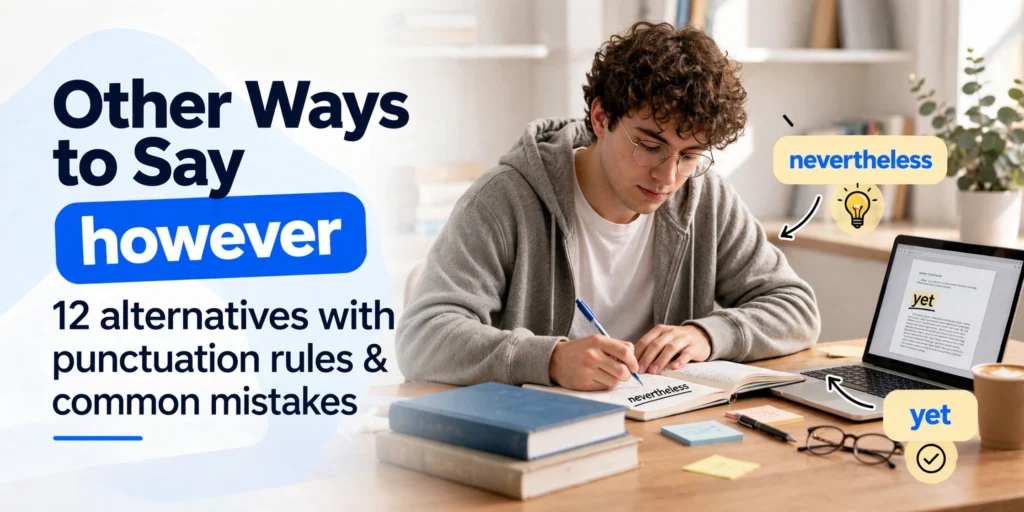
“However” is one of the most useful words in English writing — and one of the most overused. Whether you are building an argument in an essay, qualifying a point in a report, or softening a disagreement in an email, reaching for “however” every time makes your writing feel repetitive and flat. The good news is that English offers a rich set of alternatives, each with its own tone, register, and grammatical rules.
In this guide, you will find the best other ways to say “however”, from formal options like “nevertheless” and “nonetheless” to neutral connectors like “yet” and “still”, plus the contrast phrases “in contrast” and “on the other hand”. You will also learn where to place these alternatives in a sentence and how to punctuate them correctly — because a misplaced comma around “however” is one of the most common errors in written English.
Quick Answer
The best alternatives to “however” are nevertheless and nonetheless (formal), yet and still (neutral and concise), and in contrast or on the other hand (when presenting two opposing sides). Choose the alternative that matches your register: “nevertheless” suits academic writing, while “yet” and “still” work in everyday prose. Always punctuate carefully — conjunctive adverbs like “however” need a semicolon or full stop before them, not just a comma.
Formal Alternatives: Nevertheless, Nonetheless, and Notwithstanding
When you are writing academically or professionally, “however” can sound a little plain. The words nevertheless and nonetheless carry the same meaning — “in spite of what has just been said” — but add a more formal, authoritative tone. They are perfect for essays, dissertations, and business reports.
- Nevertheless: “The experiment produced inconsistent results. Nevertheless, the underlying hypothesis remains plausible.” Notice how “nevertheless” opens the second sentence for emphasis.
- Nonetheless: “The costs were higher than projected. Nonetheless, the board approved the investment.” It works in exactly the same positions as “nevertheless”.
- Notwithstanding is even more formal and often appears in legal writing. It can precede the noun it qualifies: “Notwithstanding the delays, the project was completed on budget.”
A note on tone: in informal writing, “nevertheless” can sound stiff or pompous. Match your choice to your audience. For a neutral alternative that works in almost any register, see the next section.
Neutral Alternatives: Yet, Still, and Even So
If “nevertheless” feels too grand, the neutral alternatives yet, still, and even so express the same contrast more simply. These are the workhorses of everyday written English and suit blogs, emails, and journalism.
- Yet: “The policy was unpopular, yet it achieved its goals.” Here “yet” functions as a coordinating conjunction, just like “but” — so a single comma is enough.
- Still: “She had little experience. Still, she performed brilliantly under pressure.” “Still” at the start of a sentence gives a light, conversational contrast.
- Even so: “The market was volatile. Even so, investors remained confident.” This two-word phrase is slightly more emphatic than “still” and pairs naturally with factual statements.
You can also use though at the end of a sentence for a casual aside: “The trip was exhausting. Worth it, though.” This informal option is best kept out of formal writing.
Showing Two Sides: In Contrast, On the Other Hand, and Conversely
Sometimes “however” is used to introduce a direct comparison between two things. In that case, contrast phrases are more precise than a generic “however”. Use them when you are weighing alternatives or comparing data.
- In contrast: “The northern region saw record rainfall. In contrast, the south experienced its driest summer in decades.” This phrase explicitly signals that two facts are being compared.
- On the other hand: “Working from home saves commuting time. On the other hand, it can feel isolating.” The classic pairing is “on the one hand … on the other hand”, but the second half can stand alone.
- Conversely: “Higher interest rates discourage borrowing. Conversely, lower rates encourage spending.” “Conversely” is a more formal way of saying “the opposite is also true”.
Learning to vary these transitional phrases is a core skill in academic writing — just as varying your opening phrases keeps conclusions fresh.
Position and Punctuation: Where Your Alternative Goes
Where you place your “however” alternative changes the rhythm of the sentence — and sometimes the punctuation rules change with it. Mastering these three positions will make your writing sound polished and correct.
1. At the start of a sentence. This is the most emphatic position. Follow the connector with a comma: “However, the data tells a different story.” The same rule applies to “nevertheless”, “nonetheless”, “still”, “in contrast”, and “on the other hand”.
2. In the middle of a sentence. Joining two independent clauses with a conjunctive adverb requires a semicolon before it and a comma after it: “The proposal was ambitious; however, it lacked funding.” A comma alone here creates a comma splice — the most common “however” mistake. Alternatively, use a full stop and start a new sentence.
3. As a parenthetical interruption. “However” and its cousins can sit mid-sentence between commas to soften a statement: “The results, however, were inconclusive.” This placement sounds more conversational and works well with “nevertheless” and “still”: “The results, still, were inconclusive.” Similar care with sentence connectors applies when you cite sources, as in our guide to other ways to say “according to”.
However vs But vs Although: Choosing the Right Connector
These three words overlap in meaning but differ in grammar and formality, and confusing them is a frequent source of errors.
- But is a coordinating conjunction. It joins two clauses with just a comma: “It was raining, but we went out anyway.” It is neutral and works in every register.
- Although (and though) is a subordinating conjunction. It introduces a dependent clause and must attach to a main clause: “Although it was raining, we went out.” It cannot stand alone between two full sentences the way “however” can.
- However is a conjunctive adverb. It connects ideas across sentences or clauses but is grammatically “looser” — which is why it needs the semicolon or full stop described above.
In formal writing, many style guides still frown on starting a sentence with “but” or “and”, though this rule is relaxing. “However”, “nevertheless”, and “yet” are safe sentence-starters in any register. When you present evidence and then qualify it, you will also want precise verbs for your claims — see our guide to other ways to say “this shows” for alternatives that strengthen analytical writing.
Common Mistakes
Wrong: The report was thorough, however it missed the deadline.
Right: The report was thorough; however, it missed the deadline.
A comma alone before “however” creates a comma splice. Use a semicolon or a full stop.
Wrong: However the experiment failed.
Right: However, the experiment failed.
A sentence-initial “however” must be followed by a comma.
Wrong: The team worked hard. Although, they lost the match.
Right: The team worked hard. However, they lost the match.
“Although” cannot introduce a standalone sentence — it needs a main clause to attach to.
Wrong: She was tired, nevertheless she kept working.
Right: She was tired; nevertheless, she kept working.
“Nevertheless” follows the same punctuation rules as “however”: semicolon before, comma after.
Wrong: On the other hand of the argument, costs will rise.
Right: On the other hand, costs will rise.
“On the other hand” is a fixed phrase — do not add “of” after it.
Frequently Asked Questions
What is the most formal way to say “however”?
“Nevertheless” and “nonetheless” are the most formal direct synonyms, widely used in academic and legal writing. For maximum formality, “notwithstanding” works well, especially at the start of a clause: “Notwithstanding these concerns, the policy was adopted.”
Can I start a sentence with “however”?
Yes — starting a sentence with “however” is perfectly correct and very common. Just remember the comma: “However, further research is needed.” The myth that you cannot start sentences with “however” (or “but”, or “and”) is outdated, though some conservative style guides still prefer “but” mid-sentence in formal prose.
Is “but” the same as “however”?
They convey the same contrast, but they are grammatically different. “But” is a coordinating conjunction that joins clauses with a single comma (“It was late, but we continued”). “However” is a conjunctive adverb that needs stronger punctuation — a semicolon or full stop before it and a comma after it. In formal writing, “however” sounds more measured than “but”.
What can I use instead of “however” in the middle of a sentence?
Mid-sentence, you can use “however” parenthetically between commas (“The outcome, however, was positive”) or switch to “yet” or “but” as a conjunction (“The outcome was unexpected, yet positive”). For a softer aside at the end of a sentence, “though” works well in informal writing (“The outcome was positive, though”).
Once you have mastered alternatives to “however”, keep building your toolkit of transitions — for example, our guide to alternatives to “in conclusion” will help you finish essays and reports with the same polish.
Comments (2)