Other Ways to Say “This Shows” in an Essay
If you have ever re-read an essay and spotted “this shows” in almost every paragraph, you are not alone. It is one of the most overused phrases in student writing. We reach for it whenever we need to connect a quotation or fact to our argument, until the same tired construction appears in every paragraph.
The problem is not that “this shows” is wrong — it is that it is vague and repetitive. “Shows” can mean anything from “proves beyond doubt” to “gently hints at”, and an examiner cannot tell which one you mean. In essays marked for GCSEs, A-levels, or university coursework, precision is what separates description from genuine analysis. Choosing a sharper verb tells the reader exactly how confident you are in the point you are making.
This article gives you 25 formal alternatives to “this shows”, grouped by meaning so you can pick the right one every time. You will find assertive verbs for conclusive evidence, cautious verbs for interpretation, and illustrative verbs for examples. If you are working on analytical phrasing more broadly, our guide to other ways to say “this shows” covers the phrase in general writing as well.
Quick Answer
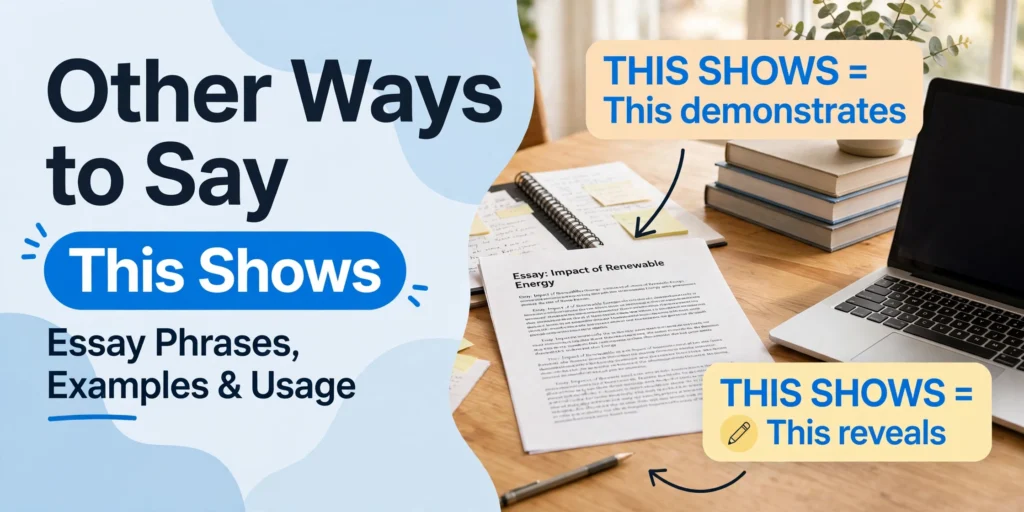
Strong alternatives to “this shows” in an essay include “this demonstrates”, “this illustrates”, “this reveals”, “this suggests”, “this indicates”, and “this confirms”. Use confident verbs like demonstrates or confirms when your evidence is conclusive, and cautious verbs like suggests or implies when you are interpreting. Matching the verb to the strength of your evidence makes your analysis more precise and your writing more persuasive.
Why “This Shows” Feels Repetitive
Repetition is the most obvious issue: reading “this shows” five times in two pages makes even a strong argument feel monotonous. But “shows” is a weak verb — it says almost nothing about the relationship between your evidence and your claim. Compare “This shows that Dickens criticises industrial society” with “This reveals Dickens’s criticism of industrial society.” The second version sounds more analytical because the verb does more work.
Examiners also read “this shows” as a sign that a student has not fully thought through their point. When every quotation is followed by the same phrase, it looks as though the writer is gesturing at an idea rather than articulating it. A varied vocabulary of linking verbs demonstrates control over your material and signals that you understand exactly what your evidence is doing.
Alternatives That Prove Your Point
When your evidence is conclusive — a statistic, a direct statement, an undeniable fact — use a confident verb. These alternatives leave no doubt that you believe your point is proven.
- This demonstrates — The survey data demonstrates a clear link between sleep and exam performance.
- This proves — The witness’s signed statement proves that the meeting took place.
- This confirms — The experiment’s results confirm the hypothesis stated in the introduction.
- This establishes — The census records establish that the town’s population doubled in a decade.
- This substantiates — The recovered documents substantiate the historian’s central claim.
- This validates — The clinical trial validates the effectiveness of the treatment.
A word of caution: reserve “proves” for evidence that genuinely settles the matter. In most essays, absolute proof is rare, so “demonstrates” or “confirms” is usually the safer, more honest choice. For presenting evidence attributed to a source, you may also find our list of other ways to say “according to” useful.
Alternatives That Suggest a Meaning
Essays are often about interpretation rather than proof. When you are reading between the lines — analysing a character’s motives, a poet’s imagery, or an ambiguous result — these cautious verbs show the reader you are interpreting, not asserting.
- This suggests — The character’s repeated glances at the door suggest she is planning to leave.
- This implies — The author’s choice of the word “cage” implies a sense of entrapment.
- This indicates — The rising figures indicate growing public concern about the issue.
- This hints at — The final stanza hints at the poet’s regret.
- This points to — The evidence points to a more complicated cause than first assumed.
- This alludes to — The speech alludes to the country’s colonial past.
Saying “this suggests” rather than “this proves” shows intellectual honesty — you are inviting the reader to agree with your reading rather than pretending the text leaves no room for debate.
Alternatives That Illustrate Your Point
Sometimes your evidence does not prove or suggest so much as exemplify — it gives the reader a concrete picture of an abstract idea. These verbs work well when you are introducing an example or a telling detail.
- This illustrates — Orwell’s description of the canteen illustrates his broader critique of bureaucracy.
- This exemplifies — The poem’s final line exemplifies the Romantic fascination with nature.
- This epitomises — Her decision to stay epitomises the novel’s theme of loyalty.
- This captures — The photograph captures the exhaustion of the striking workers.
- This reflects — The dialogue reflects the social tensions of the period.
- This portrays — The opening scene portrays a community in decline.
Alternatives That Reveal or Emphasise
A fourth useful group covers verbs that draw the reader’s attention to something significant in your evidence — an insight, a contrast, or a key detail worth underlining.
- This reveals — The letter reveals the extent of the author’s financial troubles.
- This highlights — The case study highlights the dangers of over-regulation.
- This underscores — The statistics underscore the urgency of climate action.
- This emphasises — The repetition emphasises the speaker’s frustration.
- This exposes — The investigation exposes flaws in the safety procedures.
- This conveys — The imagery conveys a powerful sense of loss.
- This encapsulates — The final paragraph encapsulates the essay’s central argument.
These verbs are especially effective when you want to show the reader why a quotation matters. “This reveals” tells the reader that something hidden or important has come to light, which is more persuasive than the flat “this shows”. When your analysis turns to contrasting ideas, our other ways to say “however” will help you vary those transitions too.
Choosing the Right Verb for Your Evidence
The golden rule is simple: match the verb to the strength of your claim. If your evidence is a hard fact — a date, a statistic, a direct quotation that states something plainly — reach for a strong verb like demonstrates, confirms, or establishes. If you are offering an interpretation that a reasonable reader might disagree with, choose a cautious verb like suggests, implies, or indicates. Mismatching them is a common error: “this proves” about a subjective reading sounds overstated, while “this suggests” about a proven fact sounds timid.
Watch your grammar too: most of these verbs take “that” plus a clause or a noun phrase, and a vague “this” as your subject confuses readers — make clear whether you mean the quotation, the data, or the example.
Finally, aim for variety across the whole essay rather than within a single paragraph. Keep a short list of your favourite alternatives beside you while you write your conclusion, and check that you have not repeated the same verb more than twice. A small amount of planning here makes a noticeable difference to how polished your essay reads.
Common Mistakes
- Wrong: This proves that the character is sad. Right: This suggests that the character is unhappy. (One quotation rarely “proves” an emotion — use a cautious verb for interpretation.)
- Wrong: This shows us the theme of the novel. Right: This illustrates the novel’s central theme. (Avoid chatty constructions like “shows us” in formal essays.)
- Wrong: This evidences the author’s point. Right: This supports the author’s point. (“Evidences” as a verb sounds awkward in academic English.)
- Wrong: This is demonstrative of the trend. Right: This demonstrates the trend. (Use the verb directly rather than a clunky noun phrase.)
- Wrong: This shows that, in conclusion, the data is reliable. Right: This confirms that the data is reliable. (One precise verb is enough — do not stack filler phrases.)
Frequently Asked Questions
Is “this shows” actually wrong in an essay?
No, it is not grammatically wrong, and using it once or twice will not harm your grade. The issue is overuse and vagueness. Examiners reward precise, varied vocabulary, so “this shows” becomes a weakness only when it appears repeatedly or when a more exact verb would express your meaning better.
What is the best single replacement for “this shows”?
“This demonstrates” is the most versatile formal alternative — it is confident without overstating, and it suits evidence-based arguments in almost any subject. For interpretive writing, “this suggests” is the safest default — but rotate a varied set of verbs rather than repeating one favourite.
Can I use “this proves” in a history essay?
Use it sparingly. Historians rarely deal in absolute proof, so “proves” can sound overstated when you are interpreting sources. Reserve it for evidence that genuinely settles a factual question; in most cases “demonstrates”, “confirms”, or “indicates” will be more accurate.
How many different linking verbs should I use in one essay?
Aim for a working set of five or six that you rotate naturally, rather than forcing a different verb into every sentence. Variety across paragraphs matters more than variety within them. Planning your key analytical verbs when you outline the essay usually produces the most natural result.
Related reading: for more help varying your academic vocabulary, explore our guides to other ways to say “this shows”, other ways to say “according to”, and other ways to say “however”.


Join the conversation